More on philosophical liberalism
So I discovered that
The Economist is doing a whole series on "Liberal Thinkers." The first one, which I missed in the throes of moving, was about John Stuart Mill. In future weeks the essays will be about John Maynard Keynes, "Schumpeter, Popper, and Hayek," "Berlin, Rawls, and Norzick," and "Rousseau, Marx, and Nietzsche." Look for them.
Against the tyranny of the majority
Above all, though, like all liberals Mill believed in the power of individual thought. His first big work, “A System of Logic”, argues that humanity’s greatest weakness is its tendency to delude itself as to the veracity of unexamined convictions. He renounced shibboleths, orthodoxies and received wisdom: anything that stopped people thinking for themselves.
He wanted them to be exposed to as wide a range of opinions as possible, and for no idea or practice to remain unchallenged. That was the path to both true happiness and progress…
As Richard Reeves’s biography makes clear, Mill thought the coming industrial, democratic age could enable human flourishing in some ways, but hinder it in others…
Yet Mill was even more taken by the philosophical argument for free trade. “It is hardly possible to overrate the value, in the present low state of human improvement, of placing human beings in contact with persons dissimilar to themselves, and with modes of thought and action unlike those with which they are familiar.” This applied to everyone: “there is no nation which does not need to borrow from others.”…
As democracy spread, he anticipated, ideas would clash. He supported the Reform Act of 1832, which, as well as extending the franchise, did away with “rotten boroughs”, constituencies with tiny electorates, often controlled by a single person. He praised France’s move in 1848 to institute universal male suffrage. Each voter’s views would be represented—and each would have reason to be informed. Participation in collective decision-making was for Mill part of the good life.
For the same reason he was an early proponent of votes for women. “I consider [sex] to be as entirely irrelevant to political rights as difference in height or in the colour of the hair,” he wrote…
EXCERPT
Mill believed that society was advancing. But he also foresaw threats. Capitalism had flaws; democracy had an alarming tendency to undermine itself…
Mill loved the idea of a country founded on liberty, but he feared America had fallen into precisely this trap. Americans displayed “general indifference to those kinds of knowledge and mental culture which cannot be immediately converted into pounds, shillings and pence.”…
Democracy itself threatened the free exchange of ideas in a different way. Mill thought it right that ordinary people were being emancipated. But once free to make their own choices, they were liable to be taken in by prejudice or narrow appeals to self-interest. Give the working classes a vote, and chaos could result…
That in turn might cramp society’s intellectual development, the views of the majority stifling individual creativity and thought. Those who challenged received wisdom—the freethinkers, the cranks, the Mills—might be shunned by “public opinion”. Expertise could be devalued as the “will of the people” reigned supreme.
The upshot was frightening. Paradoxically individual freedom could end up being more restricted under mass democracy than under the despotic sovereigns of yore…
One solution was to give educated voters greater power. In this dispensation, people who could not read or write, or who had received the 19th-century equivalent of welfare benefits, would not get a vote…
Although that approach looks snobbish, or worse, Mill was enlightened for his time. Indeed, he would have approved many of the social changes in the 21st century, including the universal franchise and women’s rights…
Teaching Comparative blog entries are indexed. Use the search box to look for country names or concept labels attached to each entry.
 Just The Facts! 2nd edition is a concise guide to concepts, terminology, and examples that will appear on May's exam.
Just The Facts! is available. Order HERE.
Amazon's customers gave this book a 5-star rating.
Just The Facts! 2nd edition is a concise guide to concepts, terminology, and examples that will appear on May's exam.
Just The Facts! is available. Order HERE.
Amazon's customers gave this book a 5-star rating.
Labels: concepts, economics, history, liberalism
What's a liberal?
In the second of a series about liberals and liberal philosophy (the first was about John Stuart Mill), the editors of
The Economist offer their understanding and prospects of de Tocqueville. It's good (even with some editing) for FRQs or debates.
De Tocqueville and the French exception
The gloomiest of the great liberals worried that democracy might not be compatible with liberty
HE IS the most unusual member of the liberal pantheon. Liberalism has usually been at its most vigorous among the Anglo-American middle classes. By contrast, Alexis de Tocqueville was a proud member of the French aristocracy… Tocqueville believed that liberal optimism needs to be served with a side-order of pessimism. Far from being automatic, progress depends on wise government and sensible policy…
 |
| Alexis de Tocqueville |
He broadened the liberal tradition by subjecting the bland pieties of the Anglo-American middle class to a certain aristocratic disdain; and he deepened it by pointing to the growing dangers of bureaucratic centralisation. Better than any other liberal, Tocqueville understood the importance of ensuring that the collective business of society is done as much as possible by the people themselves, through voluntary effort, rather than by the government.
Tocqueville’s liberalism was driven by two forces. The first was his fierce commitment to the sanctity of the individual. The purpose of politics was to protect people’s rights (particularly the right to free discussion) and to give them scope to develop their abilities to the full. The second was his unshakable belief that the future lay with “democracy”. By that he meant more than just parliamentary democracy with its principle of elections and wide suffrage. He meant a society based on equality.
Many members of Tocqueville’s class thought that democratisation was both an accident and a mistake—an accident because cleverer management of the old regime could have prevented the revolution in 1789, and a mistake because democracy destroyed everything they held most dear…
The great question at the heart of Tocqueville’s thought is the relationship between liberty and democracy. Tocqueville was certain that it was impossible to have liberty without democracy, but he worried that it was possible to have democracy without liberty. For example, democracy might transfer power from the old aristocracy to an all-powerful central state, thereby reducing individuals to helpless, isolated atoms. Or it might make a mockery of free discussion by manipulating everybody into bowing down before conventional wisdom…
[H]e was the first serious thinker to warn that liberalism could destroy itself. Tocqueville worried that states might use the principle of equality to accumulate power and ride roughshod over local traditions and local communities. Such centralisation might have all sorts of malign consequences. It might reduce the variety of institutions by obliging them to follow a central script. It might reduce individuals to a position of defencelessness before the mighty state, either by forcing them to obey the state’s edicts or making them dependent on the state’s largesse…
[T]he United States represented democracy at its finest… His real wish was to understand how America had combined democracy with liberty so successfully. He was impressed by the New England townships, with their robust local governments, but he was equally taken by the raw egalitarianism of the frontier.
Why did the children of the American revolution achieve what the children of the French revolution could not? The most obvious factor was the dispersal of power. The government in Washington was disciplined by checks and balances. Power was exercised at the lowest possible level—not just the states but also cities, townships and voluntary organisations that flourished in America even as they declined in France. The second factor was what he called “manners”. Like most French liberals, Tocqueville was an Anglophile. He thought that America had inherited many of Britain’s best traditions, such as common law and a ruling class that was committed to running local institutions.
America also had the invaluable advantage of freedom of religion. Tocqueville believed that a liberal society depended ultimately on Christian morality. Alone among the world’s religions, Christianity preached the equality of man and the infinite worth of the individual. But the ancien régime had robbed Christianity of its true spirit by turning it into an adjunct of the state. America’s decision to make religion a matter of free conscience created a vital alliance between the “spirit of religion” and the “spirit of liberty”. America was a society that “goes along by itself”, as Tocqueville put it, not just because it dispersed power but because it produced self-confident, energetic citizens, capable of organising themselves rather than looking to the government to solve their problems.
He was not blind to the faults of American democracy. He puzzled over the fact that the world’s most liberal society practised slavery, though, like most liberals, he comforted himself with the thought that it was sure to wither. He worried about the cult of the common man. Americans were so appalled by the idea that one person’s opinion might be better than another’s that they embraced dolts and persecuted gifted heretics…
It is worth adding that the threat to liberty today does not stem just from big government. It also comes from big companies, particularly tech firms that trade in information, and from the nexus between the two. Gargantuan tech companies enjoy market shares unknown since the Gilded Age. They are intertwined with the government through lobbying and the revolving door that has government officials working for them when they leave office…
China is an example not of democracy allied to liberty but of centralisation allied to authoritarianism. Its state and its pliant tech firms can control the flow of information to an extent never dreamed of. Increasingly, China embodies everything that Tocqueville warned against: power centralised in the hands of the state; citizens reduced to atoms; a collective willingness to sacrifice liberty for a comfortable life…
Teaching Comparative blog entries are indexed. Use the search box to look for country names or concept labels attached to each entry.
What You Need to Know 7th edition is ready to help.
Order the book
HERE
Amazon's customers gave this book a 4-star rating.
Labels: concepts, history, liberalism
Philosophy beyond government and politics
Does it still all boil down to which words we use?
This is probably beyond what is required for your course, but you and some of your students might be interested in pursuing one of philosophy's big ideas.
Liberalism is the most successful idea of the past 400 years
OVER the past four centuries liberalism has been so successful that it has driven all its opponents off the battlefield. Now it is disintegrating, destroyed by a mix of hubris and internal contradictions, according to Patrick Deneen, a professor of politics at the University of Notre Dame.
The gathering wreckage of liberalism’s twilight years can be seen all around, especially in America, Mr Deneen’s main focus. The founding tenets of the faith have been shattered. Equality of opportunity has produced a new meritocratic aristocracy that has all the aloofness of the old aristocracy with none of its sense of noblesse oblige. Democracy has degenerated into a theatre of the absurd. And technological advances are reducing ever more areas of work into meaningless drudgery…
Mr Deneen uses the term “liberalism” in its philosophical rather than its popular sense. He is describing the great tradition of political theory that is commonly traced to Thomas Hobbes and John Locke rather than the set of vaguely leftish attitudes that Americans now associate with the word…
The legitimacy of the system is based on a shared belief in a “social contract” between consenting adults. But this produces a paradox. Because the liberal spirit mechanically destroys inherited customs and local traditions, sometimes in the name of market efficiency and sometimes in the name of individual rights, it creates more room for the expansion of the state, as marketmaker and law-enforcer…
He does an impressive job of capturing the current mood of disillusionment, echoing left-wing complaints about rampant commercialism, right-wing complaints about narcissistic and bullying students, and general worries about atomisation and selfishness. But when he concludes that all this adds up to a failure of liberalism, is his argument convincing?…
[L]iberalism contains a wide range of intellectual traditions which provide different answers to the question of how to trade off the relative claims of rights and responsibilities, individual expression and social ties…
The late 19th century saw America suffering from many of the problems that are reappearing today, including the creation of a business aristocracy, the rise of vast companies, the corruption of politics and the sense that society was dividing into winners and losers. But a wide variety of reformers, working within the liberal tradition, tackled these problems head on. Theodore Roosevelt took on the trusts. Progressives cleaned up government corruption. University reformers modernised academic syllabuses and built ladders of opportunity. Rather than dying, liberalism reformed itself.
Mr Deneen is right to point out that the record of liberalism in recent years has been dismal. He is also right to assert that the world has much to learn from the premodern notions of liberty as self-mastery and self-denial. The biggest enemy of liberalism is not so much atomisation but old-fashioned greed… But he is wrong to argue that the only way for people to liberate themselves from the contradictions of liberalism is “liberation from liberalism itself”. The best way to read “Why Liberalism Failed” is not as a funeral oration but as a call to action: up your game, or else.
Teaching Comparative blog entries are indexed. Use the search box to look for country names or concept labels attached to each entry.
What You Need to Know 7th edition is ready to help.
Order the book
HERE
Amazon's customers gave this book a 4-star rating.
Labels: concepts, liberalism
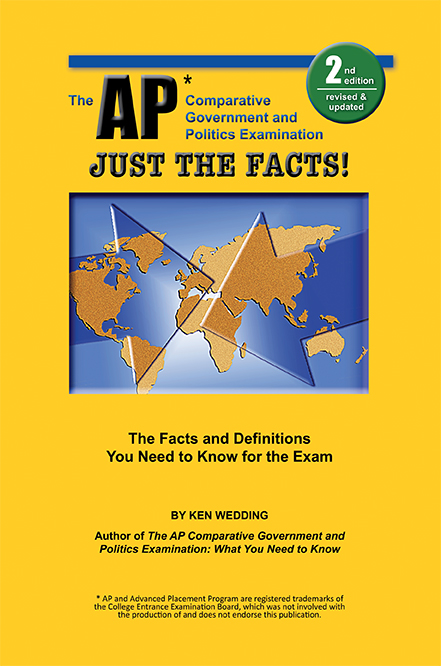 Just The Facts! 2nd edition is a concise guide to concepts, terminology, and examples that will appear on May's exam.


