So, what are the Chinese characteristics?
Another pronouncement by a government official: goals without much of a definition
Top legislator stresses socialist rule of law with Chinese characteristics
China's top legislator Zhang Dejiang has called for efforts to improve the socialist legal system with Chinese characteristics.
 |
| Zhang Dejiang, right |
Zhang, chairman of the Standing Committee of the National People's Congress (NPC), made the remarks during an inspection tour of south China's Guangxi Zhuang Autonomous Region…
Legislators should have the "four consciousnesses" firmly rooted in their minds and have strong confidence in the path, theory, system and culture of socialism with Chinese characteristics, he said, noting they should uphold the Party's leadership in the process of legislation and ensure every legislation is in compliance with constitutional spirit.
Zhang asked local lawmakers to bring in new legislation in strict accordance with the law, and ensure the full implementation of the central authority's major policies and effective abidance by laws and regulations.
Local legislators should keep close ties with the people to respond positively to their requests, Zhang said.
Teaching Comparative blog entries are indexed. Use the search box to look for country names or concept labels attached to each entry.
What You Need to Know 7th edition is ready to help.
Order the book
HERE
Amazon's customers gave this book a 4-star rating.
Labels: China, ideology, legal systems, politics
More ways that Brexit is complex and ambiguous
In a referendum, it's simple and straightforward: leave the EU or stay. In political reality, things are much more complex.
Breaking with the European court of justice won’t be easy for Britain
Since the UK voted to leave the EU, Theresa May has tried to boil down arguments over Brexit to simple soundbites. One of the favourite phrases deployed by the prime minister… is that the UK will “take back control” from Europe – over money, over borders and over laws…
 |
| PM May |
May was clear… Brexit would see the UK making a clear break from the jurisdiction of the European court of justice (ECJ), the Luxembourg-based guardian and interpreter of EU law, as it leaves the single market and customs union.
“We will not have truly left the European Union if we are not in control of our own laws,” she said…
Nothing delights hardcore Brexiters in the Tory party more than promises to end what is often referred to as the “meddling” of EU judges in the British legal system and way of life.
In popular eurosceptic mythology the ECJ has come to be seen as the ultimate symbol of supranational authority, of power seeping away from these shores to Brussels as the EU tries to become a state in its own right…
[A]mong anti-EU purists at Westminster the issue of legal sovereignty and the role of the ECJ… has long been the most totemic in the Conservative party. Breaking away from the court is the eurosceptics’ holy grail…
Legal experts see real problems ahead – a stark incompatibility between the desire to stay close to the EU in trade and customs, while breaking free from European rules and regulations that govern the single market and customs union.
Sir Paul Jenkins, who for eight years before 2014 was head of the government legal department and its most senior legal official, told the Observer: “If the UK is to be part of something close enough to a customs union or the single market to remove the need for hard borders, it will only work if the rules are identical to the EU’s own internal rules. Not only must they be the same, but there must be consistent policing of those rules.”…
Writing for the Observer, Catherine Barnard, professor of EU law at Trinity College, Cambridge, says May may well find that escaping the court’s jurisdiction is impossible.
But it could be worse than that, because while failing to escape its reach, the UK will also lose influence at the court, which will no longer contain a British judge after Brexit. According to Barnard, contrary to the impression that the ECJ has always tended to make judgments against the UK national interest, it has often done the reverse.
On crucial legal issues, as with so much else in the Brexit debate, ministers are finding that breaking free from the EU while remaining closely involved – and retaining its benefits – is not an easy balancing act to pull off.
Teaching Comparative blog entries are indexed. Use the search box to look for country names or concept labels attached to each entry.
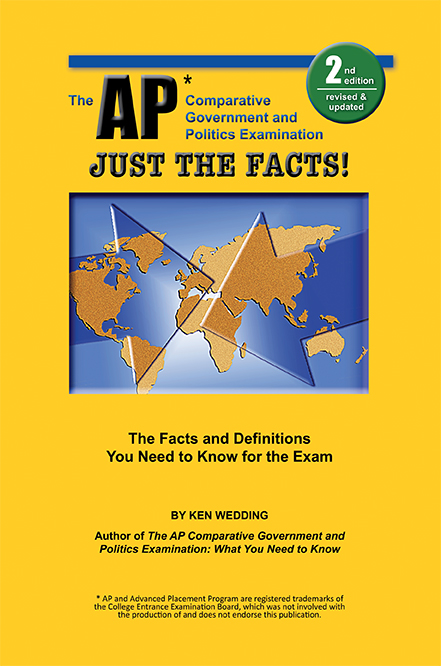
 Just The Facts! 2nd edition is a concise guide to concepts, terminology, and examples that will appear on May's exam.
Just The Facts! is available. Order HERE.
Amazon's customers gave this book a 5-star rating.
Just The Facts! 2nd edition is a concise guide to concepts, terminology, and examples that will appear on May's exam.
Just The Facts! is available. Order HERE.
Amazon's customers gave this book a 5-star rating.
Labels: EU, legal systems, politics, rule of law, sovereignty, UK