Nigeria's Chief Justice Onnoghen Gets the Boot
Chief Justice
Walter Onnoghen who was suspended by President Muhammadu Buhari for failing to declare
all his assets, has been found guilty by the Code of Conduct Tribunal in a
two-hour judgement, declaring that Onnoghen violated the Code of Conduct Bureau
rules for public officers of his status and has among others, barred him from
public office for ten years.
From The Guardian, Abuja
The allegation of
false and non-assets declaration against Justice Walter Onnoghen, which began
like a bad dream in January, came to a dramatic end yesterday at the Code of
Conduct Tribunal (CCT).Onnoghen watched helplessly as the tribunal headed by
Mr. Danladi Umar, a non-judicial officer, found him guilty of the six-count
charge brought against him by the Federal Government through the Code of
Conduct Bureau (CCB).
The tribunal in a unanimous
judgment also ordered the removal of Onnoghen as Chief Justice of Nigeria (CJN)
and chairman, National Judicial Council (NJC). He was also barred from holding
public office for 10 years for contravening the CCB laws in his Assets
Declaration Form. Onnoghen will, in addition, forfeit to the Federal
Government, various sums of money found in his five bank accounts with Standard
Chartered Bank, having failed to declare them…
Reactions have been
trailing the ruling. Ibadan-based lawyer, Fatai Akinsanmi, said: "I was
not shocked because I had been following the matter. When the news broke, many
thought it was witch-hunting but the unfolding scenarios show it was not a witch-hunt.
It is a good development if the number one judicial officer can be prosecuted
and judgment is served. The CCT ought to investigate individual claims in their
Code of Conduct form."
Lagos-based rights
group, Socio-Economic Rights and Accountability Project (SERAP), welcomed the
verdict…
Labels: leadership, Nigeria, rule of law
Promises from a former military dictator
The election is over. Buhari was chosen. Now he's campaigning?
Buhari: I'll Preserve Sanctity Of The Rule Of Law
Nigeria's President Muhammadu Buhari has said he would not waiver in his commitment to due process and preserving the sanctity of the rule of law.
The President made the statement at the final day of the 50th Convocation Ceremonies of the University of Lagos…
Buhari's speech read: “With the 2019 general election that have come and gone, we as a nation have once again reiterated our choice of democracy as the system of government by which we hope to imbibe an all-round development.
“Our administration is committed to ensuring that the sacredness of that choice is preserved. With this policy enunciated and every programme instituted, we shall ensure that our democratic culture takes firmer roots and legacies further consolidated.
“Let me reiterate that my administration will not waver in its commitment to following due process, preserving the sanctity of the rule of law, battling grand corruption, securing the lives and property of our people and rehabilitating or upgrading our critical infrastructure.
“We will continue to be unrelenting in enthroning hard work, honesty and place the welfare of our citizens above everything else… "
Teaching Comparative blog entries are indexed. Use the search box to look for country names or concept labels attached to each entry.
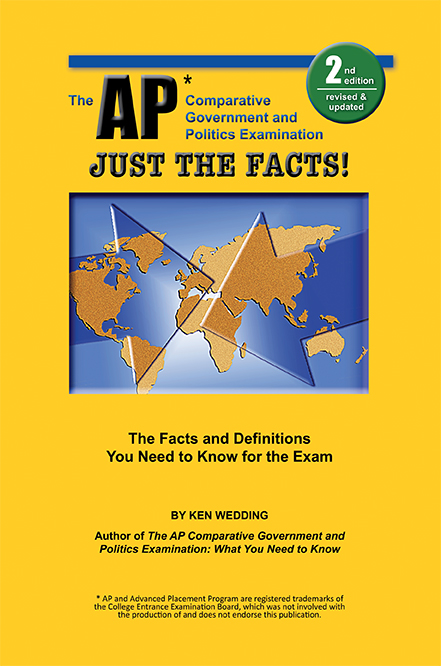
 Just The Facts! 2nd edition is a concise guide to concepts, terminology, and examples that will appear on May's exam.
Just The Facts! is available. Order HERE.
Amazon's customers gave this book a 5-star rating.
Just The Facts! 2nd edition is a concise guide to concepts, terminology, and examples that will appear on May's exam.
Just The Facts! is available. Order HERE.
Amazon's customers gave this book a 5-star rating.
Labels: leadership, Nigeria, rule of law
Parliament without a government?
How does a Parliamentary system function without a government?
Parliament Grabs Control of Brexit From a Wounded Theresa May
Britain’s Parliament grabbed control Monday of the government’s efforts to leave the European Union, challenging the country’s political traditions and inflicting on Prime Minister Theresa May a rebuke not suffered by any recent predecessor.
By stepping into the process known as Brexit and trying to define an alternative path, lawmakers could create a constitutional showdown in Britain, where the government normally controls the agenda in Parliament, especially on its most pressing issues.
Parliament passed an amendment giving itself the power to vote on alternatives to the government’s Brexit plan…
Mrs. May’s grip on power is ebbing, with members of her cabinet openly discussing contradictory Brexit policies, rumors swirling of a plot to replace her and several of her Conservative Party lawmakers calling on her to name a date for her departure from power…
Parliament’s attempt to take control was led by Oliver Letwin, a veteran Conservative lawmaker, and is driven largely by fear of leaving without an agreement, a rupture that could leave ports jammed and cause huge economic dislocation…
Under the amendment… which passed by a vote of 329 to 302, Parliament will hold a series of votes on Wednesday on alternatives to Mrs. May’s plan.
These could include a so-called “soft Brexit” that would keep Britain tied into European economic structures; a second referendum, revoking Brexit completely; or leaving without any deal…
Demonstrably, discipline has almost completely broken down inside the government and there is a feeling among many at Westminster that something has to give soon…
Teaching Comparative blog entries are indexed. Use the search box to look for country names or concept labels attached to each entry.
What You Need to Know 7th edition is ready to help.
Order the book
HERE
Amazon's customers gave this book a 4-star rating.
Labels: government, parliament, rule of law, UK
And the winner is (or will be)…
Without transparency, knowing everything that's going on in Iran is impossible.
Clues to the identity of Iran’s next supreme leader in the back alleys of a holy city
The upcoming transition could remake Iran, the world’s only Shiite theocracy, and alter the geopolitics of the Middle East, where Iran has been projecting its influence in places such as Syria and Iraq.
But the inner workings of Iran’s Islamic system — which is based on a contested Shiite doctrine known as wilayat al-faqih, or “guardianship of the jurist” — is notoriously opaque. And efforts to determine the next steps have become somewhat of a parlor game in both the Iranian capital Tehran and in Najaf. The names being bandied about to succeed the supreme leader include those of the chief of the judiciary, the head of a powerful advisory council and Khamenei’s own son.
The clergy in Najaf, the primary center of Shiite theology in the world, are for the most part averse to the idea of a supreme religious and political authority and operate independently of the clerical establishment in Iran…
“Khamenei now is a very strong leader,” said Sheikh Khaled al-Baghdadi, a Najaf cleric clad in a white turban and loose brown robe… Baghdadi is among those who doubt the theological legitimacy of the supreme leader position but acknowledges that Khamenei has made effective use of the role…
But even as Khamenei has consolidated power — promoting allies and empowering the Islamic Revolutionary Guard Corps, which is tasked with safeguarding the Islamic system — Iran is facing an uncertain period as its economy falters and tensions with the United States rise. At home, rampant corruption and soaring inflation have stunted economic growth and angered ordinary Iranians. Abroad, Iran is confronting a U.S. pressure campaign that seeks to isolate the Islamic Republic…
Such instability, experts say, could undermine an otherwise smooth succession. And that has many Iranians ill at ease…
According to Iran’s constitution, if Khamenei dies or is otherwise incapacitated, a leadership council would be formed to lead for an interim period. A separate body, known as the Assembly of Experts, is responsible for naming a successor…
“The next leader should at least have experience leading the judicial, executive or legislative branch,” said Mohsen Kadivar, a former cleric and Iranian political dissident who teaches Islamic studies at Duke University.
But because the stakes are so high, analysts say, it is likely that the formal process will be bypassed in favor of more covert negotiations. The Revolutionary Guard in particular will hold powerful sway over the process, experts say.
“The person chosen by Khamenei will be announced . . . after the candidate receives approval from Revolutionary Guard commanders,” Kadivar said.
Teaching Comparative blog entries are indexed. Use the search box to look for country names or concept labels attached to each entry.
Just The Facts! 2nd edition is a concise guide to concepts, terminology, and examples that will appear on May's exam.
Just The Facts! is available. Order HERE.
Amazon's customers gave this book a 5-star rating.
Labels: Iran, leadership, politics, rule of law
How to get a handle on organized crime in Mexico
AMLO campaigned on a proposal for a new law enforcement organization because neither the police nor the army had been able to suppress organized crime and violence. The proposal comes to life.
Mexico Approves 60,000-Strong National Guard. Critics Call It More of the Same
Mexico’s Congress on Thursday approved the creation of a 60,000-member National Guard to tackle the nation’s public security crisis, a force that President Andrés Manuel López Obrador has made a cornerstone of his plan to confront organized crime and curb soaring violence.
The vote capped months of legislative wrangling over the nature of the force and who would control it, with human-rights activists and civil society groups lobbying fiercely to limit the military’s influence on it and warning it could represent the further militarization of policing in Mexico.
In the end, Congress decided the National Guard would have an explicitly civilian, rather than military, character, with the new force lodged under the authority of the civilian Ministry of Security and Citizen Protection.
The makeup of the force would be a hybrid, combining officers from the Federal Police with members of the army and navy’s policing units… The force’s top commander could be a military official but would report to a civilian boss.
The near-unanimous vote in the lower house of Congress followed a unanimous vote on the same proposal in the Senate on Feb. 21. The proposal, which involves reforms to more than a dozen articles in the Mexican Constitution, still needs ratification by a simple majority of Mexico’s state congresses to go into effect…
Some security analysts questioned whether the new entity would be radical enough break from the existing Federal Police — in composition, training and strategy — to alter the security situation.
“Operationally, it doesn’t change anything,” said Jaime López Aranda, a security analyst in Mexico City, noting that the National Guard would be another version of what Mexico has had for years: a hybrid model of civilian and military policing.
As for his assessment of whether the National Guard would have an impact on crime and violence, Mr. López Aranda responded: “Of course not. It’s the same people doing the exact same stuff.”
Teaching Comparative blog entries are indexed. Use the search box to look for country names or concept labels attached to each entry.
Just The Facts! 2nd edition is a concise guide to concepts, terminology, and examples that will appear on May's exam.
Just The Facts! is available. Order HERE.
Amazon's customers gave this book a 5-star rating.
Labels: corruption, Mexico, politics, rule of law
Details of rule of law
What is parliamentary immunity? Who is covered by it? Why?
Russian lawmaker detained in parliament for 2010 murders
A Russian lawmaker has been arrested on murder charges while inside Russia's upper house of parliament on Wednesday, state media report.
 |
| Arashukov |
Rauf Arashukov is accused of being involved in the 2010 killing of two people and other crimes, said the Investigative Committee of Russia.
The senator for the North Caucasus republic of Karachay-Cherkessia was detained in a parliamentary session.
He has previously denied the accusations against him.
His parliamentary immunity has now been revoked, Ria Novosti news agency reports.
He was arrested while in a parliamentary chamber as it was feared he would try to flee, a source told the state news agency.
Investigators believe the 32-year-old senator is involved in two contract killings in Cherkessk, the capital of the semi-autonomous region of Karachay-Cherkessia.
Aslan Zhukov, the leader of the youth movement Adyge-Khase, was shot dead in March 2010.
Two months later, Fral Shebkhuzov, an adviser to Karachay-Cherkessia's president, was beaten and shot dead…
The lawmaker, who became a senator in 2016, is also accused of "document fraud that allowed him to become a senator", Russia media reports say.
Teaching Comparative blog entries are indexed. Use the search box to look for country names or concept labels attached to each entry.
Just The Facts! 2nd edition is a concise guide to concepts, terminology, and examples that will appear on May's exam.
Just The Facts! is available. Order HERE.
Amazon's customers gave this book a 5-star rating.
Labels: parliament, rule of law, Russia
Separation of powers
The president suspends the chief justice. A top court suspends the proceedings against the judge.
Separation of powers?
Onnoghen - Court of Appeal Suspends CCT Proceedings
The Court of Appeal in Abuja has suspended the proceedings of the Code of Conduct Tribunal (CCT) on the alleged false asset declaration against the Chief Justice of Nigeria (CJN), Justice Walter Onnoghen…
Teaching Comparative blog entries are indexed. Use the search box to look for country names or concept labels attached to each entry.
Just The Facts! 2nd edition is a concise guide to concepts, terminology, and examples that will appear on May's exam.
Just The Facts! is available. Order HERE.
Amazon's customers gave this book a 5-star rating.
Labels: judiciary, Nigeria, rule of law
Queen's politics
The monarchy in the UK is officially head of state, but not, in theory, politically active.
Did the Queen Just Weigh In on Brexit?
Over the last few years, as Britain has divided into warring tribes over its exit from the European Union, Queen Elizabeth II has retained a sphinxlike neutrality, imperturbably getting on with the business of conveying knighthoods and hosting garden parties.
 |
| QEII |
But this week even the queen was drawn into Britain’s constitutional turmoil, after a prominent lawmaker suggested she employ a royal prerogative that has not been used for centuries: the right to tactically adjourn, or “prorogue,” a rebellious Parliament.
The 92-year-old queen then made a veiled reference to Brexit in a speech on Thursday, delivering a plea for “respecting different points of view” and “coming together to seek out the common ground.” In line with her constitutional obligation to remain neutral on political matters, she revealed nothing about her views…
Commentators spent much of Friday morning deconstructing these words for signs that the queen was recommending a particular course of action, with many concluding that she was throwing her weight behind Mrs. May’s deal.
From the queen’s words it was hard to tell. But one thing was clear: She is worried enough to get involved…
Some complained that she had overstepped her constitutional powers. “I don’t think Her Majesty should be wading in,” wrote Sean O’Grady, an editor of The Independent, who supports a second referendum…
Journalists… braced for another round of frantic interpretation. “If anyone else came out with these sort of cliché-ridden, impossible-to-disagree-with, back-of-a-greetings card platitude, they would be ignored,” complained Adam Bienkov of Business Insider on Twitter. “But this is Queen talking in Britain in 2019…
The queen was criticized in 2014 for telling a well-wisher on the eve of a referendum on Scottish independence that “I hope people will think very carefully about the future.” The remark was seen as aiding the unionist side…
She is also being urged, by a few, to be more involved. Jacob Rees-Mogg, a hard-line Brexiteer sometimes referred to as “the honorable member for the 18th century,” suggested on Wednesday that the queen might have a role in resolving the country’s constitutional dilemma…
Stephen Laws… a senior fellow at Policy Exchange, a research organization in London… described the prospect of the queen’s involvement as “unthinkably awful.”
“There is always the likelihood that people will question whatever she does,” he said. “It is the responsibility of politicians to arrange their affairs so that there is never a need to involve herself in a controversy.”
Teaching Comparative blog entries are indexed. Use the search box to look for country names or concept labels attached to each entry.
Just The Facts! 2nd edition is a concise guide to concepts, terminology, and examples that will appear on May's exam.
Just The Facts! is available. Order HERE.
Amazon's customers gave this book a 5-star rating.
Labels: monarchy, political culture, politics, rule of law, UK
As promised, a new police force for Mexico
A new police force made up of soldiers. Will it be better at respecting citizens' rights than the army?
Mexico's crime-fighting national guard wins lower house approval
Mexican legislators have overwhelmingly voted for the creation of a new 60,000-member national guard, a proposal embraced by leftist President Andres Manuel Lopez Obrador as a crucial tool in the fight against organised crimes.
The proposal was approved on Wednesday by about three-quarters of the lower house of Congress, 362 votes in favour and 119 against, with changes to Mexico's constitution requiring a two-thirds vote in both the chambers.
Obrador's MORENA party teamed up with smaller leftist allies and legislators from the centrist Institutional Revolutionary Party, or PRI, to ensure the house's approval…
In the first phase, the national guard will be composed of some 60,000 members transferred from the existing military and federal police forces, but it was not clear when it might include new hires…
The proposal must still be approved by the Senate, and then a simple majority of state legislatures, but both are seen as likely because of the political strength of MORENA and its allies across Mexico.
Teaching Comparative blog entries are indexed. Use the search box to look for country names or concept labels attached to each entry.
Just The Facts! 2nd edition is a concise guide to concepts, terminology, and examples that will appear on May's exam.
Just The Facts! is available. Order HERE.
Amazon's customers gave this book a 5-star rating.
Labels: Mexico, rule of law
First battle
Theresa May is set to be PM for the next year, unless she loses a general election.
Theresa May survives confidence vote
Prime Minister Theresa May has won a vote of confidence in her leadership of the Conservative Party by 200 to 117.
Mrs May is now immune from a leadership challenge for a year…
Mrs May won the confidence vote with a majority of 83, with 63% of Conservative MPs backing her and 37% voting against her…
The prime minister still faces a battle to get the Brexit deal she agreed with the EU through the UK Parliament, with all opposition parties and, clearly, dozens of her own MPs against it…
But in a last-minute pitch to her MPs before the vote she promised to stand down as leader before the next scheduled election in 2022…
Teaching Comparative blog entries are indexed. Use the search box to look for country names or concept labels attached to each entry.
Just The Facts! 2nd edition is a concise guide to concepts, terminology, and examples that will appear on May's exam.
Just The Facts! is available. Order HERE.
Amazon's customers gave this book a 5-star rating.
Labels: leadership, rule of law, UK, vote of confidence
No Confidence Vote
When you dig into the details of a no confidence vote, it's not textbook simple.
Theresa May Faces No-Confidence Vote as Brexit Looms
Under the party’s rules Mrs. May needs to win 158 votes from among the 315 Conservative members of Parliament to remain as party leader and therefore prime minister. If she does so, then party members cannot mount another challenge to her leadership for a year. If she lost the vote, then the party would choose another leader over the coming weeks, and Mrs. May would not be eligible to compete for the position…
[Graham Brady, the chairman of the backbench 1922 committee of Conservative lawmakers] told the BBC that he had informed Mrs. May about the 48 letters on Tuesday evening by phone. She will have the opportunity to address Conservative Party members before they cast their ballots, he said, adding that Mrs. May had pressed to hold the vote quickly because of the imminence of Thursday’s European Union summit meeting.
If she loses the confidence vote, Mrs. May could in theory remain as prime minister until a successor as Conservative Party leader were selected…
Significantly, Wednesday’s vote will be conducted by secret ballot, which suggests that protestations of loyalty, even from cabinet ministers who took to Twitter to state their support, cannot be taken at face value…
If a majority of Conservative lawmakers were to force her out, then in a round of ballots, they would narrow the candidates to succeed her down to two. The winner would then be chosen from those two contenders by the party’s members.
Teaching Comparative blog entries are indexed. Use the search box to look for country names or concept labels attached to each entry.
What You Need to Know 7th edition is ready to help.
Order the book
HERE
Amazon's customers gave this book a 4-star rating.
Labels: leadership, no confidence vote, rule of law, UK
Rule of law, Chinese version
Was President Xi describing rule of law as defined in your textbook?
Xi calls for safeguarding Constitution, socialist rule of law
[The General Office of the National People's Congress (NPC) Standing Committee jointly held a symposium in Beijing Tuesday with the Publicity Department of the CPC Central Committee and Ministry of Justice on how to thoroughly study and implement the Constitution and unswervingly advance reform and opening-up.]
President Xi Jinping has stressed promoting the spirit of the Constitution and upholding the Constitution's authority in an instruction on the country's fifth Constitution Day, which falls on Tuesday.
Xi, also general secretary of the Communist Party of China (CPC) Central Committee and chairman of the Central Military Commission, called for making efforts to guide all people to loyally uphold, willingly comply with and firmly safeguard the socialist rule of law.
The priority of upholding law-based governance is to stick to Constitution-based governance, Xi stressed.
It's necessary to develop effective and comprehensive institutions to ensure compliance with the Constitution, strengthen constitutional oversight and safeguard its authority, so as to elevate constitutional enforcement to a new level, he said.
Educational campaigns should be launched within the entirety of the Party and society to promote the spirit of the Constitution and establish its authority, said Xi…
Teaching Comparative blog entries are indexed. Use the search box to look for country names or concept labels attached to each entry.
Just The Facts! 2nd edition is a concise guide to concepts, terminology, and examples that will appear on May's exam.
Just The Facts! is available. Order HERE.
Amazon's customers gave this book a 5-star rating.
Labels: China, leadership, politics, rule of law
Rule of International Law
Keep an eye on this topic. Will Russia (Putin) accept rule of law?
Russia Navalny: Strasbourg court condemns detentions of Putin foe
 |
| Navalny |
Europe's top human rights court has found that the repeated detention of Russian opposition leader Alexei Navalny was politically motivated.
Mr Navalny filed a complaint with the European Court of Human Rights in Strasbourg and was there to hear the ruling on Thursday.
The court found that his seven arrests between 2012 and 2014 had been aimed at "suppressing political pluralism".
Since then, police have arrested him several times again under protest laws.
"We've won," he tweeted after the verdict. "Completely. The government has been thrashed. They recognised Article 18 [of the European Convention on Human Rights]. Hurray!"
[Выиграли. Полностью. Правительство разгромлено. 18 статью признали. Ура! https://t.co/V1yeMPLFmT
— Alexey Navalny (@navalny) November 15, 2018]
Under Article 18, citizens' rights and freedoms may not be restricted for political purposes.
Since leading mass protests in Moscow in 2011-12, he has campaigned against corruption under President Vladimir Putin and has embraced political causes such as opposition to the raising of the retirement age…
The court found that Mr Navalny's allegation that he had become a "particular target" "appeared "coherent in the context of a general move to bring the opposition under control"…
Russia was ordered to pay him damages and costs of €63,678 (£55,409; $71,950).
"It is a very clear judgment," Mr Navalny was quoted as saying by AFP news agency after the ruling.
"The European court recognises that it was a politically motivated arrest and persecution. It was very important not just for me but for other people all over Russia who are arrested every day."
The ECHR's role is to rule on alleged violations of the European Convention on Human Rights, which Russia ratified in 1998 when it joined the Council of Europe, an organisation which upholds the rule of law in Europe…
Russia has taken issue with previous ECHR verdicts such as one in 2014 which ordered Moscow to pay compensation to shareholders in the defunct Russian oil firm Yukos.
In 2015, the Russian parliament passed a law allowing the country's Constitutional Court to overrule ECHR judgements…
Teaching Comparative blog entries are indexed. Use the search box to look for country names or concept labels attached to each entry.
Just The Facts! 2nd edition is a concise guide to concepts, terminology, and examples that will appear on May's exam.
Just The Facts! is available. Order HERE.
Amazon's customers gave this book a 5-star rating.
Labels: judiciary, rule of law, Russia
Where, in China, does political power come from?

If a government office, like the Central Leading Group on Financial and Economic Affairs, has no public address, no website, and no external telephone number, does it exist? Does its leader wield political power? In the case of Yang Wiemin, former head of the Central Leading Group, the answer is yes. Another example of
guanxi at work?
Do Yang's remarks illuminate a political fault line in the Chinese leadership?
Former top Chinese officials call for better protection of human rights and justice for all
Former top Chinese finance officials have called for better enforcement of the law and protection of human rights in China at a top forum to mark the 40th anniversary of the country’s market reforms.
 |
| Yang |
Addressing the elite Chinese Economists 50 Forum on Sunday, Yang Weimin, who stepped down earlier this year from the secretariat of the Communist Party’s top economic policy panel, said Chinese people now demanded better protection of human rights, rather than just pursuit of economic development.
“We need to build and improve the institutions that protect the people’s democratic rights, protect human rights, are based on law, and have a fair judiciary,” said Yang, a former deputy director of the Office of the Central Leading Group on Financial and Economic Affairs.
“What people want for a good life is more about this, rather than pure economic issues.”
The forum is a club of serving and former financial officials, as well as top policy advisers and economists, and mainly discusses economic matters…
Critics have said the present administration, in power since 2012, has stalled necessary overhauls of state-owned enterprises, and even pushed back on the mild gains in political liberalisation made over the past four decades.
Yang’s call for better legal protections was echoed by Wu Xiaoling, a former vice-governor of the People’s Bank of China.
Wu said a sound justice system was needed more than ever to help settle disputes as China moved into the next stage of reforms. That system would in turn lead to sustainable social stability, he said…
“Only when we respect a lawyer’s right to mount a defence, a judge’s right to make an independent ruling, and the public and mass media’s right to monitor [the government], will we be able to continue to improve our laws and regulations,” Wu said…
Wu’s remarks contrast with Beijing’s tightening grip on lawyers in recent years, including a government crackdown on rights lawyers and legal activists, as well as an expanded party presence in law firms…
Teaching Comparative blog entries are indexed. Use the search box to look for country names or concept labels attached to each entry.
Just The Facts! 2nd edition is a concise guide to concepts, terminology, and examples that will appear on May's exam.
Just The Facts! is available. Order HERE.
Amazon's customers gave this book a 5-star rating.
Labels: China, guanxi, rule of law
Changing a subculture
Changing the subculture of Mexican police is governance. Is it politics?
As Violence Soared in Mexico, This Town Bucked the Trend
In Mexico the police, often poorly paid and poorly trained, are frequently mistrusted or feared. The population sees them not only as incapable of tackling the country’s chronic violence, but also as often being its cause — at best, complicit in routine infractions like demanding bribes at traffic stops, and at worst, co-opted by criminal gangs…
[C]ommunity meeting[s are] part of an effort by Bernardo León, a professor and writer turned police commander, to transform Morelia’s police officers into a qualified force that is welcomed by local residents. Three years into the effort, the program has shown results…
In 2017, the deadliest year in Mexico in decades, the number of deaths also went up in Michoacán. But in Morelia, the state’s capital, the number of homicide victims decreased 18 percent…
[E]xperts argue that Morelia’s experiment with community policing should be part of a broader national security strategy.
The program has made the force more “solid and resilient,” said Rodrigo Canales, a professor at the Yale School of Management who is leading a study on police forces in Mexico along with the Mexican Institute for Competitiveness…
A local police force like Morelia’s “can’t really solve the cartel situation,” said Mr. León, who was appointed to the position in 2015. “What we can do is deal with the issues that regular folks face every day.”
To do so, he recruited psychologists, lawyers and social workers and trained them to mediate neighborhood and domestic conflict. He also inaugurated victims’ centers that offer medical and psychological assistance…
To tackle bureaucratic delays, he introduced new civil courts for misdemeanors. There, citizens charged with noncriminal offenses can pay fines and receive sentences that include performing community service or attending Alcoholics Anonymous meetings.
But perhaps most significant, Mr. León offered citizens the possibility of filing their criminal complaints on the spot to the responding officer instead of having to go in person to the local prosecutor…
Overhauling the police force was an important part of the equation — and that included improving the conditions under which they worked. Mr. León tapped a special federal fund to increase the size of the force to 614 officers, up from 120, and to offer them benefits like retirement funds, scholarships for children and food stamps.
He also spent $2 million on better-quality uniforms that increased officers’ pride in their appearance. Other actions, like buying patrol cars, were subsidized by federal funds set aside for tourist areas and high-crime cities…
Though experts recognize the model’s effects, some argue that part of Morelia’s recent success cannot be reproduced, as it is in part explained by the military’s role in shielding the city from powerful drug gangs, which have been mostly confined to rural areas…
Mr. León will step down this coming week when a new mayor takes office. It is unclear whether his program will be kept in place. This kind of turnover is common and remains one of Mexico’s biggest problems in establishing a consistent security policy…
Teaching Comparative blog entries are indexed. Use the search box to look for country names or concept labels attached to each entry.
Just The Facts! 2nd edition is a concise guide to concepts, terminology, and examples that will appear on May's exam.
Just The Facts! is available. Order HERE.
Amazon's customers gave this book a 5-star rating.
Labels: change, Mexico, police, rule of law
The New York Times finally notices
The conflicts and politics in Nigeria finally made the
NYT front page. Does that make it more real? How many Americans will read it?
Deadly Lack of Security Plagues Nigeria as Buhari Seeks Re-election
Nigeria is beleaguered by security threats. In the northeast, Islamist extremists from Boko Haram and its splinter groups are waging increasingly complex attacks on military forces and civilians. In the middle part of the country, more than 1,300 people have been killed in increasingly vicious land disputes between cattle herders and farmers. Farther to the south, violence spikes from time to time in the Biafra region, where separatists are pushing to secede. And in various pockets throughout the country, like a major highway between Kaduna and Abuja, kidnappings of prominent figures and regular Nigerians alike have become common.
The threats are becoming a major issue for President Muhammadu Buhari as he tries for a second term in February. Increasingly, critics, and even allies, complain about his failure to take control of the security situation…
After almost a decade into the Boko Haram insurgency, security resources on the frontlines of the conflict are increasingly stretched. On Sunday, according to local reports, several soldiers brought an airport in Borno State, in northeastern Nigeria, to a halt, shooting into the air and threatening their superiors to protest working conditions. It is the third time this year that security forces have protested their plight stemming from the conflict.
Recently, security has deteriorated significantly. In July alone, a total of more than 400 people were killed by Boko Haram or gangs in Zamfara, or in the herder-farmer conflict, according to the International Crisis Group.
 |
| People prepare to flee a village near Jos |
In recent weeks, Mr. Buhari’s All Progressives Congress party has been hit with a wave of defections. More than 50 lawmakers, state governors and party members have joined the opposition People’s Democratic Party, many of them worried that any alignment with the president could challenge their prospects in next year’s elections.
And bizarre events have left many in the nation concerned about the general state of democracy. Twice in recent weeks, security forces from the Department of State Services, the top spy agency, have appeared in black face masks outside the National Assembly. On Aug. 7, they blocked lawmakers from entering.
Later that day, Vice President Yemi Osinbajo fired the head of the agency. And on Tuesday, he announced that a notorious security agency, the Special Anti-Robbery Squad, would be shut down. The decision was widely welcomed; it followed several months of criticism that Mr. Buhari was again deaf to the concerns of Nigerians, after several protests against alleged abuses by the agency…
The violence has also fueled ethnic divisions within the state between the Hausa and Fulani communities. Many gangs are thought to comprise mostly Fulani members, but Fulani have also been victimized. When they show up at displaced persons camps, Hausa victims have tried to push them away.
Lawal Mustapha, a university student in Zamfara, said he hoped the military intervention in Zamfara would lead to lasting changes. “We want them to restore Zamfara to how it was before all these killings, a peaceful state,” he said. “That will only happen if they improve security permanently, not just to send soldiers in who will then leave soon after.”
Teaching Comparative blog entries are indexed. Use the search box to look for country names or concept labels attached to each entry.
Just The Facts! 2nd edition is a concise guide to concepts, terminology, and examples that will appear on May's exam.
Just The Facts! is available. Order HERE.
Amazon's customers gave this book a 5-star rating.
Labels: cleavages, Nigeria, political culture, rule of law, violence
Cozy retreat for the Chinese elite
Most of this is historical trivia, but it also offers clues about how the elite in China rule.
Where China’s top leaders go in summer and in secret: a brief history of Beidaihe
When state radio reported on Wednesday that Premier Li Keqiang met United Nations General Assembly President Maria Fernanda Espinosa in Beidaihe, it was the clearest confirmation that the annual summer gathering of China’s most influential politicians was taking place at the northern Chinese seaside resort.
It was Chairman Mao Zedong, one of the key founders of the People’s Republic in 1949, who initiated senior party and government officials in Beijing to work at the famed seaside town of Beidaihe as early as 1953.
 |
| Mao at Beidaihe |
Instead of the capital, all crucial meetings in the summer were held in Beidaihe from then on. In August 1958, party elites headed by Mao made two key decisions during an expanded meeting of the party’s Politburo held in the resort…
The closed-door meetings were suspended for nearly two decades in the aftermath of the outbreak of the notorious Cultural Revolution in 1966.
Late paramount leader Deng Xiaoping came to power after Mao’s death and decided to resume the annual gathering in 1984.
Party elders and most members of the party’s decision-making Politburo gathered in Beidaihe to come up with the party’s new leadership a few months ahead of its five-yearly national congress, which brought major power reshuffles in late 1987.
Deng was effectively pulling the strings behind the scenes in power plays within the party even when he held no key position except the head of the Central Military Commission with the People’s Liberation Army…
Former President Jiang Zemin followed the rule set by the party’s revolutionary veterans after Deng’s death in 1997.
That summer, all key reshuffles of the next Politburo, and Jiang’s five-yearly work report draft, to be presented at the Communist Party national congress late in the year, were deliberated among party elders and political heavyweights at Beidaihe before they gave their blessing…
 |
| Politburo HQ in Beidaihe |
By the time Xi Jinping took the party’s helm in late 2012 – even though he had two living predecessors who might have watched over his shoulder, during a general decline of party elders’ influence and Xi’s consolidation of power – the political significance of the Beidaihe gathering, now described as the leadership’s retreat, has ebbed.
The source close to a party elder said: “Unlike the practice in 1980s and 1990s, in which there was at least one issue or two scheduled to be discussed in Beidaihe, nobody knows for the time being whether there is any agenda or meeting in the resort, although party elites are supposed to be all there to spend their summer holidays.”
Teaching Comparative blog entries are indexed. Use the search box to look for country names or concept labels attached to each entry.
Just The Facts! 2nd edition is a concise guide to concepts, terminology, and examples that will appear on May's exam.
Just The Facts! is available. Order HERE.
Amazon's customers gave this book a 5-star rating.
Labels: China, history, leadership, political culture, rule of law
Fewer people expect the Mexican inquisition
Americans seem to assume that the adversarial system of enforcing laws (used in the USA, Canada, and the UK) is "normal." It's not, but more countries are trying it out. Mexico is slowly making changes.
Judging Latin America’s judges
ONE morning this year, in a windowless modern courtroom, Jorge Alberto Rodríguez faced justice. He was accused of driving a stolen car with changed number plates. The judge began by explaining his rights to him. His lawyer then tried to trip up the policemen whom the prosecution had produced as witnesses. To no avail: after an adjournment to allow a missing defence witness to appear via video link, the judge found Mr Rodríguez guilty. That seemed to square with the evidence. Having been on bail for the nine months since his arrest, he was given a suspended jail sentence of five years and fined 15,000 pesos ($800).
Such a trial could have taken place in a British magistrate’s court. In fact, it was in Mexico City. The case was conducted under a radical judicial reform. This replaces an inquisitorial model, long the norm in Latin America, under which judges investigated and evidence was all in writing… The new system has taken more than a decade to roll out and is more expensive. But it has several advantages. Fewer defendants are remanded to overcrowded jails, cases are heard more quickly and the prosecution must publicly prove its case. Under the old system, judges relied on confessions (often extracted by torture).
Yet the reform is much criticised. Its introduction has coincided with a big rise in violence in Mexico. Although this was caused mainly by the fragmentation of criminal gangs and their move into new lines of business, many politicians blame the reform instead. Judges and prosecutors are insufficiently trained in the new ways and many are going back to “old practices”…
Mexico’s experience is not unique. Since the 1990s the main focus of judicial reform in Latin America has been on criminal procedures. In all, 15 countries have made the switch to the adversarial system. This is an improvement, but not a panacea…
Many Latin American countries have reformed their economies, electoral systems and welfare states. But establishing the rule of law is much harder. Courts depend on many other actors, especially police and prosecutors, as well as politicians and citizens. Judicial reform nearly always involves trade-offs, especially between independence and accountability. And better procedures do not in themselves create better judges or justice…
Judicial reform in Chile, as well as Mexico, has produced some improvements... But public vigilance has to be sustained if a reformed judicial system is not to lapse into bad ways…
Teaching Comparative blog entries are indexed. Use the search box to look for country names or concept labels attached to each entry.
Just The Facts! 2nd edition is a concise guide to concepts, terminology, and examples that will appear on May's exam.
Just The Facts! is available. Order HERE.
Amazon's customers gave this book a 5-star rating.
Labels: judicial system, Mexico, rule of law
Pair or proxy?
Legislatures in liberal democracies found a way to preserve voting rights of legislators a hundred years ago. It's probably time for something new.
An obscure British parliamentary rule was broken. Here’s why it’s a big deal.
Last week in the U.K.’s House of Commons, the governing party appeared to cast aside its “pairing rule,” a chamber practice that has been used to preserve voting rights of absent Members of Parliament (MPs) — including MPs out on maternity leave.
This caused a huge outcry, with the minister for the Cabinet Office forced to respond to an urgent question in the House of Commons this week, promising that such errors would not be repeated. But the ensuing controversy also highlights the limitations of relying on informal legislative practices in increasingly diverse parliamentary bodies.
This is how legislative pairing works
Pairing is an informal arrangement between two legislative parties when an MP is sick, on parental leave, or otherwise not present to vote. If a legislator knows he or she will be absent, the party whips can “pair” the absent MP with an opposing party MP. Here’s the key: The opposing party MP promises not to vote. By refraining from voting, the votes of the paired legislators cancel the other one out.
With pairing, unavoidable absences do not penalize the missing MP’s party. Moreover, according to Lord Michael Heseltine, who has held positions in U.K. politics since 1966, legislative pairing prevents the “spectacle” of ambulances arriving at Parliament to bring ill politicians to vote.
This is informal practice, and the House of Commons does not officially recognize paired voting. Instead, MPs or party whips make these arrangements at the party level, as needed. For pairs to function as intended, both whips and politicians must honestly adhere to agreed arrangements. The legislatures of Canada, Australia and the United States all use versions of paired voting procedures.
The system broke down in the House of Commons
The pairing practice applies to all MPs… But it disproportionately affects female MPs such as Jo Swinson, a Liberal Democrat on maternity leave after the birth of her second child. Here’s what happened last week: A Conservative MP, Brandon Lewis, cast two votes that violated a pairing agreement that had been set up to accommodate Swinson’s maternity leave.
Conservatives at first defended the votes Lewis cast as an “honest mistake” and a “genuine mix-up.” Other Conservative MPs later conceded that their party whip asked MPs to break their pairing arrangements on two Brexit amendment votes because of anticipated close margins. As it turns out, Lewis’s votes did not ultimately change the outcomes…
Among 43 potential changes, the 2016 Good Parliament Report… proposed proxy voting for absent MPs as an alternative to pairing. Proxy voting allows MPs to delegate their vote when they are absent to an MP who is present.
Unlike pair voting, proxy voting lets an MP continue to represent his or her constituents without worrying that an arrangement will be broken for a particularly important vote…
Teaching Comparative blog entries are indexed. Use the search box to look for country names or concept labels attached to each entry.
Just The Facts! 2nd edition is a concise guide to concepts, terminology, and examples that will appear on May's exam.
Just The Facts! is available. Order HERE.
Amazon's customers gave this book a 5-star rating.
Labels: legislature, parties, rule of law, UK, voting
Power of judges
Maybe it's about the power of judges. This is an opinion piece. Look for confirmation or contradictions to these ideas.
Opinion: The Tragedy That Changed Mexico Forever
The disappearance of 43 college students on the night of Sept. 26, 2014, in the southern Mexican state of Guerrero marked a turning point for President Enrique Peña Nieto.
When he won the presidency in 2012, Mr. Peña Nieto was hailed as a modern reformer promising a more democratic and transparent government. But the disappearance of the students from the Ayotzinapa teachers’ college in the small city of Iguala shocked Mexico and the world, and plunged the Peña Nieto government into an ever-deepening murk of corruption and cover-ups…
A ruling by a federal court on June 4 against the attorney general’s office may mark a new era of independence for Mexico’s justice system. In a unanimous 712-page opinion, the judges concluded that the government’s investigation into the attack on the students was faulty and irregular, saying it was not “prompt, effective, impartial or independent.”
The three judges of the first Collegiate Tribunal of the 19th Circuit heard a constitutional appeal brought by the attorney general’s office over a lower-court ruling in favor of four men who said they were tortured by the authorities as part of the federal investigation… The ruling upheld the view that the four prisoners had been tortured and threw out their confessions.
But the court went much further. It condemned the federal government for having used torture as one of the components of a fabricated case, violating the victims’ rights to a fair and independent investigation…
The opinion was described by legal experts and other commentators as unprecedented, historic — and totally unexpected.
“The ruling confirms what international monitors have already shown: that the Ayotzinapa investigation was a travesty,” said Daniel Wilkinson of Human Rights Watch. “For a federal court to conclude that the country’s public prosecutor can’t be trusted to handle this case on its own is devastating.”
The judges relied heavily on the evidence assembled by the Inter-American Court’s Interdisciplinary Group of Independent Experts, a panel of five legal and human rights experts from Latin America that Mr. Peña Nieto’s government, under international pressure, invited to help investigate the students’ fate…
In Mexico’s compromised mass media, a smear campaign was directed at the panel of experts, and the government refused to renew its mandate. The independent experts had to leave the country…
The government promptly declared its disagreement with the ruling. Some analysts suggested that the court had overreached. Everyone seemed focused on the most controversial element: Could the judges really order government investigators to take orders from a commission made of victims’ representatives?…
[by Francisco Goldman, a novelist and journalist, is the author, most recently, of “The Interior Circuit: A Mexico City Chronicle.”]
Teaching Comparative blog entries are indexed. Use the search box to look for country names or concept labels attached to each entry.
Just The Facts! 2nd edition is a concise guide to concepts, terminology, and examples that will appear on May's exam.
Just The Facts! is available. Order HERE.
Amazon's customers gave this book a 5-star rating.
Labels: judiciary, Mexico, politics, rule of law