More confusion in Commons
This makes Brexit seem even more insolvable.
Commons leader Andrea Leadsom quits government over Brexit
Commons Leader Andrea Leadsom has quit the cabinet, saying she no longer believes the government's approach will deliver Brexit.
Her resignation comes amid a backlash against Theresa May's Brexit plan from Conservative MPs…
[As Commons leader, she was in charge of organising government business and had been due to announce when the prime minister's Withdrawal Agreement Bill would be introduced to Parliament.]
Her resignation is the 36th by a minister under Theresa May - 21 of them over Brexit…
The move came after a day of drama at Westminster in which anger grew at the prime minister's attempt to win backing for the bill - the legislation needed to implement the agreement between the UK and EU on the terms of Brexit.
As part of it, Mrs May has offered a number of changes, including a chance for MPs to hold a vote on another referendum if they back the bill…
BBC political correspondent Jonathan Blake said… "It is an extraordinary sequence of events for a key member of the Cabinet to resign on the eve of elections.
"It is unlikely that we will see others follow her immediately, but getting into Friday and the weekend, things could move swiftly."…
Teaching Comparative blog entries are indexed. Use the search box to look for country names or concept labels attached to each entry.
Labels: Brexit, Commons, leadership, politics, UK
Renovations for the House
The House of Commons is due for a major renovation. I'll bet that a new sprinkler system will be on the list of changes. But what to do with Parliament while the old place is updated?
Parliament refit: First images released of temporary Commons chamber
The first images have been released of the proposed temporary home for MPs during restoration work in Parliament.
Architects plan to recreate the current chamber of the House of Commons, including the green benches on which MPs sit, at a new venue in Westminster.
 |
| Proposed Commons recreation |
The move to Richmond House, the former home of the Department of Health, will not happen until 2025 at the earliest.
The refurbishment of the current Palace of Westminster, due to cost £4bn, will not now be completed until the 2030s.
The repair work is likely to take between five and eight years longer than previously anticipated…
The proposed temporary chamber will be similar to the current one, complete with leather benches and an adversarial layout, but will be more accessible…
The work is expected to include replacing old cabling, installing a new sewage system and improving disabled access to the estate.
Both the Commons and Lords agreed in early 2018 that the most cost-effective way to carry out the upgrades would be for them to move out whilst the works are being done…
A committee of MPs and peers will also be set up to scrutinise the spending plans alongside the Treasury.
Former Clerk of the Commons Lord Lisvane said work was needed urgently as it was "a matter of time" before something happened to the parliamentary estate.
"I'm afraid there has been a certain amount of foot-dragging and my message now would be emphatically, crack on with it," he told the BBC…
Teaching Comparative blog entries are indexed. Use the search box to look for country names or concept labels attached to each entry.
What You Need to Know 7th edition is ready to help.
Order the book
HERE
Amazon's customers gave this book a 4-star rating.
Labels: history, political culture, politics, UK
How's he doing?
News about the Mexican presidency gets pushed off front pages by other news. Here's an evaluation by a BBC reporter.
Mexico's Amlo riding high 10 months after election
When Mexico's populist presidential candidate Andrés Manuel López Obrador was elected by a landslide in July, some analysts warned that he could quickly lose support once in office, especially if he failed to deliver on his ambitious promise of delivering a "radical transformation" of his country.
 |
| President López Obrado |
Four months after his swearing-in, his approval ratings range between 60% and 86% and are the envy of many other leaders in the hemisphere.
But how has the 65 year old commonly referred to as Amlo fared so far and what problems has he been able to tackle?
Just weeks into the top job, Amlo announced that he had launched an operation to fight widespread theft from oil pipelines, a nationwide problem costing the Mexican state about $3bn (£2.3bn) each year.
Besides deploying thousands of troops in the operation, his government also shut down major oil pipelines that criss-cross the country. Almost immediately, shortages of fuel in major cities were reported, causing massive queues at petrol stations.
Nevertheless, polls showed Mexicans supported the crackdown, and normal fuel supply has since been restored.
Official figures suggest the move has significantly reduced the amount of oil being illegally siphoned off daily, from 81,000 barrels in November of 2018 to 4,000 in the first months of 2019…
Amlo has sought an attitude of "peace and love" towards his northern neighbour despite recent public threats by Mr Trump that he would "close the border" with Mexico if the Mexican government failed to stop Central American migrants reaching the United States…
One area where President López Obrador has yet to make an impact is on Mexico's soaring murder rate. This reached a new annual record in 2018 with 28,839 violent homicides across the country, a 15% increase over 2017.
The murder rate has continued to climb since Amlo came to power. In the first quarter of 2019, 8,493 murders were reported, an increase of almost 10% compared with the same months in 2018, according to Mexican government data.
In a speech he gave on 11 March, Amlo acknowledged that "the population is currently in a defenceless state".
"Violence, as we have said many times, cannot be fought with violence (…), the construction of a better, more just and more humane society is the starting point of our public safety policy," he said.
In a move approved by Mexico's Congress, the president has created a new security agency, the National Guard, to enforce his strategy to reduce crime and violence related to Mexico's powerful drug cartels…
He travels around the country on commercial flights after putting Mexico's Dreamliner presidential plane up for sale arguing that it was too lavish for the leader of a country where millions live in extreme poverty.
On his first day in office he also ordered the presidential residence, Los Pinos, to be opened to the public and turned into a cultural centre.
Mr López Obrador and his family will continue to live at their middle-class home in Mexico City's Tlalpan neighbourhood until his youngest son finishes elementary school in mid-2019.
After that, they plan to move to a midsize apartment near his office at Mexico's National Palace, from where he says he will continue to work towards a "fourth transformation" in Mexico's history, following its 1810 independence, the 1854-1857 liberalising reforms led by then-President Benito Juárez, and the wars of the 1910-1920 Revolution.
Teaching Comparative blog entries are indexed. Use the search box to look for country names or concept labels attached to each entry.
What You Need to Know 7th edition is ready to help.
Order the book
HERE
Amazon's customers gave this book a 4-star rating.
Labels: leadership, Mexico, politics
He's back…
It might not be a big deal in other places, but after Nigerian President Buhari's long absence for hospitalization, his recent return from London made headlines.
Buhari Returns to Abuja After 'Private Visit' to UK
President Muhammadu Buhari… returned to Abuja, after a 10-day 'private visit' to the United Kingdom…
 |
| Buhari |
A statement by his spokesperson, Femi Adesina, said some "reckless online media, irresponsible political opposition, and other bilious groups and individuals, had gone on overdrive since the President left the country on April 25, insinuating that he was going for hospitalization, and would not return after 10 days as stated."…
The presidency did not provide details of Mr Buhari's 'private visit,' leading to speculations he travelled to see his doctors as he has done in the past…
Teaching Comparative blog entries are indexed. Use the search box to look for country names or concept labels attached to each entry.
What You Need to Know 7th edition is ready to help.
Order the book
HERE
Amazon's customers gave this book a 4-star rating.
Labels: leadership, Nigeria, politics
Local elections in the UK
The elections for local councils in England and Northern Ireland seem to have sent messages to the major parties. What messages did the Tories and Labour receive?
Local elections: Tories and Labour hit by Brexit backlash in polls
The Conservatives and Labour have faced a backlash at the ballot box over the Brexit deadlock, with smaller parties and independents winning seats.
In England so far, the Tories have lost more than 700 seats and 25 councils overall, while the Liberal Democrats have gained nearly 450 seats.
National politics seems to have been a deciding factor for voters, with Labour also losing almost more than 70 so far…
The Green Party has done well, adding more than 100 seats so far, but UKIP has lost ground, with 80 fewer councillors at this stage than in 2015. Meanwhile, the number of independent councillors is up by more than 300…
While local elections give voters the chance to choose the decision-makers who affect their communities, the national issue loomed large on the doorstep…
Theresa May, appearing at the Welsh Conservative conference, said voters had sent the "simple message" that her party and Labour had to "get on" with delivering Brexit.
Speaking in Greater Manchester, Labour leader Jeremy Corbyn said he "wanted to do better" and conceded voters who disagreed with its backing for Brexit had deserted the party.
But Lib Dem leader Sir Vince Cable, in Chelmsford Essex, where his party took control of the council, said it had been a "brilliant" result and that "every vote for the Liberal Democrats is a vote for stopping Brexit".
Polling expert Prof Sir John Curtice said the days of the Conservatives and Labour dominating the electoral landscape, as happened in the 2017 election, when they won 80% of the vote between them, "may be over"…
Prof Curtice said there was a North/South divide emerging in the losses too, with the Conservatives shedding more seats in the South - especially in areas that voted Remain - and Labour losing more in the North.
Green Party co-leader Sian Berry said she was confident her party would end the day with a "record number of councillors on a record number of councils".
She told BBC Breakfast the Greens were not simply benefiting from a protest vote over Brexit and their gains reflected "huge new concerns" about climate change as well as the strength of their local campaigning on a range of issues.
UKIP is down by more than 60 seats on its 2015 performance…
Of the 248 elections in England, 168 have been district councils which are in charge of setting and collecting council tax, bin collections, local planning and council housing.
There were also elections taking place for 47 unitary authorities and 33 metropolitan boroughs which look after education, public transport, policing and fire services, as well as all the services of district councils.
In Northern Ireland, councils are responsible for services including local planning and licensing, waste collection and enforcing safety regulations to do with food, workplaces and the environment.
Teaching Comparative blog entries are indexed. Use the search box to look for country names or concept labels attached to each entry.
What You Need to Know 7th edition is ready to help.
Order the book
HERE
Amazon's customers gave this book a 4-star rating.
Labels: elections, parties, politics, UK
Complicated politics in the UK
Will Brexit lead to UKBreakup?
Brexit drives support for Scottish independence to 49 percent
Support for Scottish independence has risen to its highest point in the past four years, largely driven by voters who want to remain in the European Union…
As the pro-independence Scottish National Party (SNP) meets for its spring conference, the YouGov poll showed support for secession from the United Kingdom had risen to 49 percent from 45 percent at the last YouGov poll carried out for The Times in June 2018.
Scots rejected independence by 45-55 percent in a 2014 referendum. Then the United Kingdom voted to leave the European Union in a 2016 referendum, but among its four nations Scotland and Northern Ireland voted to stay, feeding political tension.
Britain is mired in political chaos and it is still unclear when or even if it will leave the EU.
YouGov also found that 53 percent of Scots thought there should not be another referendum on independence within the next five years…
The poll also showed voters moving away from both the Conservatives and the Labour Party north of the English border…
Teaching Comparative blog entries are indexed. Use the search box to look for country names or concept labels attached to each entry.
What You Need to Know 7th edition is ready to help.
Order the book
HERE
Amazon's customers gave this book a 4-star rating.
Labels: cleavages, nation, politics, UK
The biggest part of the regime?
The Revolutionary Guard Corps in Iran may be the biggest military, economic, and political force in the country. It probably rivals China's PLA in importance to the regime.
Iran’s Supreme Leader Replaces Head of Revolutionary Guards
Iran’s supreme leader has replaced the top commander of the Islamic Revolutionary Guards Corps… two weeks after the Trump administration designated the elite force of the Iranian military as a foreign terrorist organization…
 |
| Gen. Salami |
Mr. Khamenei replaced General Jafari with a deputy commander of the Revolutionary Guards, Brig. Gen Hossein Salami, and elevated his rank to major general.
General Salami takes over a 125,000-member branch of the Iranian military that has grown into a vast military-industrial complex since it was created by founders of the Islamic revolution that overthrew the shah 40 years ago.
The Revolutionary Guards Corps reports directly to Ayatollah Khamenei, exerts deep influence in politics and the economy, and has its own air force, navy and intelligence service.
It also is in charge of Iran’s ballistic missile development and operates a subsidiary known as the Al Quds force, which carries out clandestine operations and other activities in Lebanon, Syria and Iraq…
General Salami has been outspoken recently in expressing Iran’s antipathy toward Israel, which regards Iran as its most dangerous foe in the Middle East…
Teaching Comparative blog entries are indexed. Use the search box to look for country names or concept labels attached to each entry.
What You Need to Know 7th edition is ready to help.
Order the book
HERE
Amazon's customers gave this book a 4-star rating.
Labels: Iran, politics, regime
Chinese rock and roll
Musicians must be careful about what they say, but some of them are very loud.
The special flavour of rock’n’roll Beijing
The indie bands of the Chinese capital, Beijing, have their own raw, distinctive sound, says the BBC's Stephen McDonell - partly because they are so isolated from the rest of the rock'n'roll world…
Of course you can hear outstanding symphonies or jazz here. There are plays, there's dance, and there's still traditional Chinese music like Peking opera on offer. But the country's indie bands are dealing with the China of today - meaning, they know they have to be careful what they say and how they say it…
But Beijing's music-bar owners seem pretty blase about the prospect of being closed down or arrested because of subversive lyrics. Most musicians seem to know, somehow, the limits of what can be said. They push up against the edge - and when they cross the line, they usually do so in a clever, cryptic fashion…
And let's not forget, most artists here sing mostly about young love, heartbreak, hangovers, the streets where they live, the people they miss.
Some will wonder what's so special about Beijing and bands. It's not as if the city invented rock'n'roll. What created what we might describe as a "Beijing sound" has been isolation. It's not that the young rockers of China have never heard of David Bowie or the Foo Fighters, it's that few international bands play here. So, if you want to go and see some live music, it's odds-on to be a Chinese band.
The sound itself is raw, less polished, with mountains of enthusiasm and commitment to nothing more than the love of music for its own sake.
 |
| Ricky Sixx (Prince wannabe) |
Players know they're never going to be on television in China, never going to be played on the radio here. Their fans hear their music by coming to the gigs. Popularity spreads by word of mouth.
There's a sense that everyone is equal. The most famous band will not necessarily be the headline act. The line-up is often drawn out of a hat and the set lists can be completely random…
I remember the first time I saw PK 14 play. They'd turn heads at any international music festival. Who did they remind me of? Was it early Talking Heads or Joy Division?
Not really. This nerdy, cool, shaking, high-energy, poetic explosion of music was all their own, with Chinese lyrics pelting out over syncopated drum rhythms and thrashing guitars.
You can't get this anywhere else: you have to come to Beijing…
Teaching Comparative blog entries are indexed. Use the search box to look for country names or concept labels attached to each entry.
What You Need to Know 7th edition is ready to help.
Order the book
HERE
Amazon's customers gave this book a 4-star rating.
Labels: China, music, politics, popular culture
Old news revisited
An analysis from
The South China Morning Post columnist reviews the release of one of President Xi's first speeches as leader of the PRC.
Xi Jinping’s speech shows China’s Communist Party is still haunted by the fall of the Soviet Union
Monday [marked] the publication of lengthy excerpts – 6,000 words in total – from a speech Xi gave in January 2013, less than two months after he became party chief and two months before he was confirmed as the state president…
Though innocuously titled “A few issues on upholding and developing socialism with Chinese characteristics” and made public six years later, those excerpts… are still significant and relevant today, because of their timing and content.
On January 5 six years ago, Xi gave that speech to about 300 newly appointed members of the party’s Central Committee with the rest of the seven-member Politburo Standing Committee – the country’s highest governing council – present at the auditorium of the Central Party School.
 |
| Some of the Chinese leadership |
That was probably the first time Xi had revealed his intentions in detail to China’s political elites…
According to the excerpts, Xi struck a forceful but frank tone in laying out his vision for the party and the country and warning of the dangers ahead.
Citing Karl Marx and Friedrich Engels, Xi said socialism would triumph over capitalism but cited Deng Xiaoping as saying that it would be a long historical process, which would probably take several dozens of generations.
He warned that the collapse of the Soviet Union served as a painful lesson for the party. The underlying reason for the collapse was that the Soviet Communist Party had lost its ideological controls, he said.
[H]e said the party’s decision to pursue reform and opening up in 1978 had ensured the country would achieve stability and prosperity without copying the Western system…
Even more interestingly, he recognised that Western developed countries would maintain long-term economic, technological, and military advantages and China must be fully prepared for the two systems – socialism in its primary stage and a more advanced capitalism – to cooperate and struggle for a long time to come.
As China must learn and borrow from capitalism, it must face the reality that people would compare the strong points of Western developed countries with the shortcomings of China’s socialist development and be critical, Xi said…
The timing of the release [of the speech] is also significant as several politically sensitive anniversaries are coming up.
June marks the 30th anniversary of the Tiananmen protests and the subsequent bloody government crackdown. Efforts to mark the occasion will again focus the international spotlight on China’s political system and spur calls for political reform.
In October, China will hold elaborate ceremonies to mark the 70 anniversary of the founding of the People’s Republic. While China has lots to celebrate – its economic strength and its lifting of hundreds of millions of people out of poverty, for example – Chinese leaders will be reminded of the enormous domestic challenges ahead…
China’s economy may be the world’s second largest already and Xi has undertaken comprehensive and forceful steps to strengthen the party’s control at all levels of society, but its leaders are still smarting from the collapse of the then 69-year-old Soviet Union in 1991.
The release of Xi’s six-year-old speech is aimed at sending a clear message on where he stands on these thorny political issues.
The analyst who wrote this essay is Wang Xiangwei the former editor-in-chief of the South China Morning Post. He is now based in Beijing as editorial adviser to the paper. The South China Morning Post is an independent newspaper that almost always follows the Communist Party line.
Teaching Comparative blog entries are indexed. Use the search box to look for country names or concept labels attached to each entry.
What You Need to Know 7th edition is ready to help.
Order the book
HERE
Amazon's customers gave this book a 4-star rating.
Labels: China, history, ideology, leadership, politics
Touchy, touchy
Chinese leadership seems very touchy about a guy who's been dead for nearly 15 years and events that took place 30 years ago.
Tiananmen anniversary prompts raised security at Zhao Ziyang’s family home
Police surveillance around the late Chinese leader Zhao Ziyang’s family residence was tightened on Friday, as friends and relatives paid tribute to the purged Communist Party leader on China’s tomb sweeping day, ahead of the 30th anniversary of the Tiananmen student-led protests…
“Police security is tighter this year [than in previous years]. The monitoring area stretches from the hutongs (alleys) around our home to the main road,” said Wang Yannan, Zhao's daughter, on Friday…
Zhao, who was purged for siding with the students in 1989, spent the last 15 years of his life under house arrest. He died on January 17, 2005.
The Communist Party has branded the student-led movement a rebellion and barred any public commemoration…
Teaching Comparative blog entries are indexed. Use the search box to look for country names or concept labels attached to each entry.
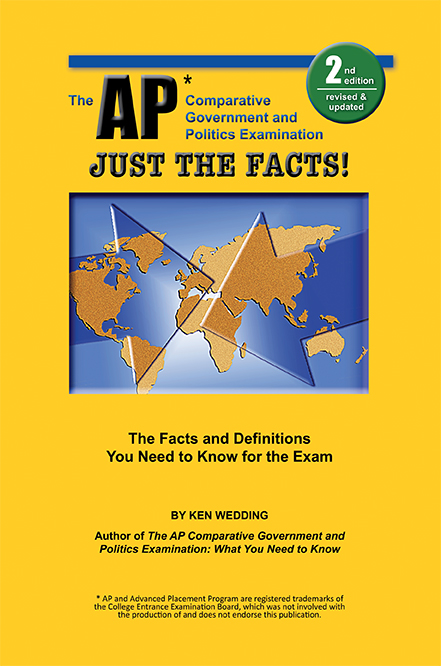
 Just The Facts! 2nd edition is a concise guide to concepts, terminology, and examples that will appear on May's exam.
Just The Facts! is available. Order HERE.
Amazon's customers gave this book a 5-star rating.
Just The Facts! 2nd edition is a concise guide to concepts, terminology, and examples that will appear on May's exam.
Just The Facts! is available. Order HERE.
Amazon's customers gave this book a 5-star rating.
Labels: China, history, leadership, politics, Tianamen
The demands of democratic centralism
Democratic centralism requires inspection from "above" and feedback from "below."
New round of inspection to oversee central gov't departments, SOEs
A total of 15 teams of disciplinary inspectors have been dispatched to three central government departments and 42 state-owned enterprises (SOEs)... said an official statement Tuesday.
This is the third round of routine disciplinary inspections launched by the 19th Communist Party of China Central Committee, the statement said.
The three central government departments were the State-owned Assets Supervision and Administration Commission of the State Council, the National Energy Administration, and the State Administration of Science, Technology and Industry for National Defense.
The 42 SOEs were administrated by the central government, including the China Aerospace Science and Technology Corporation and China State Shipbuilding Co., Ltd.
The inspection teams will be stationed at the departments and state firms for two and a half months, and will receive complaints about violations of Party disciplinary rules from the public.
Teaching Comparative blog entries are indexed. Use the search box to look for country names or concept labels attached to each entry.
What You Need to Know 7th edition is ready to help.
Order the book
HERE
Amazon's customers gave this book a 4-star rating.
Labels: China, democratic centralism, ideology, politics, regime
Failed in place?
According to the textbooks' accounts, PM May should have called another election by now. Or at least she should have formed a new government. Why didn't she? And where, in the UK "constitution" is there a provision for a binding referendum? Can "democratic" regime survive in the UK?
‘We’re in the Last Hour’: Democracy Itself Is on Trial in Brexit, Britons Say
The whole world of Britain’s Parliament — its effete codes of conduct, its arcane and stilted language, its reunions of Oxbridge school chums — seemed impossibly remote from the real, unfolding national crisis of Brexit, the process of extricating the country from the European Union…
Over the past weeks, as factions within the British government have grappled for control over the country’s exit from the bloc, the mood among voters has become dark.
Those Britons who wished to remain are reminded, daily, that a risky and momentous national change is being initiated against their will and judgment. More striking is the deep cynicism among those who voted to leave, the group that Prime Minister Theresa May is trying to satisfy. They are now equally bitter and disillusioned, as the government’s paralysis has called into question whether Britain will ever leave.
Parliament’s rejection of Mrs. May’s withdrawal plan… — for the third time — means the turbulence will continue.
In interviews, many Britons expressed despair over the inability of the political system to produce a compromise. No one feels that the government has represented their interests. No one is satisfied. No one is hopeful.
It has amounted to a hollowing out of confidence in democracy itself…
“There’s a fin-de-siècle sense that modern British politics has run out of road,” said Mr. Davies, author of “Nervous States: Democracy and the Decline of Reason.” “Maybe the best thing to come out of this is the recognition that the political elites — people just want them to get off the stage. I don’t know who they want to replace them. But there’s a sense that a reboot would be something people would be in favor of.”…
The referendum question has divided Britain into warring tribes, unable to settle on any shared vision of the future. An ancient, robust democracy is groaning under the weight of conflicting demands — on the executive, to carry out the will of the people; and on the members of Parliament, to follow their conscience and to act in what they believe to be the people’s interest…
“I think people have totally lost confidence in democracy, in British democracy and the way it’s run,” said Tommy Turner, 32, a firefighter. He was perched on a stool at the Hare & Hounds, a working-class pub in Surrey, where nearly everyone voted to leave the European Union. Among his friends, he said, he sensed a profound sense of betrayal that Britain was not exiting on March 29, as promised.
“You’ve got egotistical people in politics, and they want to follow their own agenda,” he said. “They don’t want to follow what the people have voted for.”…
Polling has borne out his worry. Britons’ assessment of their leaders is scathing, with 81 percent saying that Britain has handled Brexit badly, and 7 percent saying it has handled it well, according to data released recently by NatCen Social Research, an independent agency…
Particularly drastic, researchers said, is the souring of Leave voters in the past six months, as Mrs. May concluded her negotiations on the withdrawal agreement and shared the terms of departure with the country. Expectations that Brexit would have concrete effects — by lifting the economy or slowing immigration — have diminished sharply, the data show…
[A]t The Highbury Barn, a pub in North London that offers haddock from the fishmonger across the street and provides pans of water for visiting dogs. In this neighborhood, Islington North, in the constituency of the opposition Labour leader, Jeremy Corbyn, the number of signatories on a petition asking the government to revoke Article 50, the part of the European Union treaty that lays out the terms of Britain’s exit, reached one-quarter of the population.
But people here took an equally dismal view of the government’s performance…
Aidan Hughes, 58, who works in finance, was waiting for a cab in the back of the bar.
“What we’re seeing is that the process the government’s involved in has been effectively hijacked by an even smaller segment of the ruling government, the right-wing element of the party,” he said. He blamed the first-past-the-post voting system, which tends to increase polarization between two large parties and exaggerate geographical divides, setting up stark conflict between sections of society.
He said it was time for Britain to move toward a system of proportional representation, common to democracies that evolved later than Britain’s, which allows smaller parties to enter Parliament more easily.
“We would then have people with different views coming together to compromise, to find a way forward,” he said. “Whereas whoever wins an election now can currently push their views, irrespective of support.”…
In a landscape of pervasive gloom, Mr. Hughes, the finance worker, did see one reason for hope: That Britons, young and old, were passionately engaged, as never before, in the inner workings of their own government. Even if it was because they were so angry.
“This is starting to drag people into an interest in what’s actually happening,” he said. “Clearly it’s a total mess and it’s been handled appallingly by the government. Be that as it may, at least it’s gotten people animated in talking about these topics.”
Teaching Comparative blog entries are indexed. Use the search box to look for country names or concept labels attached to each entry.
What You Need to Know 7th edition is ready to help.
Order the book
HERE
Amazon's customers gave this book a 4-star rating.
Labels: Brexit, politics, regime, UK
And the winner is (or will be)…
Without transparency, knowing everything that's going on in Iran is impossible.
Clues to the identity of Iran’s next supreme leader in the back alleys of a holy city
The upcoming transition could remake Iran, the world’s only Shiite theocracy, and alter the geopolitics of the Middle East, where Iran has been projecting its influence in places such as Syria and Iraq.
But the inner workings of Iran’s Islamic system — which is based on a contested Shiite doctrine known as wilayat al-faqih, or “guardianship of the jurist” — is notoriously opaque. And efforts to determine the next steps have become somewhat of a parlor game in both the Iranian capital Tehran and in Najaf. The names being bandied about to succeed the supreme leader include those of the chief of the judiciary, the head of a powerful advisory council and Khamenei’s own son.
The clergy in Najaf, the primary center of Shiite theology in the world, are for the most part averse to the idea of a supreme religious and political authority and operate independently of the clerical establishment in Iran…
“Khamenei now is a very strong leader,” said Sheikh Khaled al-Baghdadi, a Najaf cleric clad in a white turban and loose brown robe… Baghdadi is among those who doubt the theological legitimacy of the supreme leader position but acknowledges that Khamenei has made effective use of the role…
But even as Khamenei has consolidated power — promoting allies and empowering the Islamic Revolutionary Guard Corps, which is tasked with safeguarding the Islamic system — Iran is facing an uncertain period as its economy falters and tensions with the United States rise. At home, rampant corruption and soaring inflation have stunted economic growth and angered ordinary Iranians. Abroad, Iran is confronting a U.S. pressure campaign that seeks to isolate the Islamic Republic…
Such instability, experts say, could undermine an otherwise smooth succession. And that has many Iranians ill at ease…
According to Iran’s constitution, if Khamenei dies or is otherwise incapacitated, a leadership council would be formed to lead for an interim period. A separate body, known as the Assembly of Experts, is responsible for naming a successor…
“The next leader should at least have experience leading the judicial, executive or legislative branch,” said Mohsen Kadivar, a former cleric and Iranian political dissident who teaches Islamic studies at Duke University.
But because the stakes are so high, analysts say, it is likely that the formal process will be bypassed in favor of more covert negotiations. The Revolutionary Guard in particular will hold powerful sway over the process, experts say.
“The person chosen by Khamenei will be announced . . . after the candidate receives approval from Revolutionary Guard commanders,” Kadivar said.
Teaching Comparative blog entries are indexed. Use the search box to look for country names or concept labels attached to each entry.
Just The Facts! 2nd edition is a concise guide to concepts, terminology, and examples that will appear on May's exam.
Just The Facts! is available. Order HERE.
Amazon's customers gave this book a 5-star rating.
Labels: Iran, leadership, politics, rule of law
Russian InterNYET
Russia did not get started with a great Internet wall when China did. Now it may be too late.
Russians are shunning state-controlled TV for YouTube
When the Soviet people turned on their television sets on August 19th 1991, they knew there was an emergency. Every channel was playing classical music or showing “Swan Lake” on a loop. A few hours earlier Mikhail Gorbachev had been detained during an attempted coup. As the Soviet Union crumbled, the fiercest street battles unfolded over television towers. “To take the Kremlin, you must take television,” said one of Mr Gorbachev’s aides.
Vladimir Putin took note. He began his rule in 2000 by establishing a monopoly over television, the country’s main source of news. It has helped him create an illusion of stability… But the Kremlin’s most reliable propaganda tool is losing its power. Russian pundits have long described politics as a battle between the television and the refrigerator (that is, between propaganda and economics). Now, the internet is weighing in.
According to the Levada Centre, an independent pollster, Russians’ trust in television has fallen by 30 percentage points since 2009, to below 50%. The number of people who trust internet-based information sources has tripled to nearly a quarter of the population. Older people still get most of their news from television, but most of those aged 18-24 rely on the internet, which remains relatively free.
YouTube in particular is eroding the state-television monopoly. It is now viewed by 82% of the Russian population aged 18-44. Channel One, Russia’s main television channel, reaches 83% of the same age group…
News is the fourth-most-popular YouTube category among Russians, after “do it yourself”, music and drama. Mr Navalny, who has become a dominant political voice on the internet, has two YouTube channels, one of which has daily news programmes. In the past year his audience has doubled. He has 2.5m subscribers and 4.5m unique viewers a month. His weekly YouTube webcast is watched live by nearly 1m people. By comparison, Channel One’s main evening news show is watched by 3m-4m people.
The Kremlin is desperately looking for ways to control the internet. “The government is trying to work out how to turn the internet into a television,” says Gregory Asmolov, an expert on the Russian internet at King’s College London. This, he argues, would require not only strict regulation, but control over physical infrastructure and dominance in providing content.
Last month the Duma preliminarily approved a law on “digital sovereignty” which tries to separate Russia’s internet from the global one. It wants to criminalise anti-government messages online, in effect reviving laws on “anti-Soviet propaganda”.
Yet controlling the internet will take more than a few laws. Unlike in China, where the ruling party built its “Great Firewall” by the early 2000s, in Russia the internet was a free zone both in terms of content and infrastructure, with hundreds of private service providers. In the early 2000s it became an alternative to state-dominated television…
[In 2011,] when the Kremlin tried to rig parliamentary elections, sites such as Golos (“Voice”) activated thousands of volunteer election monitors who recorded widespread violations. In the wake of street protests, Mr Putin unleashed repression both online and offline, including denial-of-service attacks on websites, new regulations and prosecution of activists. In 2014 he declared the internet a CIA project and demanded that national internet firms move their servers to Russia. The Kremlin launched groups of “cyber guards” to search for prohibited content, and tried to hollow out the volunteer movement by replicating independent crowdsourcing sites with its own. It even equipped polling stations with webcams, not to increase transparency, says Mr Asmolov, but to create a semblance of it. It also deployed an army of trolls to flood social media with derisive and inflammatory messages…
This heavy-handed approach has alienated young internet users. More recently, the government has changed tactics. Instead of persecuting users, it is establishing greater control over internet providers. New legislation on “digital sovereignty” will oblige them to install surveillance equipment that can be operated from a single control centre. This will allow the state to filter internet traffic, isolate regions or even cut off the worldwide web throughout the country in case of emergency. The government showed it can cordon off individual regions from the internet during recent protests in Ingushetia.
But replicating China’s “great firewall” may be difficult, says Andrei Soldatov, the author of “The Red Web” and an expert on Russian internet surveillance. Russia is more integrated into the internet’s global architecture; its biggest firms, like Yandex, have servers abroad, while global giants such as Google have servers in Russia. More importantly, Russians have grown used to sites like YouTube, which is a big provider of children’s entertainment…
Applying the new law fully, however, might be like smashing a computer screen with a hammer. The Kremlin will have a switch to bring down the internet if a political crisis erupts, but few ways to prevent it from erupting. Pulling the plug to block the protesters’ message from spreading would be the most powerful message of all. In 1991 almost no one had internet access. But everyone knew the country was in turmoil when they turned on the television and saw nothing but “Swan Lake”.
Teaching Comparative blog entries are indexed. Use the search box to look for country names or concept labels attached to each entry.
Just The Facts! 2nd edition is a concise guide to concepts, terminology, and examples that will appear on May's exam.
Just The Facts! is available. Order HERE.
Amazon's customers gave this book a 5-star rating.
Labels: censorship, political culture, politics, Russia, social media
The "real" regime of Nigeria?
Most Americans would be hard pressed to name a state in Nigeria. But government in states may be the most important part of the regime.
Nigeria’s state elections are more violent than national ones
Most of Nigeria’s 36 states, which elect[ed] their governors and state legislators on March 9th, have [politically linked [gangs of hoodlums who terrorise the city.] These straddle the boundary between party cadres and criminal gangs. They embody the rottenness of state politics in Nigeria. Governors run their states like personal fiefs, amassing fortunes and grooming protégés once they have hit the two-term limit. Although outsiders often pay little attention to them… Since states are in charge of budgets for education and health, their elections are also more important.
When it gained independence from Britain in 1960 Nigeria was divided into three regions. These were later split into four regions before being sliced up into 12 states in 1967 as the government tried to prevent the secession of one of the regions, Biafra. It was brought to heel in a bloody civil war. In the years since then the country has been further diced into 36 states, several of which are failing…
Governance is often abysmal. At the end of 2017, according to BudgIT, an NGO, only two states generated more than half of their revenue internally, instead of relying on federal handouts…
Checks on governors’ power are feeble. Although each state has its own legislative assembly and electoral commission for local polls, Maliki Kuliya, who served as Mr Kwankwaso’s justice commissioner, says that these are “just appendages of the executive”. As a result, political parties usually matter less than the politicians who constantly switch between them…
Teaching Comparative blog entries are indexed. Use the search box to look for country names or concept labels attached to each entry.
What You Need to Know 7th edition is ready to help.
Order the book
HERE
Amazon's customers gave this book a 4-star rating.
Labels: corruption, federalism, Nigeria, politics, regime
Don't despair. Trust the Party.
It almost sounds like a line from
Animal Farm, but delegates in Beijing are told to "keep the faith" in the face of challenges ahead.
Wang Yang, top Chinese adviser, urges faith in Communist Party’s judgment in face of ‘unprecedented’ challenges
China’s biggest political advisory body has been told to stick to the directives of the Communist Party to confront risks and tasks Beijing called “unprecedented”.
 |
| President Xi and Premier Li applaud Wang's speech |
“[We] should treat studying the political thoughts of Xi Jinping as the most important task of all, and consolidate the self-confidence in our political system,” Wang Yang, head of the China People’s Political Consultative Conference, said at the closing ceremony of the body’s annual session…
Wang’s words were addressed to more than 2,000 members of the CPPCC, the country’s biggest political advisory body, which includes former officials, academics, business owners and religious leaders from across the country.
At the opening ceremony of the 10-day session on March 3, Wang, the fourth-highest-ranking official in the Communist Party, said China was facing “unprecedented” level of risks, challenges and social demands this year.
He said the advisory body should strengthen consensus building on issues of sensitivity and risk, and guide various sectors to objectively view changing domestic and international situations and the risks they pose with China’s reform and development.
His remarks came as China is locked in a costly trade war with the United States and facing setbacks in its attempts to spread its influence around the world. At home, China is faced with its slowest economic growth in decades, while trying to carry out structural reforms and fend off financial risks…
Beijing is also faced with a series of unflattering milestones this year, including the 30th anniversary of the 1989 crackdown on pro-democracy demonstrations, the 60th anniversary of the exile of Tibet spiritual leader Dalai Lama, the 10th anniversary of the deadly clashes in Xinjiang and the 20th anniversary of its crackdown on spiritual group Falun Gong.
Beijing-based political commentator Zhang Lifan said the government was reaching out to various interest groups as it dealt with pressure from the trade war with the United States and slow economic growth, but the outcome might not be satisfying.
“It’s being played up to reach out to overseas Chinese, the private sector and other groups to rally support for Xi and the party,” Zhang said, “but it could barely convince those who are not loyal parties already.”
Teaching Comparative blog entries are indexed. Use the search box to look for country names or concept labels attached to each entry.
Just The Facts! 2nd edition is a concise guide to concepts, terminology, and examples that will appear on May's exam.
Just The Facts! is available. Order HERE.
Amazon's customers gave this book a 5-star rating.
Labels: China, ideology, leadership, politics
How goes the new presidency in Mexico?
Here's the
Economist's view of AMLO's presidency.
AMLO splashes the cash in his first 100 days
"POWER STUNS the intelligent and drives fools mad.” Andrés Manuel López Obrador, Mexico’s president, repeats this adage often, as a rebuke to politicians who promise much and accomplish little. On March 4th, the 94th day of his presidential term, he tweeted the phrase again to show that power has neither stunned nor maddened him, and that he will keep his promise to transform Mexico.
Mr López Obrador, or AMLO, as he is known, has already brought considerable change. He cancelled construction of a part-built international airport, stopped new private investment in the oil industry and shut down fuel pipelines to prevent theft… AMLO has cut the salaries of senior officials and bureaucrats, including his own, and put their cars up for auction. He travels about by commercial airliner.
More than three-quarters of Mexicans like what they see. Nearing 100 days in office, AMLO is more popular than any president at that stage bar Vicente Fox, the first president of the democratic era…
His plan to achieve this involves restoring the state to its earlier position as the main underwriter of Mexicans’ well-being…
AMLO’s statism does not preclude co-operation with the private sector. As Mexico City’s mayor in the early 2000s, he worked closely with firms, for example to rebuild the city’s centre. Many of the infrastructure projects he plans, such as the “Maya train” through the south, will need private or foreign finance. But no one will doubt that the train comes from him.
AMLO has begun by giving more money directly to individuals. His government has doubled pension benefits and made more people eligible for them. It set a minimum price for beans grown in the state of Zacatecas. Eventually, most major crops across Mexico will have support prices. The government will give scholarships and grants to 2.3m young adults…
Change is coming to child care. The “children’s room” programme created by Felipe Calderón, president from 2006 to 2012, pays 950 pesos a month per child to women who provide day care in their neighbourhoods, often their homes. Some 300,000 mothers use the programme. Many do not realise that the state is subsidising the bill. AMLO plans to correct this (and save some money) by paying mothers 800 pesos a month directly.
The pesos-for-the-people approach may not always help its intended beneficiaries. AMLO said he would end subsidies for women’s shelters but failed to explain how he would give money to victims of domestic abuse. After an outcry, he retreated.
Seeming generous will sustain his popularity only if he keeps other promises, especially to reduce crime and corruption, and keep the economy strong…
The biggest threat to his popularity is the economy. The central bank has revised its projection of GDP growth for this year down from 2.2% to 1.6%. Foreign direct investment in the last quarter of 2018 was 15% below its level a year before, partly because investors distrust AMLO…
But for now, millions of Mexicans are cheering a windfall, and the president, just as he hopes…
Teaching Comparative blog entries are indexed. Use the search box to look for country names or concept labels attached to each entry.
What You Need to Know 7th edition is ready to help.
Order the book
HERE
Amazon's customers gave this book a 4-star rating.
Labels: economics, leadership, Mexico, politics
The next supreme leader in Iran?
When a man gets two important promotions quickly, he becomes an immediate suspect for more promotions
Hardline Iranian cleric Raisi gets second powerful job in a week
Hardline Iranian cleric Ebrahim Raisi was elected on Tuesday as deputy chief of the Assembly of Experts, an influential clerical body which chooses the Supreme Leader, the Islamic Republic News Agency (IRNA) reported.
 |
| Raisi |
He got the job less than a week after he was appointed head of the judiciary - making the protégé of Supreme Leader Ayatollah Ali Khamenei a key player in Iran’s politics.
A potential contender to succeed Khamenei, Raisi is a former presidential candidate seen as having close links to the elite Revolutionary Guards. He helped oversee the execution of political prisoners in 1988 when he was deputy prosecutor in Tehran…
As deputy chief of the 88-member Assembly of Experts, he is likely to play a prominent role in selecting the next supreme leader.
Raisi’s position as the head of the judiciary, who is appointed by the supreme leader, is also a powerful position in a country that has long used its legal system to crack down on political dissent.
Iran says its judiciary is independent, and its judgements and rulings are not influenced by political interests.
Teaching Comparative blog entries are indexed. Use the search box to look for country names or concept labels attached to each entry.
Just The Facts! 2nd edition is a concise guide to concepts, terminology, and examples that will appear on May's exam.
Just The Facts! is available. Order HERE.
Amazon's customers gave this book a 5-star rating.
Labels: Iran, leadership, politics
What now?
Parliament said "No" to the PM's deal and now to "No Deal Brexit." And the next step is…?
MPs vote to reject no-deal Brexit
In a night of high drama in the Commons, MPs surprised the government and voted by 312 to 308 to reject a no-deal Brexit under any circumstances.
The vote is not binding - under current law the UK could still leave without a deal on 29 March.
On Thursday, MPs will vote on whether to ask the EU for permission to delay the date for departure.
There could be a short extension - or a much longer one - depending on whether MPs backed the prime minister's existing withdrawal deal that has been agreed with the EU by 20 March, the government says.
That means Theresa May could make a third attempt to get her deal through Parliament in the next few days…
Looking down from the press gallery, some ministers could be seen wrestling with their conscience: hating the idea of a no-deal Brexit, hating the idea of defying the government - and not quite clear if they'd lose their jobs if they did.
Thirteen ministers, including four in the cabinet, could not bring themselves to back the government.
Afterwards, some ministers were seen literally running away, such is the anger tonight has provoked.
So, "what's going to happen next?" seemed like a reasonable question to a minister.
"I've no idea. Find me someone who has and I'll find you a liar," came the reply…
Teaching Comparative blog entries are indexed. Use the search box to look for country names or concept labels attached to each entry.
Just The Facts! 2nd edition is a concise guide to concepts, terminology, and examples that will appear on May's exam.
Just The Facts! is available. Order HERE.
Amazon's customers gave this book a 5-star rating.
Labels: Brexit, politics, UK
Presidential reassurance
Mexico's president gave a speech in which he reassured citizens that his new administration was doing things right.
100 Days In, Mexico’s President Revels in High Ratings and Waves Off Recession Fear
As a candidate, President Andrés Manuel López Obrador of Mexico promised to remake Mexico, vowing to end corruption and impunity, attack inequality, pacify the country and disrupt a status quo that, he said, favored the few — the wealthy and powerful — and marginalized everyone else.
On Monday, in a confident speech marking his first 100 days in office, he insisted that transformation was firmly underway.
 |
| AMLO at the podium |
“We have already begun to write the prologue of the great work of national transformation,” he declared. “We will continue to build, among everyone, the beautiful utopia. We are going to continue walking toward that great ideal of living in a new, free, fair, democratic and fraternal homeland.”
Most Mexicans seem to agree, giving their folksy, man-of-the-people president stratospheric approval ratings. Some recent surveys put his support above 80 percent…
Despite Mr. Lopez Obrador’s popularity, doubt and antipathy abound among some sectors of the Mexican population. His speech didn’t dwell much on the less favorable and widely criticized aspects of his term, most notably weaknesses in the national economy…
In his speech, which was broadcast live on television from the presidential palace in downtown Mexico City, the president extolled his signature achievements to date.
He said his government had begun delivering on its promises to buoy the poor and marginalized through an array of social welfare and development programs, including increasing pensions and other benefits for the elderly, expanding student scholarship programs for the impoverished and promoting job-creation initiatives for the young.
He also underlined the creation of a new security force, the National Guard, which will be in charge of the nation’s public security. And he highlighted his government’s push to combat fuel theft, which, he said, had led to “good results,” including cutting the monthly volume of stolen fuel from 81,000 barrels in November to the current rate of 15,000 barrels…
Mr. Lopez used the speech, which ran nearly 80 minutes, to deliver not only a list of greatest hits in the administration’s first three months but also an outline of the evolving blueprint for the rest of his term in office.
He reiterated his promise to cancel a sweeping education reform that was a signature effort of his predecessor, and to push, among other initiatives, major infrastructure and public works projects including a new oil refinery, roads, an airport expansion and a rail line that would stretch through several southern states and create, he said, 300,000 jobs during the construction phase.
“I am convinced that everything we do to reactivate the economy, to produce, to create jobs and achieve the material and cultural well-being of the people will result in social peace and tranquillity,” he said. “If there is justice, there will be security.”
Teaching Comparative blog entries are indexed. Use the search box to look for country names or concept labels attached to each entry.
Just The Facts! 2nd edition is a concise guide to concepts, terminology, and examples that will appear on May's exam.
Just The Facts! is available. Order HERE.
Amazon's customers gave this book a 5-star rating.
Labels: leadership, Mexico, politics