Government has so much to do
If you've ever found a blurry blank spot on a Google Earth map, you've probably come across something Google is not allowed to display. Who disallows it? Probably a government. Even in China.
China unveils new rules on maps, regulating online map services
China released new regulations on maps…
Included in the new regulations… is a new chapter on online map services, as well as new rules on compiling, checking and publishing maps.
 |
| Blurry spot? |
Geographic maps are of great political, scientific and legal importance, as it draws the territory of a country, directly reflecting its national sovereignty and political views, a statement released by the State Council, China's cabinet, said…
[S]ecurity supervision must also be strengthened as violations, such as errors in compilation, leaks of secret geographic information and personal information, have occurred frequently in recent years.
Replacing the 1995 regulations on map drawing and publication, the new document upholds the basic principles of safeguarding national sovereignty and geographic information security, as well as improving public services, said the statement.
The regulations state China encourages internet map service providers to develop applications of geographic information science and technology and offer value-added services in people's daily life.
However, the providers must possess proper qualifications, must house servers storing geographic data within Chinese territory and must develop measures to ensure data security…
Databases of providers must not store or record information that is, in accordance with China's laws and regulations, prohibited from being shown on maps. Service providers are required to stop transmitting map information and report to mapping, publishing or internet security authorities when illegal content is detected…
Teaching Comparative blog entries are indexed. Use the search box to look for country names or concept labels attached to each entry.
The Comparative Government and Politics Review Checklist.
Two pages summarizing the course requirements to help you review and study for the final and for the big exam in May. . It contains a description of comparative methods, a list of commonly used theories
, a list of vital concepts, thumbnail descriptions of the AP6,
and
a description of the AP exam format
. $2.00.
Order HERE.
 Just The Facts! 2nd edition is a concise guide to concepts, terminology, and examples that will appear on May's exam.
Just The Facts! is available. Order HERE.
Amazon's customers gave this book a 5-star rating.
Just The Facts! 2nd edition is a concise guide to concepts, terminology, and examples that will appear on May's exam.
Just The Facts! is available. Order HERE.
Amazon's customers gave this book a 5-star rating.
What You Need to Know 7th edition is ready to help.
Order the book
HERE
Amazon's customers gave this book a 4-star rating.
What You Need to Know: Teaching Tools, the original version and v2.0 are available to help curriculum planning.
Labels: China, policy, regulation
What are we voting on?
As if the governing procedures of the EU weren't complex enough, journalists seem to be unsure of what the real issue is.
- Can you identify who drafted the legislation the MEPs voted on?
- Can you hypothesize who lobbied on these issues?
- Which issue, net neutrality or roaming charges, do you think the MEPs thought was most important? Why?
- Who is going to write the regulations that will implement the new law?
- Why will places like the Netherlands have to change their laws now?
- Is there a court that could interpret this law for specific cases?
 |
| European Union Parliament |
Mobile phones: Data roaming charges will be abolished
The ban on data roaming charges from 15 June 2017 has received a final green light in the European Parliament.
Roaming charges are added by mobile operators for calls, texts and internet browsing when phone users are abroad.
An interim cap on charges will take effect from 30 April next year, prior to the full ban across the EU…
Some 665 MEPs voted in favour of the deal…
From 15 June 2017, users within the EU will be charged the same as they would in their home country.
Critics of the ban suggest the loss of revenue for mobile phone companies could push up prices in general, including prices for non-travellers…
European Parliament votes against net neutrality amendments
The European Parliament has voted against a set of rules intended to safeguard "net neutrality" in the EU.
A series of amendments to a regulation on how internet traffic is managed in Europe were all rejected by MEPs.
Proponents of net neutrality, who demand that web traffic be treated equally by networks, have already criticised the move.
The existing legislation, which was accepted, will be developed into regulations…
The Body of European Regulators (BEREC) would now have nine months to issue guidelines to bodies like Ofcom [Office or Ministry of Communications] in the UK, he added…
Besides a host of net neutrality campaigners, inventor of the world wide web Sir Tim Berners-Lee had added his voice to those supporting the amendments…
And a string of tech companies signed a letter to the president of the European Parliament, Martin Schulz, asking MEPs to adopt the amendments.
The firms included Netflix, Tumblr, Vimeo, Kickstarter and Reddit…
Interestingly, three countries within the EU - Netherlands, Slovenia and Finland - already have a range of net neutrality rules enshrined in law.
These laws might have to be altered depending on how the new, EU-wide rules are interpreted by regulators later…
Teaching Comparative blog entries are indexed. Use the search box to look for country names or concept labels attached to each entry.
Just The Facts! 2nd edition is a concise guide to concepts, terminology, and examples that will appear on May's exam.
Just The Facts! is available. Order HERE.
Amazon's customers gave this book a 5-star rating.
What You Need to Know 7th edition is ready to help.
Order the book
HERE
Amazon's customers gave this book a 4-star rating.
What You Need to Know: Teaching Tools, the original version and v2.0 are available to help curriculum planning.
Labels: EU, legislation, regime, regulation


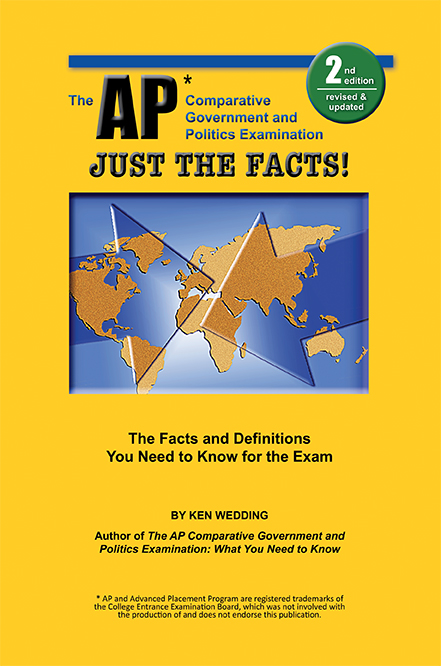 Just The Facts! 2nd edition is a concise guide to concepts, terminology, and examples that will appear on May's exam.


