Red tape in China. Patriotic? Necessary?
Red Tape is the symbol of government restrictions on independent action by people, groups, and companies. China may be the champion of red tape and democratic centralism may be the primary cause.
China’s endless war on red tape leads to … more red tape
China’s war on bureaucratic window dressing has been stepped up, with 2019 declared the year of reducing the burden on grass-roots officials.
Chinese President Xi Jinping is counting on the millions of junior party cadres across the country to implement his ambitious campaigns to end corruption, alleviate poverty and rejuvenate the nation. Instead, they often find themselves entangled in endless meetings and exhausted by the mountains of reports they are required to prepare…
Li, a staffer at a county-level legislature in the southern province of Guangdong… said his fellow cadres also lamented that their appraisals were based on “ridiculous” check-the-box indicators instead of meaningful measures of their performance…
In a March directive announcing the latest crackdown on “formalism” – as the flurry of meaningless bureaucratic activity is known in China – the party’s Central Committee warned against evaluating cadres’ performance solely on the basis of photos or videos taken of their work.
The directive, which declared 2019 the year for reducing the grass roots burden, also called for governments to cut down on meetings and guidelines by 30 to 50 per cent.
The number of meetings being held is staggering. Last week local state media reported that the public Security Bureau in Tianjin City, northeast China, had convened more than 160,000 meetings in recent years for its officers to learn from past corruption cases involving the city’s former mayor and police chief…
The March directive to chip away at redundant files and meetings showed the central government realised that bureaucrats could hardly focus on their real tasks with all that red tape, Zhuang said…
Since coming to power, Xi has made repeated efforts to chip away at the stubborn sloth of China’s bureaucracy. He declared war against “formalism” almost immediately after becoming the party’s general secretary in 2012…
Nor is Xi the first Chinese leader to tackle the issue. Mao Zedong, Deng Xiaoping, Jiang Zemin and Hu Jintao all tried to fix the problem, with varying degrees of success, only to see the problem emerge once again, seemingly stronger than ever…
To many civil servants, the campaigns – many aimed at curbing formalism themselves – have only meant more meetings, more documents, more peculiar evaluations, in which they are required to repeatedly reflect on their mistakes, and endlessly rewrite most of their reports…
And, just days after Beijing’s directive, Li received a new guideline from the municipal party cell, handed down at 10am.
“May all counties submit documents on discussions about ‘curbing the burden of grass roots governance’. The voice of the front line needs to be heard,” it read.
“All materials shall be sent to the municipal party cell’s mailbox by three this afternoon,” the guideline continued.
Teaching Comparative blog entries are indexed. Use the search box to look for country names or concept labels attached to each entry.
What You Need to Know 7th edition is ready to help.
Order the book
HERE
Amazon's customers gave this book a 4-star rating.
Labels: bureaucracy, China, democratic centralism, regime
The biggest part of the regime?
The Revolutionary Guard Corps in Iran may be the biggest military, economic, and political force in the country. It probably rivals China's PLA in importance to the regime.
Iran’s Supreme Leader Replaces Head of Revolutionary Guards
Iran’s supreme leader has replaced the top commander of the Islamic Revolutionary Guards Corps… two weeks after the Trump administration designated the elite force of the Iranian military as a foreign terrorist organization…
 |
| Gen. Salami |
Mr. Khamenei replaced General Jafari with a deputy commander of the Revolutionary Guards, Brig. Gen Hossein Salami, and elevated his rank to major general.
General Salami takes over a 125,000-member branch of the Iranian military that has grown into a vast military-industrial complex since it was created by founders of the Islamic revolution that overthrew the shah 40 years ago.
The Revolutionary Guards Corps reports directly to Ayatollah Khamenei, exerts deep influence in politics and the economy, and has its own air force, navy and intelligence service.
It also is in charge of Iran’s ballistic missile development and operates a subsidiary known as the Al Quds force, which carries out clandestine operations and other activities in Lebanon, Syria and Iraq…
General Salami has been outspoken recently in expressing Iran’s antipathy toward Israel, which regards Iran as its most dangerous foe in the Middle East…
Teaching Comparative blog entries are indexed. Use the search box to look for country names or concept labels attached to each entry.
What You Need to Know 7th edition is ready to help.
Order the book
HERE
Amazon's customers gave this book a 4-star rating.
Labels: Iran, politics, regime
The demands of democratic centralism
Democratic centralism requires inspection from "above" and feedback from "below."
New round of inspection to oversee central gov't departments, SOEs
A total of 15 teams of disciplinary inspectors have been dispatched to three central government departments and 42 state-owned enterprises (SOEs)... said an official statement Tuesday.
This is the third round of routine disciplinary inspections launched by the 19th Communist Party of China Central Committee, the statement said.
The three central government departments were the State-owned Assets Supervision and Administration Commission of the State Council, the National Energy Administration, and the State Administration of Science, Technology and Industry for National Defense.
The 42 SOEs were administrated by the central government, including the China Aerospace Science and Technology Corporation and China State Shipbuilding Co., Ltd.
The inspection teams will be stationed at the departments and state firms for two and a half months, and will receive complaints about violations of Party disciplinary rules from the public.
Teaching Comparative blog entries are indexed. Use the search box to look for country names or concept labels attached to each entry.
What You Need to Know 7th edition is ready to help.
Order the book
HERE
Amazon's customers gave this book a 4-star rating.
Labels: China, democratic centralism, ideology, politics, regime
Failed in place?
According to the textbooks' accounts, PM May should have called another election by now. Or at least she should have formed a new government. Why didn't she? And where, in the UK "constitution" is there a provision for a binding referendum? Can "democratic" regime survive in the UK?
‘We’re in the Last Hour’: Democracy Itself Is on Trial in Brexit, Britons Say
The whole world of Britain’s Parliament — its effete codes of conduct, its arcane and stilted language, its reunions of Oxbridge school chums — seemed impossibly remote from the real, unfolding national crisis of Brexit, the process of extricating the country from the European Union…
Over the past weeks, as factions within the British government have grappled for control over the country’s exit from the bloc, the mood among voters has become dark.
Those Britons who wished to remain are reminded, daily, that a risky and momentous national change is being initiated against their will and judgment. More striking is the deep cynicism among those who voted to leave, the group that Prime Minister Theresa May is trying to satisfy. They are now equally bitter and disillusioned, as the government’s paralysis has called into question whether Britain will ever leave.
Parliament’s rejection of Mrs. May’s withdrawal plan… — for the third time — means the turbulence will continue.
In interviews, many Britons expressed despair over the inability of the political system to produce a compromise. No one feels that the government has represented their interests. No one is satisfied. No one is hopeful.
It has amounted to a hollowing out of confidence in democracy itself…
“There’s a fin-de-siècle sense that modern British politics has run out of road,” said Mr. Davies, author of “Nervous States: Democracy and the Decline of Reason.” “Maybe the best thing to come out of this is the recognition that the political elites — people just want them to get off the stage. I don’t know who they want to replace them. But there’s a sense that a reboot would be something people would be in favor of.”…
The referendum question has divided Britain into warring tribes, unable to settle on any shared vision of the future. An ancient, robust democracy is groaning under the weight of conflicting demands — on the executive, to carry out the will of the people; and on the members of Parliament, to follow their conscience and to act in what they believe to be the people’s interest…
“I think people have totally lost confidence in democracy, in British democracy and the way it’s run,” said Tommy Turner, 32, a firefighter. He was perched on a stool at the Hare & Hounds, a working-class pub in Surrey, where nearly everyone voted to leave the European Union. Among his friends, he said, he sensed a profound sense of betrayal that Britain was not exiting on March 29, as promised.
“You’ve got egotistical people in politics, and they want to follow their own agenda,” he said. “They don’t want to follow what the people have voted for.”…
Polling has borne out his worry. Britons’ assessment of their leaders is scathing, with 81 percent saying that Britain has handled Brexit badly, and 7 percent saying it has handled it well, according to data released recently by NatCen Social Research, an independent agency…
Particularly drastic, researchers said, is the souring of Leave voters in the past six months, as Mrs. May concluded her negotiations on the withdrawal agreement and shared the terms of departure with the country. Expectations that Brexit would have concrete effects — by lifting the economy or slowing immigration — have diminished sharply, the data show…
[A]t The Highbury Barn, a pub in North London that offers haddock from the fishmonger across the street and provides pans of water for visiting dogs. In this neighborhood, Islington North, in the constituency of the opposition Labour leader, Jeremy Corbyn, the number of signatories on a petition asking the government to revoke Article 50, the part of the European Union treaty that lays out the terms of Britain’s exit, reached one-quarter of the population.
But people here took an equally dismal view of the government’s performance…
Aidan Hughes, 58, who works in finance, was waiting for a cab in the back of the bar.
“What we’re seeing is that the process the government’s involved in has been effectively hijacked by an even smaller segment of the ruling government, the right-wing element of the party,” he said. He blamed the first-past-the-post voting system, which tends to increase polarization between two large parties and exaggerate geographical divides, setting up stark conflict between sections of society.
He said it was time for Britain to move toward a system of proportional representation, common to democracies that evolved later than Britain’s, which allows smaller parties to enter Parliament more easily.
“We would then have people with different views coming together to compromise, to find a way forward,” he said. “Whereas whoever wins an election now can currently push their views, irrespective of support.”…
In a landscape of pervasive gloom, Mr. Hughes, the finance worker, did see one reason for hope: That Britons, young and old, were passionately engaged, as never before, in the inner workings of their own government. Even if it was because they were so angry.
“This is starting to drag people into an interest in what’s actually happening,” he said. “Clearly it’s a total mess and it’s been handled appallingly by the government. Be that as it may, at least it’s gotten people animated in talking about these topics.”
Teaching Comparative blog entries are indexed. Use the search box to look for country names or concept labels attached to each entry.
What You Need to Know 7th edition is ready to help.
Order the book
HERE
Amazon's customers gave this book a 4-star rating.
Labels: Brexit, politics, regime, UK
The "real" regime of Nigeria?
Most Americans would be hard pressed to name a state in Nigeria. But government in states may be the most important part of the regime.
Nigeria’s state elections are more violent than national ones
Most of Nigeria’s 36 states, which elect[ed] their governors and state legislators on March 9th, have [politically linked [gangs of hoodlums who terrorise the city.] These straddle the boundary between party cadres and criminal gangs. They embody the rottenness of state politics in Nigeria. Governors run their states like personal fiefs, amassing fortunes and grooming protégés once they have hit the two-term limit. Although outsiders often pay little attention to them… Since states are in charge of budgets for education and health, their elections are also more important.
When it gained independence from Britain in 1960 Nigeria was divided into three regions. These were later split into four regions before being sliced up into 12 states in 1967 as the government tried to prevent the secession of one of the regions, Biafra. It was brought to heel in a bloody civil war. In the years since then the country has been further diced into 36 states, several of which are failing…
Governance is often abysmal. At the end of 2017, according to BudgIT, an NGO, only two states generated more than half of their revenue internally, instead of relying on federal handouts…
Checks on governors’ power are feeble. Although each state has its own legislative assembly and electoral commission for local polls, Maliki Kuliya, who served as Mr Kwankwaso’s justice commissioner, says that these are “just appendages of the executive”. As a result, political parties usually matter less than the politicians who constantly switch between them…
Teaching Comparative blog entries are indexed. Use the search box to look for country names or concept labels attached to each entry.
What You Need to Know 7th edition is ready to help.
Order the book
HERE
Amazon's customers gave this book a 4-star rating.
Labels: corruption, federalism, Nigeria, politics, regime
Democracy in the Peoples Republic
Regime in China
China recruits Westerners to sell its “democracy”
The annual sitting of the National People’s Congress, China’s well-fed eunuch of a parliament, poses several tests for foreign reporters. Though its committees may suggest tweaks to new laws, and some play a diplomatic role engaging with foreign legislators, meetings of its 3,000 or so delegates are mostly very dull…
There is the odd experience of meeting supposed colleagues who are in fact complete strangers, meaning foreigners employed by Chinese state media, or by obscure Western news outlets that channel Chinese propaganda. Some ask planted questions at press conferences. Others pop up in the state media lauding China’s political system. Xinhua, China’s official news agency, this year put out a video entitled “Chinese democracy in the eyes of an American”. A fresh-faced young man from Chicago, Colin Linneweber, strolls around Tiananmen Square while opining that “it’s widely acknowledged that a key to China’s success is its system of democracy”, and praising the country’s “stability”. He then presents mini-profiles of delegates with such day jobs as farmer, migrant worker and postman, whose proposals for making China better became law. It is tempting to be quite cross with such Westerners. Ordinary Chinese who start praising democracy on the square, a ghost-haunted, massively policed spot, would be instantly arrested. Stability comes at a price, what is more. China’s one-party rule involves more than the absence of messy things like real elections or a free press. It requires active, unsleeping maintenance by state-security agents tasked with tracking, threatening or jailing any who challenge the Communist monopoly on power.
As far back as China’s civil war, party leaders called themselves democrats, unlike their dictatorial rivals, the Nationalist Party or Kuomintang. In 1945 Mao Zedong impressed Chinese intellectuals when he assured a businessman and educational reformer, Huang Yanpei, that democracy would help a Communist government avoid cycles of triumph and decline that doomed imperial dynasties. “Only when a government is subject to the people’s supervision will it not dare to slacken,” Mao declared…
After Mao’s death, when economic opening was not matched by political liberalisation, party leaders sounded a bit defensive about that choice, assuring foreigners that only a firm grip on their vast country could avoid chaos. In the 1990s rule passed to Jiang Zemin, an admirer of Western culture who loved to quote Abraham Lincoln’s call for government of, by and for the people. Asked by an American interviewer whether China was a dictatorship, Mr Jiang replied that he was the elected head of a collective party leadership, although the method of his election had to take account of China’s levels of economic and educational development.
Jump to the present day, and foreigners hear no such half-apologies from the China led by President Xi Jinping. Mr Xi calls China a socialist, consultative democracy, featuring the “orderly participation” of the people and always under the party’s control. Today, state media hail China’s political system as far more responsive and effective than the West’s “conflict-driven”, money-tainted politics…
The Asian Barometer Survey, run by National Taiwan University, has on four occasions quizzed the Chinese public about democracy. Writing in the Taiwan Journal of Democracy, Yue Yin, a political scientist, notes that a narrow majority of the survey’s respondents in China support press censorship in the name of stability, while two-thirds say they are at ease with one-party rule. Yet accountability matters. Nearly 80% reject a government in which “experts decide everything” and 60% say the public should be free to criticise the authorities.
That suggests another way to understand propaganda films in which foreigners call the legislature a beacon of democracy. Such videos are a backhanded tribute to the West. An American’s views on accountable government carry weight, because ordinary Chinese know that American voters can kick the bums out. For now, China’s rulers still mind when their authoritarian system is judged against Western norms. When they no longer think they need the Colin Linnewebers of this world, start worrying.
Teaching Comparative blog entries are indexed. Use the search box to look for country names or concept labels attached to each entry.
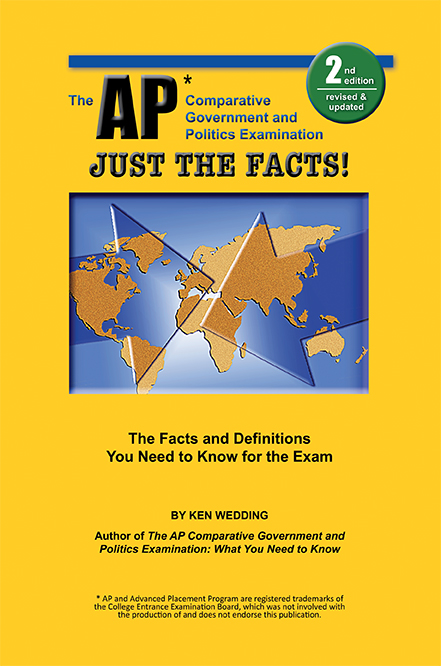
 Just The Facts! 2nd edition is a concise guide to concepts, terminology, and examples that will appear on May's exam.
Just The Facts! is available. Order HERE.
Amazon's customers gave this book a 5-star rating.
Just The Facts! 2nd edition is a concise guide to concepts, terminology, and examples that will appear on May's exam.
Just The Facts! is available. Order HERE.
Amazon's customers gave this book a 5-star rating.
Labels: China, democracy, history, leadership, regime
Someone studied comparative government and politics.
Journalists are renowned for using the terms government and regime as synonyms. At least one of the editors at
The Economist studied comparative government and politics long enough to learn the difference.
[Thanks to
Paul Fitzpatrick in Texas for pointing this one out.]
Mexico’s new president sets out to change his country’s course
But did voters want a new regime or just a new government?
[W]hen Andrés Manuel López Obrador declared that he would be the first Mexican president since 1910 to use the [National Palace] as his workplace, he was making a statement that was both political and historical. Mr López Obrador (known as AMLO to Mexicans), who won a landslide victory in a presidential election on July 1st, promises a “fourth transformation”, after those of political independence, Juárez’s assertion of national sovereignty and the revolution in 1910-17. “This is a change of regime, not just of government,” says Lorenzo Meyer, a historian sympathetic to AMLO.
Although he does not take office until December 1st, some of the contours of this change are already clear… Mr López Obrador is steeped in a particular version of Mexican history (about which he has written several books), from which he derives his inspirations and world-view.
His first hero is Juárez, a liberal but one in whom the new president sees a leader who “proposed a new Mexico based on honesty and republican values”… Second is Lázaro Cárdenas, who in the 1930s nationalised the oil industry and carried out a state-controlled agrarian reform. He stands… “for bringing social justice to a society that still has colonial characteristics”, of racism for example…
What all this means is that AMLO will be economically moderate, socially bold and politically centralising— but not necessarily democratic…
He thinks he can fund a big increase in public investment, mainly for transport projects in the poorer south, by eliminating waste. The first law approved by the new congress (in which AMLO has a majority) involves a swingeing cut in the salaries of senior officials. Federal “delegates” will police spending by state governors…
Like Juárez, AMLO is personally austere. His recipe for fighting corruption and crime seems to be to restore the authority of the federal government. That may well be popular. Historically, Mexico has floundered when power is dispersed. But the president’s “delegates” look to some like a device to turn his Morena movement into a party of the state. AMLO mistrusts “civil society”, the pressure groups that call for stronger checks and balances. Even some of his supporters worry that his aim may be to strengthen the state rather than democracy…
[AMLO's] vision of history may not accord with a country which many Mexicans do not think is still “colonial”, but who voted for him out of despair at crime and corruption. It is still unclear whether Mexico wants a change of regime, or just of government.
Teaching Comparative blog entries are indexed. Use the search box to look for country names or concept labels attached to each entry.
Just The Facts! 2nd edition is a concise guide to concepts, terminology, and examples that will appear on May's exam.
Just The Facts! is available. Order HERE.
Amazon's customers gave this book a 5-star rating.
Labels: concepts, government, leadership, Mexico, regime
Simplifying?
Maybe this will make it easier to teach and learn about China's regime. Instead of having to keep track of parallel government and Party organizations, we'll only have to keep track of Party elements and the government organs that are puppets of the Party.
By the way, there is a great interactive graphic in the original of this article illustrating the Chinese regime.
China unveils bold overhaul to tighten Communist Party control
Beijing on Wednesday unveiled a massive plan to further assert the Communist Party’s control over economic and foreign affairs, cultural policies, and the appointment and training of cadres.
While the central government is restructured every five years after each term of cabinet, major overhauls of the party organs are rarely seen…
The party’s influence has grown under President Xi Jinping, in line with his slogan “the party leads everything”, reversing past practice of leaving policy implementation to the state.
Four of the party’s “leading groups” – on financial and economic affairs, cybersecurity, reforms and foreign affairs – have been upgraded to become commissions…
All four of those groups are chaired by Xi, and the reforms and cybersecurity bodies were set up after he took the party’s top job in 2012…
Aside from the upgrades, some party agencies will also take responsibility for offices that were previously under the State Council, China’s cabinet…
It will set up another two party commissions that will oversee ministries with almost identical functions. To establish an “authentic and effective” audit system and strengthen supervision, it will create the Central Audit Commission above the cabinet-level National Audit Office…
Beijing-based political commentator Zhang Lifan said the overhaul would help the party to consolidate its control.
“It will be good for the party to cut its operating costs and increase efficiency by merging offices with overlapping functions,” Zhang said…
 |
| This graphic is interactive in the original post. |
Politics professor Li said the shift reflected Beijing’s growing confidence in the party’s status, even on the global stage.
“China used to follow in the footsteps of the West, but now it’s more confident and doesn’t believe that it has to do certain things via the government.”
But he was not concerned that blurring the line between party and state could result in an over-concentration of power, saying Beijing’s rationale for the reforms was partly to avoid a situation like the collapse of the Soviet Union.
“The Soviet collapse was caused by the separation of the party and the state,” Li said. “The West’s notion of separation of power is not always a good idea.”
Teaching Comparative blog entries are indexed. Use the search box to look for country names or concept labels attached to each entry.
Just The Facts! 2nd edition is a concise guide to concepts, terminology, and examples that will appear on May's exam.
Just The Facts! is available. Order HERE.
Amazon's customers gave this book a 5-star rating.
Labels: China, Communist Party, regime
Unifying control of broadcast media
Among the changes approved at the recent National People's Congress was the creation of clear Party controls over the media messages to the world.
Beijing plans to merge state media outlets as it tightens control
China Central Television (CCTV), China National Radio (CNR) and China Radio International (CRI) will be consolidated into a new broadcaster called Voice of China – a nod to federally funded Voice of America in the United States and Germany’s Deutsche Welle…
 |
| Xi greets CCTV workers |
A document introducing the changes… says the consolidated group will sit directly under the State Council, China’s cabinet, and will be led by the party’s Central Propaganda Department.
It also outlines changes to the propaganda unit and the Central Organisation Department – two already powerful agencies that will have even more heft after the revamp.
The propaganda department will absorb the country’s top media watchdog… taking over its regulatory power on news, publications and film…
The changes are part of a structural reform of party and state departments designed to entrench the party’s control over all levers of government and all aspects of life.
According to the document, Voice of China’s main duties will be to “promote the party’s theories, principles and policies”, “coordinate and organise major propaganda coverage”, “strengthen the ability to shape public opinion”, “improve its global communication capabilities”, and “tell the China story well”.
Under Xi, Beijing has also grown increasingly eager to be heard in a world it sees as dominated by Western narratives that are unfair and biased against China…
Teaching Comparative blog entries are indexed. Use the search box to look for country names or concept labels attached to each entry.
What You Need to Know 7th edition is ready to help.
Order the book
HERE
Amazon's customers gave this book a 4-star rating.
Labels: China, Communist Party, media, regime
Huge election
Nearly 3,000 legislators? Remind me, how were these delegates elected? Who voted for them?
China elects 2,980 deputies to national legislature
A total of 2,980 deputies to the 13th National People's Congress (NPC), China's national legislature, have been elected and are awaiting final confirmation.
A report on the election of new NPC deputies, from 35 electoral units across the country, was submitted to the NPC Standing Committee for confirmation Friday…
 |
| Zhang Dejiang (C, rear), chairman of the Standing Committee of China's National People's Congress (NPC), presides over the opening meeting of the Committee |
"The deputies to the 13th NPC make up a broad cross-section with each region, ethnic group and sector of society having proper representatives," said Xin Chunying, deputy secretary-general of the NPC Standing Committee, elaborating on the report at the meeting.
The elections were legal and the qualifications of all deputies are valid, according to a commission of the NPC Standing Committee in charge of checking their validity…
Lawmakers agreed that the 12th NPC Standing Committee has performed its duties well during its five-year tenure, with new progress made in theoretical and practical innovations to the system of people's congresses, and in the building of socialist democracy and rule of law, according to a statement issued after panel discussions Friday afternoon.
"The NPC Standing Committee has firmly safeguarded the authority and core status of Xi Jinping, general secretary of the Communist Party of China (CPC) Central Committee, and the authority and centralized, unified leadership of the CPC Central Committee with Xi at the core," the statement said…
Teaching Comparative blog entries are indexed. Use the search box to look for country names or concept labels attached to each entry.
Labels: China, election, regime
Referendum or revolution
It's difficult for outsiders to know the reality of Iranian politics. But here are some hints.
Iranian intellectuals call for referendum amid political unrest
A group of prominent Iranian intellectuals have said they have lost hope that the Islamic Republic can reform, and have called for a referendum to establish whether the ruling establishment is still backed by a majority.
A day after Iran’s president, Hassan Rouhani, touted the idea of holding a referendum as a means to heal Iran’s deepening political divisions, 15 figures – including some based in Iran – said leaders had failed to deliver on republican ideals…
Rouhani did not elaborate on what he was proposing to put to a vote, but he has sounded increasingly frustrated about the political stalemate…
Meanwhile, the Iranian currency has taken another dive against the dollar in recent days, adding to fears about the state of the economy.
Speaking last week, Rouhani expressed concern about what he said was the unwillingness of his hardline opponents to listen to the voices of ordinary people, particularly after a wave of unrest that began in late December.
“The previous regime, which thought that its rule would be lifelong and its monarchy eternal, lost everything because it did not listen to the voices of criticism, advice, reformers, the clergy, elders and intellectuals,” he said, referring to the late shah’s rule. “The previous regime did not listen to the voice of people’s protests and only listened to one voice, and that was the people’s revolution. For a government that only wants to hear the sound of revolution, it will be too late.”
The activists’ letter… criticises the conservative-dominated judiciary, which acts independently of Rouhani’s government. “The judiciary is reduced to the executor of the political wishes of those who hold the reins of power…
Saeed Barzin, a London-based Iranian analyst, said Rouhani’s call for a referendum was a threat to push back the economic and political meddling of an unelected faction dominated by hardliners, in particular the Revolutionary Guards.
“The undercurrent issue is how the power will be distributed after Khamenei, and in a way the power struggle has already begun,” Barzin said. “Reformists feel under threat that the current situation might lead to people losing hope in reform or becoming radical or becoming apolitical. Hardliners, on the other side, might see an opportunity here to scapegoat Rouhani and even conduct a soft coup d’état, but it’s a gamble.”…
Teaching Comparative blog entries are indexed. Use the search box to look for country names or concept labels attached to each entry.
What You Need to Know 7th edition is ready to help.
Order the book
HERE
Amazon's customers gave this book a 4-star rating.
Labels: Iran, leadership, politics, protest, regime
King/Queen of the United States?
Here's one for students to discuss. And there are enough assertions to be checked with research. (Are nations with monarchies "generally richer and more stable?") Does being a member of a titled aristocracy have any influence on opinions?
What’s the Cure for Ailing Nations? More Kings and Queens, Monarchists Say
Count Nikolai Tolstoy says, more kings, queens and all the frippery that royalty brings would be not just a salve for a superpower in political turmoil, but also a stabilizing force for the world at large.
“I love the monarchy,” Count Tolstoy, 82, said as he sat in his lush garden behind an expansive stone house. “Most people think the monarchy is just decorative and filled with splendor and personalities. They do not appreciate the important ideological reasons for a monarchy.”
The count… leads the International Monarchist League and is part of a loose confederation of monarchists scattered across the globe, including in the United States.
Their core arguments: Countries with monarchies are better off because royal families act as a unifying force and a powerful symbol; monarchies rise above politics; and nations with royalty are generally richer and more stable…
A recent study that examined the economic performance of monarchies versus republics bolsters their views. Led by Mauro F. Guillén, a management professor at the Wharton School at the University of Pennsylvania, the study found “robust and quantitatively meaningful evidence” that monarchies outperform other forms of government…
Count Tolstoy insists that monarchists are not pining for the days of absolute rulers and the divine right of kings…
 |
| Dutch King Willem-Alexander |
Instead, his group advocates constitutional monarchies, in which a king or queen is head of state and the real power rests with an elected Parliament…
Finding people to reject the monarchists’ vision is not hard, even in Britain, where Queen Elizabeth II is revered by many.
A London-based grass-roots organization called Republic, which wants the country to hold a referendum on the monarchy when the queen dies, says bluntly on its website, “The monarchy isn’t fit for purpose. It is corrupt and secretive.”…
Teaching Comparative blog entries are indexed. Use the search box to look for country names or concept labels attached to each entry.
What You Need to Know 7th edition is ready to help.
Order the book
HERE
Amazon's customers gave this book a 4-star rating.
Labels: concepts, democracy, monarchy, regime
Reform without reform
Can you explain why this situation would not arise in China? Which other country you're studying is this situation most likely to occur and why?
Mexico’s Government Is Blocking Its Own Anti-Corruption Drive, Commissioners Say
Mexico’s landmark anti-corruption drive, inaugurated by President Enrique Peña Nieto under intense pressure to answer the scandals jolting his administration, is being blocked by the government’s refusal to cooperate on some of the biggest cases facing the nation, according to members of the commission coordinating the effort…
Marred by scandals that have embroiled his administration, his allies and even his own family, Mr. Peña Nieto agreed to the creation of a broad anti-corruption system last year that was enshrined in the Constitution, a watershed moment in Mexico.
But after nine months of pushing to examine the kind of corruption that ignited public outrage and brought the new watchdog into existence, some of its most prominent members say they have been stymied every step of the way, unable to make the most basic headway.
After announcing the new system with great fanfare, they say, the government is now refusing to allow any serious investigations into its actions…
In principle, regular citizens are at the helm of the new system, giving them the power to ensure that it works in the interest of the Mexican people, not the government.
But in interviews, all five members of the special citizen commission recited a long inventory of obstacles placed before them by the government.
None of the 18 judges who are supposed to oversee anti-corruption cases have been appointed by lawmakers. The prosecutor empowered under the new system to pursue investigations independently has not been named…
A big part of the problem, the commission members contend, is that their power is rooted in title only. All significant decisions have to be made by a collection of seven agencies. But six of them come from different branches of government, leaving the citizen’s commission, which technically oversees the entire process, heavily outvoted…
For many Mexicans, the new anti-corruption system — and particularly the power of citizens to coordinate it — showed that the government, when pushed hard enough, might finally combat the impunity that defines much of life in Mexico.
But many civil society leaders, including some who helped engineer the creation of the anti-corruption system, say they have fallen prey to a familiar trick: The government creates a panel to address a major issue, only to starve it of resources, inhibit its progress or ignore it…
The anti-corruption drive is still missing its independent prosecutor, arguably the most important person in the entire operation. The selection has been frozen in the legislature…
Teaching Comparative blog entries are indexed. Use the search box to look for country names or concept labels attached to each entry.
What You Need to Know 7th edition is ready to help.
Order the book
HERE
Amazon's customers gave this book a 4-star rating.
Labels: corruption, Mexico, political culture, politics, regime
Parliamentary trivia
If it helps you remember the outlines of relationships between the head of state and the legislature in the UK, fine. If it doesn't help, it doesn't matter.
Parliament advertises for new Black Rod
Parliament is advertising for a new Black Rod to replace Lieutenant General David Leakey, who is retiring.
Black Rod is best known for a role in the State Opening of Parliament, knocking on the door of the House of Commons to summon MPs for the Queen's Speech.
 |
| Black Rod knocking on Commons' door |
But the post-holder has year-round responsibilities for the security and maintenance of the House of Lords.
The successful applicant can expect to earn up to £93,000 per year…
The famous image of Black Rod has its origins in a tradition dating back to the Civil War.
Black Rod summons MPs to the Lords to hear the Queen's Speech but has the door to the House of Commons slammed in his face, and has to knock three times to gain entry.
 |
| Lieutenant General David Leakey |
He is the Monarch's representative in the House of Lords and the routine is symbolic of the House of Commons' independence from the Crown…
The closing date for applicants is 10 October.
Teaching Comparative blog entries are indexed. Use the search box to look for country names or concept labels attached to each entry.
What You Need to Know 7th edition is ready to help.
Order the book
HERE
Amazon's customers gave this book a 4-star rating.
Labels: history, regime, UK
The EU: Maybe if we make things more confusing…
James Kanter, writing in the NYTimes, mentions the reputation problems of the EU when writing about some reform ideas of EU Commission president Jean-Claude Juncker. Prominent among critiques of the EU is its
"democratic deficit." It's a key to understanding the operation of the EU.
E.U. Leader Suggests Simplifying How the Bloc Is Run
Jean-Claude Juncker, the president of the European Commission, laid out plans on Wednesday to simplify the byzantine governance of the European Union…
 |
| Juncker addresses the EU Parliament |
The complexity of the European Union is legendary. It has a plethora of institutions and no single leader, leaving many wondering who is in charge…
Mr. Juncker, of Luxembourg, leads the commission, a mass of powerful bureaucrats. Donald Tusk of Poland leads the European Council, which consists of the leaders of the 28 member nations and sets the union’s overall political direction. Antonio Tajani of Italy is president of the European Parliament.
Then there is the Council of the European Union — not to be confused with the European Council — which is made up of ministers and has a six-month rotating presidency.
The structure of the bloc… contributes to what scholars call a “democratic deficit,” the feeling that structures and officials in Brussels are unaccountable to ordinary people…
“The European landscape would be clearer and more understandable if the European ship was steered by one and the same captain at the helm,” [Juncker] said…
Mr. Juncker’s wide-ranging speech touched on these themes:
- The favorable circumstances and relatively healthy economic growth across much of the bloc…
- A new European minister for economy and finance…
- Proposals in finance, intelligence-gathering and cybersecurity…
- A warning that Britain’s exit from the bloc was “very sad and tragic”…
- A far tougher line with Turkey…
Teaching Comparative blog entries are indexed. Use the search box to look for country names or concept labels attached to each entry.
What You Need to Know 7th edition is ready to help.
Order the book
HERE
Amazon's customers gave this book a 4-star rating.
Labels: democratic deficit, EU, regime
Briefing on the details of Parliamentary politics
The BBC offers a detailed and valuable outline of how things will work for the current government.
Theresa May and the DUP deal: What you need to know
Theresa May has done a deal with the DUP which means she stays as UK prime minister. Here's a guide to what's going on.
- What has happened?
- What was the result of the election?
- So how come Theresa May is still prime minister?
- So are the Conservatives and the DUP in coalition?
- What is in it for the DUP?
- Why is doing a deal with DUP controversial?
- What about the Good Friday agreement?
- What about Brexit?
- So will Theresa May survive as prime minister?
- What are the key dates for Mrs May?
- Why are Labour in such good spirits?
- Is there likely to be another general election?
- Further reading
Teaching Comparative blog entries are indexed. Use the search box to look for country names or concept labels attached to each entry.
Just The Facts! 2nd edition is a concise guide to concepts, terminology, and examples that will appear on May's exam.
Just The Facts! is available. Order HERE.
Amazon's customers gave this book a 5-star rating.
Labels: Brexit, government, parties, politics, regime, UK
Separation of Communist Party of China and the functions of government?
From an outsider's perspective (and probably those of most textbook authors) there's little doubt about the locus of ultimate political power in China. So when Chinese officials argue for integrating the decision making power of the Party with the policy enacting power of the regime, those of us from far away can only wonder what they're talking about. Wang Qishan's statement at the article's end says it all, to me, an observer from far outside.
The article comes from the
South China Morning Post, a generally pro-Chinese newspaper published in Hong Kong.
Why is China blurring the line between party and state
 |
| Wang Qishan |
Ridding the Communist Party of corruption while leaving its absolute grip on power untouched was a daunting task, party anti-graft tsar Wang Qishan admitted two years ago.
Now, with many corrupt officials in jail, he’s spearheading an effort to combine the party and government corruption watchdogs into a super anti-graft organisation – the National Supervisory Commission.
While some have welcomed the move… it has also stoked concerns the restructuring marks the beginning of a fusing of the state and the party, making the prospect of liberal political reform even more remote.
At a meeting in February explaining the creation of the commission, Wang raised eyebrows when he said “there is no such thing as separation between the party and the government”.
“There is only a division of functions,” he said. “We must take a clear position and be straightforward on this issue.”
Late paramount leader Deng Xiaoping in 1980 laid part of the blame for problems such as stifling bureaucracy on the conflicting powers of party cadres and government officials.
The concept of the separation of party and state, later written into the top-level political report at the party’s 13th national congress in 1987, urged the party to only take part in major decisions and retreat from daily government operations.
It was part of an effort to tackle excessive concentration of power, seen by the party as the root of the political mayhem during the Mao Zedong era…
Attempts at further political reform have stalled for decades following the leadership shake-up that accompanied the crackdown on pro-democracy protests in 1989. Party committees were reinstated in government institutions…
Wang’s remark was affirmation of an ongoing trend of further mingling the party and the government…
Last year, for the first time, the party’s seven-member Politburo Standing Committee began hearing reports from the State Council (China’s cabinet), the National People’s Congress (its legislature), the Chinese People’s Political Consultative Conference (its top political advisory body), the Supreme People’s Court and the Supreme People’s Procuratorate, which investigates and prosecutes offenders…
American political scientist Francis Fukuyama, told an audience at the US Council on Foreign Relations he had asked Wang if he could ever envision a time when China’s courts could be independent.
“And his answer was absolutely not. It’ll never happen,” Fukuyama said. “The Communist Party must remain in control. He was not ambiguous on that point.”
Teaching Comparative blog entries are indexed. Use the search box to look for country names or concept labels attached to each entry.
What You Need to Know 7th edition is ready to help.
Order the book
HERE
Amazon's customers gave this book a 4-star rating.
Labels: China, Communist Party, regime, rule of law
Is "deep state" a real thing?
The concept of a "deep state" is being thrown around in American politics. Ishaan Tharoor, writing in the
Washington Post tries to clarify the idea. As I read it, I thought of ways in which there are elements of a deep state in Nigeria, Russia, Mexico, and Iran. Which elements of the regime and civil society might be part of a deep state in each. And could a deep state be part of the political systems in China or the UK?
Is the concept of deep state different from the concept of an iron triangle?
What an actual ‘deep state’ looks like
Key figures in the White House see themselves locked in a battle with the "deep state" — a term they're using, as my colleagues explained, to describe "a group of Obama-aligned critics, federal bureaucrats and intelligence figures" as well as the media…
[T]here has been a great deal of chatter — and a good number of articles — pondering the "deep state" and its reach in the United States… Some observers on the American left see the nexus of the national security apparatus, arms companies and corporate lobbies as the basis for a kind of all-pervasive shadow government dominating political life in the country…
But the "deep state" in its more well-established contexts is something more concrete. The term is most closely associated with the turbulent politics of Turkey, a country whose democracy was for decades routinely interrupted by cabals in the military and civil bureaucracy…
The concept of the "deep state" also resonates strongly in countries where the military is vast and difficult to check. Think of Egypt, where an army-led putsch ousted an elected Islamist president, Mohamed Morsi, in 2013; or Pakistan, where the military and its powerful intelligence arm remain the most influential actors within the state…
The distinction between these countries and the United States is incredibly important: "In the American case, the bureaucrats themselves don’t control, or want to control, the system they are trying to protect," wrote Steven Cook of the Council on Foreign Relations…
Turkish experts will tell you that discussion of the "deep state" flourishes in a climate of conspiracy and political polarization. It encourages the public to doubt the pillars of civil society — from the judiciary to the press — and take shelter in the shadow of a populist leader…
See also Rumblings of a ‘Deep State’ Undermining Trump? It Was Once a Foreign Concept from The New York Times.
Teaching Comparative blog entries are indexed. Use the search box to look for country names or concept labels attached to each entry.
What You Need to Know 7th edition is ready to help.
Order the book
HERE
Amazon's customers gave this book a 4-star rating.
Labels: concepts, deep state, politics, regime
What's a student (or a teacher) to do?
Even if your textbook was published in 2016, it's out of date. Does your textbook correctly identify the British PM? Does it discuss Brexit? Does it identify President Xi of China?
The thing to remember is that your comparative government and politics course is neither a history course nor a current events course. The article here discusses internal politics in the EU. You won't be asked about the current state of those politics on your exam, but reviewing them might help you remember the basics about the regime and the political forces within the EU.
E.U., Pressured from Inside and Out, Considers a Reboot
The European Union took a step toward coming to terms with the obvious on Wednesday: The 27 diverse nations in the bloc do not necessarily agree on the direction they are moving, how fast to get there, or how closely they should remain together.
For decades, the Eurocrats [EU employees] leading the bloc have usually insisted that there is one direction and one speed — an inevitable momentum toward an “ever closer union.” But with Britain preparing to soon formally leave the bloc, and with other crises creating internal strains, Jean-Claude Juncker, the leader of the group’s executive body, is offering something new on the menu: a buffet of options for leaders to consider over the next year or so.
 |
| Juncker |
Mr. Juncker set out five potential paths for the bloc’s future on Wednesday. Several envision things continuing as they are or even tighter integration, while others acknowledge that Europe can work at different speeds and would roll back some of the powers of the European Commission [where the Eurocrats work], the permanent bureaucracy, which Mr. Juncker heads…
Speaking to the European Parliament, Mr. Juncker urged governments, which hold the real power in the bloc, to “stop bashing the E.U.” for problems, like youth unemployment and low economic growth, that are the responsibility of nation states…
In conceding that there could be more than one way forward, Mr. Juncker may have helped the European establishment fend off those critics who say countries must leave the bloc in order to regain greater control of their sovereignty…
The issues are sensitive. Even the suggestion of a varied Europe brought some howls. Gianni Pittella, the leader of the Socialist Democrats in the European Parliament, suggested that Mr. Juncker had shied away from choosing a single pathway to restore faith in the European project because of political cowardice…
Which of Mr. Juncker’s scenarios is likely to prevail will depend on the outcome of elections in those countries and on the winners of the next round of European elections, to be held in 2019.
Teaching Comparative blog entries are indexed. Use the search box to look for country names or concept labels attached to each entry.
Just The Facts! 2nd edition is a concise guide to concepts, terminology, and examples that will appear on May's exam.
Just The Facts! is available. Order HERE.
Amazon's customers gave this book a 5-star rating.
Labels: EU, politics, regime
Directly from China
Xinhua, the source of this article, is the Chinese government's news agency. This article could be an excerpt from a Chinese textbook on the regime in the Peoples Republic of China.
People's congresses: democracy behind China's success story
China's system of people's congresses is in the spotlight again as the fifth session of the 12th National People's Congress (NPC), the country's top legislature [opened] Sunday.
Rather than creating policy conundrums or delays -- as is often the case with parliaments in some Western nations when the ruling party or coalition does not hold a majority -- the people's congress system lends support to and supervises the government to achieve effective governance and rule of law…
According to the Constitution, the people's congress system is the fundamental political system in China, with about 2.6 million deputies at various levels.
At the pinnacle of the system sits the NPC, which supervises the State Council, China's cabinet, as well as the top court and procuratorate.
With nearly 3,000 deputies, the NPC is different from the legislatures in Western political systems.
In China's political system, the NPC is the supreme organ of state power. The central government, the Supreme People's Court and the Supreme People's Procuratorate answer to the NPC and are supervised by it. In the West, the parliament stands equally with the administration and justice arms, and the three balance and checks each another.
This vertical design has the advantages of uniting different forces in governance and avoiding internal frictions…
Compared with legislators in the West who make politics their career and usually have a staff and campaign team, NPC deputies are part-time and many of them are ordinary citizens.
A deputy to the NPC can be the country's president or a farmer, a celebrated tycoon or a migrant worker, a lawyer or an official…
Though they are part-time, NPC deputies are actively engaged in state affairs. At the annual full session, they review and vote on important legal documents and personnel changes, including electing president and vice president of China every five years, as well as submit motions and proposals.
At the 2016 session they approved the country's 13th Five-Year Plan (2016-2020), a fundamental guide to ensuring China becomes a well-off society. This year the deputies will review the draft general provisions of civil law of China, a landmark move by China to step up protection of civil rights and advance rule of law…
There are five levels of people's congresses. The deputies are elected by their respective constituencies, either directly or indirectly. NPC deputies are elected by the people's congresses of provinces, autonomous regions and municipalities. At the lower levels of township and county, deputies to people's congresses are elected directly by voters…
Unlike multi-party systems in the West, there are no majority party or minority parties in the NPC. The NPC upholds the leadership of the Communist Party of China (CPC). The proposition of the CPC becomes the will of the state upon the approval of the NPC…
Teaching Comparative blog entries are indexed. Use the search box to look for country names or concept labels attached to each entry.
Just The Facts! 2nd edition is a concise guide to concepts, terminology, and examples that will appear on May's exam.
Just The Facts! is available. Order HERE.
Amazon's customers gave this book a 5-star rating.
Labels: China, legislature, politics, regime