Meanwhile in China
While Nigeria is considering a national birth control policy, China seems about to abandon its birth control policy
China to scrap population targets, health official says
China will not set a population target in the future and will give people more freedom around childbirth, a health official said, in the next step of a gradual loosening of decades of tight population-control policies…
Wei Yunpeng, deputy director of the Population Monitoring and Family Development Division of the National Health Commission, was speaking at a conference hosted by his administration and the United Nations Population Fund.
Wei’s comments are the latest sign that the government is moving to end decades of restrictive birth-control policies, fuelling speculation that China might announce removing birth limits at an upcoming meeting of the Communist Party Central Committee. Parliament removed “family planning” policies from the latest draft of a revised civil code scheduled for adoption in 2020, another signal that the policy is being eliminated.
“It’s not strange that an official would say this because fully liberalising fertility is the direction of birth policy reform,” said He Yafu, an independent demographer based in Guangdong and long-time advocate for policy changes. “In the future, China will not only remove birth limits, but will encourage childbirth.”
The government abandoned the decades-old one-child policy in 2016 and moved to a two-child policy. Bloomberg reported in May that the country was planning to scrap birth limits altogether as soon as this year. It would be a landmark end to a much criticised policy – one of history’s biggest social experiments – that slowed China’s rapid population growth but left the country with a worker shortage and an ageing population with 30 million fewer women than men.
Teaching Comparative blog entries are indexed. Use the search box to look for country names or concept labels attached to each entry.
 Just The Facts! 2nd edition is a concise guide to concepts, terminology, and examples that will appear on May's exam.
Just The Facts! is available. Order HERE.
Amazon's customers gave this book a 5-star rating.
Just The Facts! 2nd edition is a concise guide to concepts, terminology, and examples that will appear on May's exam.
Just The Facts! is available. Order HERE.
Amazon's customers gave this book a 5-star rating.
Labels: China, demographics, policy, population control
State birth control in Nigeria
Complications abound, but population growth is a real problem.
FG to limit number of children per mother
The Federal Government on Tuesday declared that it was working hard to come out with a policy that would limit the number of children that a mother could have in Nigeria.
It stated that traditional rulers and other leaders across the country were being engaged as regards this, adding that the move was aimed at addressing one of the “great challenges” in the Economic Recovery and Growth Plan of the Federal Government.
The Minister of Finance, Zainab Ahmed, who disclosed this while responding to questions during a session at the 24th Nigerian Economic Summit in Abuja, noted that the country’s population had been identified as one of the great challenges confronting the successful implementation of the ERGP.
Ahmed said, “We have been engaging traditional rulers and other leaders. Specifically, we have found out that to be able to address one of the great challenges that we identified in the ERGP, which is the growth in our population, we need to engage these institutions.
“And we hope that with their support, we will get to a point where we can come out with the policy that limits the number of children that a mother can have because that is important for sustaining our growth.”…
Teaching Comparative blog entries are indexed. Use the search box to look for country names or concept labels attached to each entry.
What You Need to Know 7th edition is ready to help.
Order the book
HERE
Amazon's customers gave this book a 4-star rating.
Just The Facts! 2nd edition is a concise guide to concepts, terminology, and examples that will appear on May's exam.
Just The Facts! is available. Order HERE.
Amazon's customers gave this book a 5-star rating.
Labels: Nigeria, policy, political culture
How things work in China
How does policy get made in China? Follow the assignment of tasks.
Tasks set out for advancing law-based governance in China
A total of 98 tasks in advancing law-based governance in China have been assigned to respective units, according to a statement made public recently.
The statement came after a meeting on facilitating the tasks set by the Commission for Law-based Governance of the Communist Party of China (CPC) Central Committee.
In legislative affairs, tasks include promoting legislation with a holistic approach to national security, protection of intellectual property rights and key reform areas.
In law enforcement, improvements are expected in key sectors including food and drug, work safety, environment protection and public security.
The tasks also include reforming civil litigation systems and building a public legal service system.
Each task has been allocated to a responsible unit and given specific requirements on its monthly work plan and time table, according to the statement.
The tasks were also assigned to the office of the commission and four coordination teams, which will be responsible for follow-up inspections and supervision of respective areas.
Teaching Comparative blog entries are indexed. Use the search box to look for country names or concept labels attached to each entry.
What You Need to Know 7th edition is ready to help.
Order the book
HERE
Amazon's customers gave this book a 4-star rating.
Labels: China, democratic centralism, policy
Child(ren) per family
In the 1960s, China's poverty and birth rate were a combination for disaster. The country already had three times as many people as the USA, but only half as much farmland. Thus, the one child per family policy. Today, growing wealth and an aging population have set the stage for a need for more people. It's a planner's nightmare.
China is in a muddle over population policy
WHEN Li Dongxia was a baby, her parents sent her to be raised by her grandparents and other family members half an hour from their home… That was not a choice but a necessity: they already had a daughter, and risked incurring a fine or losing their jobs for breaking a law that prevented many couples from having more than one child. Hidden away… and at first kept in the dark herself, Ms Li says she was just starting primary school when she found out that the kindly aunt and uncle who often visited were in fact her biological parents...
The era that produced her unconventional childhood feels like a long time ago. The policy responsible for it is gone, swapped in late 2015 for a looser regulation that permits all families to have two kids. These days the worry among policymakers is not that babies are too numerous, but that Chinese born in the 1980s and 1990s are procreating too little…
[W]omen still have less than two children on average, meaning that the population will soon begin to decline. The government predicts it will peak at a little over 1.4bn in 2030… The working-age population, defined as those between 16 and 59 years old, has been falling since 2012… An ageing population will strain the social-security system and constrict the labour market. James Liang of Peking University argues that having an older workforce could also end up making Chinese firms less innovative…
Unwinding the one-child policy was supposed to help. But figures released in January confirm that after briefly boosting birth rates, its effect is petering out…
The reason is that as China grows wealthier… the population’s desire for larger families has waned. Would-be parents frequently tell pollsters that they balk at the cost of raising children. As well as fretting about rising house prices and limited day care, many young couples know that they may eventually have to find money to support all four of their parents in old age…
One big concern is that officials may end up trying to nudge busy and ambitious women into accepting more domestic roles. Leta Hong Fincher, an author and academic, argues that state media have helped popularise the concept of “leftover women”—a pejorative term for unmarried females in their mid-20s and later—in an effort to panic educated, urban Chinese into settling down sooner than they otherwise would. She thinks such propaganda is growing more aggressive. If that is indeed the kind of solution that is gestating within the bureaucracy, the hoped-for baby boom will be stillborn.
Teaching Comparative blog entries are indexed. Use the search box to look for country names or concept labels attached to each entry.
What You Need to Know 7th edition is ready to help.
Order the book
HERE
Amazon's customers gave this book a 4-star rating.
Labels: China, demographics, policy, politics, population
Natural disasters and government
Kevin James who teaches at Albany High School has posted a wonderful little essay on cultural limitations of media and the effects of natural disasters on government.
Go read it.
Labels: concepts, ethnocentrism, government, policy
The last links are the most difficult
"The last mile… is a colloquial phrase widely used… to refer to the final leg of the telecommunications networks that deliver… services to retail end-users (customers). More specifically, the last mile refers to the portion of the telecommunications network chain that physically reaches the end-user's premises… The word 'mile' is used metaphorically… The last mile is typically the speed bottleneck in communication networks…"
-
Wikipedia
The last, toughest mile: China’s new approach to beating poverty
MOST of Tian Shuang’s relatives are herding goats in the barren hills of Ningxia province, one of the poorest parts of western China. But last year Mr Tian came down to Minning, a small town in the valley, when the local government, as part of an anti-poverty programme, gave him a job growing mushrooms and ornamental plants in a commercial nursery garden. His name, address and income (20,000 yuan a year, or $2,900—six times the minimum wage) are written on a board by its greenhouse door…
Minning is a model town. Its poverty-alleviation scheme was set up by Xi Jinping, China’s president, between 1999 and 2002 when he was governor of Fujian, a wealthy province in the south… The system that Minning pioneered is now spreading throughout China. It focuses on poor individuals, and on drawing up specific plans for each, rather than merely helping poor places to develop in the hope that wealth will trickle down to the poorest…
China has been a hero of the world’s poverty-reduction efforts. It has eradicated poverty in cities (by its definition, at least) and reduced the number of rural people below the official poverty line…
Politically, poverty reduction matters because, as one party member says, unless China solves the problem of income inequality, the party’s legitimacy will be questioned. The party owes its power to a revolt fuelled by the miseries of the countryside. It does not want to be accused of failing to fulfil its mandate to eliminate them…
But the last stage of poverty reduction will be the most difficult. China’s success so far has been based largely on economic growth, which has generated jobs for the able-bodied. The final stage will be costly and complicated because many of the remaining poor are people who, because of physical or mental disabilities, cannot hold down jobs. A recent government survey found that 46% of China’s poor were poor because of their health…
There are signs that China’s is indeed improving its main form of poor relief, which is called “subsistence guarantee”, or dibao. The dibao programme has been notoriously inefficient. Many households that qualify for payments do not receive them because of corruption and bureaucratic failings…
All these efforts are aimed only at extreme poverty in the countryside. The government claims the urban kind does not exist, ie, that no one in cities has less than 2,300 yuan a year. But that minimum is too low for cities, where living costs are higher…
At current rates of reduction (more than 10m fewer people annually in extreme poverty), Mr Xi should be able meet his target by 2020. It will be hailed as a great achievement. But huge government effort will still be needed to help the worse-off. It will not be the end of poverty in China.
Teaching Comparative blog entries are indexed. Use the search box to look for country names or concept labels attached to each entry.
What You Need to Know 7th edition is ready to help.
Order the book
HERE
Amazon's customers gave this book a 4-star rating.
Labels: China, policy, poverty
Budgets, not just for households
The US government budget is not the only one being debated these days. In the UK, budget makers are looking forward to more austerity. And what are the alternatives?
Government looks for new spending cuts of up to 6%
Government departments have been told to find spending cuts of up to 6% as part of plans to save £3.5bn by 2020…
Treasury… said the NHS and core schools budgets would not be included, with savings found by councils to be spent on under-pressure social services…
Departments have already faced significant cuts in their budgets since 2010, but they will now be told to find further savings of between 2% and 6% by 2019-20, the Treasury said, with up to £1bn to be reinvested in "priority areas"…
 |
| McDonnell |
[S]hadow chancellor John McDonnell said further cuts would put councils in an impossible position and "it was difficult to see" how they would maintain services.
With interest rates so low, he said there was an "overwhelming case" for government to borrow to fund spending on infrastructure, such as roads, rail and broadband.
"The government has said schools and hospitals are going to be protected. That is simply not true. The NHS is suffering the biggest crisis since its foundation and schools are having the first budget cut per head since the 1970s… "
Public spending as a share of GDP has fallen steadily since 2010 when it totalled 45%. This year's figure is forecast to be 40%…
 |
| Chancellor Hammond |
But ahead of his first Budget on 8 March, Mr Hammond is under pressure to increase spending on a number of fronts amid signs that stronger-than-expected tax receipts could give him additional room for manoeuvre…
Conservative MP Sarah Wollaston said the effects of an ageing society, on top of underlying financial pressures, were creating a "perfect storm" for the health service.
She said the NHS needed a cash "lifeline" in the Budget and that plugging gaps in day-to-day spending by re-allocating capital spending was a "false economy".
The government is being warned that a further dose of austerity, without better financial planning and reform, could push some public services to "breaking point"…
Teaching Comparative blog entries are indexed. Use the search box to look for country names or concept labels attached to each entry.
What You Need to Know 7th edition is ready to help.
Order the book
HERE
Amazon's customers gave this book a 4-star rating.
Labels: economy, policy, taxes, UK
Sinking Mexican city
Here's an environmental issue that illustrates the capacity of the state. Will Mexico lose its capital and its government?
Climate change is threatening to push a crowded capital toward a breaking point.
Mexico City, a mile and a half above sea level, [is] sinking, collapsing in on itself…
Always short of water, Mexico City keeps drilling deeper for more, weakening the ancient clay lake beds on which the Aztecs first built much of the city, causing it to crumble even further…
It is a cycle made worse by climate change. More heat and drought mean more evaporation and yet more demand for water, adding pressure to tap distant reservoirs at staggering costs or further drain underground aquifers and hasten the city’s collapse…
 |
| Props for tilted buildings |
The effects of climate change are varied and opportunistic, but one thing is consistent: They are like sparks in the tinder. They expose cities’ biggest vulnerabilities, inflaming troubles that politicians and city planners often ignore or try to paper over. And they spread outward, defying borders…
For many cities around the world, adapting to climate change is a route to long-term prosperity. That’s the good news, where societies are willing to listen. But adaptation can also be costly and slow. It can run counter to the rhythms of political campaigns and headlong into powerful, entrenched interests, confounding business as usual…
Unlike traffic jams or crime, climate change isn’t something most people easily feel or see. It is certainly not what residents in Mexico City talk about every day. But it is like an approaching storm, straining an already precarious social fabric and threatening to push a great city toward a breaking point…
Overseeing the city’s water supply is a thin, patient man with the war-weary air of an old general: Ramón Aguirre Díaz, director of the Water System of Mexico City, is unusually frank about the perils ahead…
If it stops raining in the reservoirs where the city gets its water, “we’re facing a potential disaster,” he said. “There is no way we can provide enough trucks of water to deal with that scenario.”
“If we have the problems that California and São Paulo have had,” he added, “there is the serious possibility of unrest.”…
Teaching Comparative blog entries are indexed. Use the search box to look for country names or concept labels attached to each entry.
What You Need to Know 7th edition is ready to help.
Order the book
HERE
Amazon's customers gave this book a 4-star rating.
Labels: environment, Mexico, policy, state capacity
Recession? Stimulus spending
Look it up in your econ text. When the economy needs a boost, government spending is the most direct way to stimulate the economy. (Even if you have to pay for it later.) [From the
Daily Trust]
Govt Set to Employ 200,000 Graduate Teachers
The Federal Government says the implementation plan for effective commencement of its social investment programmes has reached an advanced stage.
Vice President Yemi Osinbajo… said the selection of the first 200,000 unemployed graduates for teaching jobs was being completed…
"Definitely, before the end of this month, we expect that several states would have come on stream with their home-grown school feeding programme. The programme will energise agriculture in the different states because it is what you plant that you feed the children with.
"We'll be hiring caterers, cooks, etc in each state because it'll be federal government-funded from primary 1 to 3 and the state governments, hopefully, would be able to cater for the other classes…
Osinbajo added that the micro-credit scheme in which very low-cost loans would be given to more than one million artisans, traders, market women and others ranging from N60,000 to N100,000, would also kick off this month…
Teaching Comparative blog entries are indexed. Use the search box to look for country names or concept labels attached to each entry.
What You Need to Know 7th edition is ready to help.
Order the book
HERE
Amazon's customers gave this book a 4-star rating.
Just The Facts! 2nd edition is a concise guide to concepts, terminology, and examples that will appear on May's exam.
Just The Facts! is available. Order HERE.
Amazon's customers gave this book a 5-star rating.
The Comparative Government and Politics Review Checklist.
Two pages summarizing the course requirements to help you review and study for the final and for the big exam in May. . It contains a description of comparative methods, a list of commonly used theories
, a list of vital concepts, thumbnail descriptions of the AP6,
and
a description of the AP exam format
. $2.00.
Order HERE.
What You Need to Know: Teaching Tools, the original version and v2.0 are available to help curriculum planning.
Labels: economy, Nigeria, policy, recession, stimulus
Words and/or deeds
It's usually necessary, when examining a government's policies, to pay attention to deeds as well as words.
In Iran, there's little but criticism of the USA. But things are happening that suggest policies less critical.
Sign of Thaw With Iran: American Cellphones Ringing in Tehran
Until recently, an American phone in Iran would not receive any signal. But that has quietly changed. This past week, a spokesman for AT&T acknowledged that the company was providing voice and data service in Iran to its customers with American phones through a partnership with a local firm, RighTel. An employee at the Iranian company, fully owned by a state entity, confirmed the partnership.

While the announcement that Airbus and Boeing will provide dozens of jetliners to Iranian carriers garnered worldwide headlines last month, the deal that AT&T clinched in March, making it the only American provider to offer phone service in Iran, flew under the radar.
The agreement is one of the few signs that the promises President Hassan Rouhani made long ago of welcoming Western businesses and ending Iran’s isolation are at last beginning to be realized…
A representative for AT&T said the company would not disclose information on financial arrangements made with the Treasury or with its Iranian partner. One possible clue: RighTel is owned by the Social Security Organization of Iran, a state entity that has large stakes in several domestic banks…
Nevertheless, having working American mobile phones in Iran sends a powerful message that times are changing, albeit very slowly…
And there is still the possibility of opposition from conservative clerics and Iran’s supreme leader, Ayatollah Ali Khamenei, who could end the arrangement in a flash if he felt it was inappropriate…
The opening up of phone service is undoubtedly a welcome surprise to Iranians and the approximately two million Iranians living in the United States, many of whom travel frequently to their home country…
Teaching Comparative blog entries are indexed. Use the search box to look for country names or concept labels attached to each entry.
What You Need to Know 7th edition is ready to help.
Order the book
HERE
Amazon's customers gave this book a 4-star rating.
Just The Facts! 2nd edition is a concise guide to concepts, terminology, and examples that will appear on May's exam.
Just The Facts! is available. Order HERE.
Amazon's customers gave this book a 5-star rating.
The Comparative Government and Politics Review Checklist.
Two pages summarizing the course requirements to help you review and study for the final and for the big exam in May. . It contains a description of comparative methods, a list of commonly used theories
, a list of vital concepts, thumbnail descriptions of the AP6,
and
a description of the AP exam format
. $2.00.
Order HERE.
What You Need to Know: Teaching Tools, the original version and v2.0 are available to help curriculum planning.
Labels: Iran, policy
Backgrounder on China and the South China Sea conflict
Unless this conflict escalates, it's not likely to be a major topic for comparative politics, but it's good to get a basic understanding of the issues. Max Fisher, writing in
The New York Times does a good job in this article.
The South China Sea: Explaining the Dispute
After an international tribunal in The Hague ruled emphatically against China in a territorial dispute with the Philippines, many Chinese state media outlets responded on Wednesday by publishing a map. It showed the South China Sea, with most of the waters encircled with the “nine-dash line” that has long represented its claims there.
This week’s ruling may have delivered a sweeping victory in court to the Philippines… But it has only escalated the larger dispute, which involves several Asian nations as well as the United States…
What follows is an explanation of why this body of water is considered such a big deal, and why it may be a harbinger of global power politics in the decades ahead.
1. What is the dispute about?
At its most basic level, this a contest between China and several Southeast Asian nations over territorial control in the South China Sea, which includes some of the most strategically important maritime territory on earth…
This is also about whether China will comply with international laws and norms, which Beijing sometimes views as a plot to constrain the country’s rise…
2. What does this week’s ruling mean?
The tribunal ruled almost categorically in favor of the Philippines… It also said China had broken international law by endangering Philippine ships and damaging the marine environment.
Maybe most important, the tribunal largely rejected the nine-dash line that China has used to indicate its South China Sea claims…
But while the ruling is considered binding, there is no enforcement mechanism… Whether China chooses to defy or comply with that pressure, though, could help to shape its place in the international community…
3. What is the ‘nine-dash line’?
This little line has shown up on official Chinese maps since the 1940s (it began with 11 dashes). It demarcates a vast but vague stretch of ocean from China’s southern coast through most of the South China Sea…
For China, the line represents long-lost historical claims that the country, after two centuries of weakness, is finally strong enough to recover. For the other nations, the line is a symbol of what they characterize as a naked power grab by China.
4. Why is the South China Sea so important?
The United States Energy Information Agency estimates there are 11 billion barrels of oil and 190 trillion cubic feet of natural gas in deposits under the sea… The waters also contain lucrative fisheries… The area’s greatest value is as a trade route…
5. Why does it matter who controls those trade routes?
This gets to a core contradiction in the South China Sea dispute: It is driven by territorial competition, yet all countries involved want open sea routes. Everyone benefits from the free flow of goods between Asia and the rest of the world, and everyone suffers if that is disrupted…
[T]he Chinese… suspect that the global status quo is engineered to serve Western interests first. So it is hardly surprising that China is seeking greater control over waterways it relies on for economic survival…
6. So this is about China’s rise?
China sees itself as a growing power that has a right to further its interests in its own backyard, just as Western powers have done for centuries…
Something Americans often miss is that for China, this is in part defensive. The history of Western imperialism looms large. Chinese leaders often distrust the United States’ intentions, and consider their country to be the far weaker party…
7. Why is the United States so involved in this?
The United States has a treaty obligation to the Philippines… As the world’s largest economy, it also has a real interest in maintaining open sea lanes — and, as the world’s biggest naval power, it often assumes the role of policing them. Plus, as the world’s only superpower, the United States often acts as a balancer in regional disputes.
But this is also, for Washington, about shaping what sort of major power China becomes.
American officials insist that they do not oppose China’s rise. Their concern is whether China will work within what scholars call the liberal order — the postwar system of international laws and institutions — or seek to overturn it…
Teaching Comparative blog entries are indexed. Use the search box to look for country names or concept labels attached to each entry.
What You Need to Know 7th edition is ready to help.
Order the book
HERE
Amazon's customers gave this book a 4-star rating.
Just The Facts! 2nd edition is a concise guide to concepts, terminology, and examples that will appear on May's exam.
Just The Facts! is available. Order HERE.
Amazon's customers gave this book a 5-star rating.
The Comparative Government and Politics Review Checklist.
Two pages summarizing the course requirements to help you review and study for the final and for the big exam in May. . It contains a description of comparative methods, a list of commonly used theories
, a list of vital concepts, thumbnail descriptions of the AP6,
and
a description of the AP exam format
. $2.00.
Order HERE.
What You Need to Know: Teaching Tools, the original version and v2.0 are available to help curriculum planning.
Labels: China, international relations, policy, resources
Get your economics thinking hats on
International forces driving domestic policy in Nigeria
Nigeria Prepares For Drastic Economic Changes
Nigeria is Africa's largest economy. Reuters correspondent Alexis Akwagyiram explains why President Muhammadu Buhari wants to stop pegging the country's currency to the U.S. dollar.
MICHEL MARTIN, HOST: Now some important economic news from Africa. Last week, Nigeria's President Muhammadu Buhari took the unusual step of publishing a piece in The Wall Street Journal to explain why he was taking some drastic steps to restore economic growth to his country, Africa's largest economy, which has been rocked by low oil prices and terrorist attacks.
One of President Buhari's most attention-getting steps was his decision to stop pegging the country's currency, the naira, to the U.S. dollar and to allow it to be traded on the open markets. That begins tomorrow. Over the past year, the decision to hold the currency at an artificial level has had a serious effect on Nigeria's relations with the international economy. For example, United Airlines stopped flying to Nigeria because it was too hard to collect money from ticket sales.
MARTIN: How are these steps being received?
AKWAGYIRAM: More than anything, there's a lot of shock, frankly, because Buhari has really dug his heels in on this…
[And] it's been welcomed all around, simply as being a commonsense solution to the problems that have been experienced in this country because Nigeria is going through its deepest economic crisis for decades. Beyond that, there has been a spike in attacks in the Niger Delta where the vast majority of oil in Nigeria is produced. So that's nearly halved all production in the last few months. So where's the money going to come from?
MARTIN: What do you think changed his mind?
AKWAGYIRAM: I think… the biggest thing is that he needed to fund the budget. Now, his spending plan is very ambitious. It's an expansion budget whereby he aims to stimulate other sectors - stimulate manufacturing so that he can switch Nigeria and make it more of an exporting country rather than an importing country.
Now, in order to fund that budget, the country needs to borrow. And investors were very, very wary of that peg. So investors were actually moving out - en masse out of Nigeria. As well as that, just the reliance on oil. Nigeria relies on oil for 70 percent of its national income. Now, obviously we've seen the price of oil go from about a hundred dollars per barrel in 2014 to around $40 per barrel. So already, there's a problem…
Teaching Comparative blog entries are indexed. Use the search box to look for country names or concept labels attached to each entry.
What You Need to Know 7th edition is ready to help.
Order the book
HERE
Amazon's customers gave this book a 4-star rating.
Just The Facts! 2nd edition is a concise guide to concepts, terminology, and examples that will appear on May's exam.
Just The Facts! is available. Order HERE.
Amazon's customers gave this book a 5-star rating.
The Comparative Government and Politics Review Checklist.
Two pages summarizing the course requirements to help you review and study for the final and for the big exam in May. . It contains a description of comparative methods, a list of commonly used theories
, a list of vital concepts, thumbnail descriptions of the AP6,
and
a description of the AP exam format
. $2.00.
Order HERE.
What You Need to Know: Teaching Tools, the original version and v2.0 are available to help curriculum planning.
Labels: economics, Nigeria, policy, politics
EU: Common Agricultural Policy
The EU's Common Agricultural Policy (CAP) is the priciest program in the EU. It seems to do much of what was promised in the EU treaties, but like most things in the EU there's a deficit of democracy. Why would the CAP be an issue in the UK in the debate over EU membership?
The common agricultural policy and EU solidarity
Giles Fraser says the EU “has become a huge and largely invisible way of redistributing wealth from the poor to the rich”… Clearly there is an element of the common agricultural policy that does do just that…
According to the eminent historian Tony Judt… “taken all in all, the EU is a good thing … from the late eighties, the budgets of the European Community and the Union nevertheless had a distinctly redistributive quality, transferring resources from wealthy regions to poorer ones and contributing to a steady reduction in the aggregate gap between rich and poor…
It’s because of this approach that poor regions like mine, the north-east of England, are net beneficiaries of EU funding despite the fact we belong to a net contributing nation. In the 80s the EU helped lift Spain, Portugal and Ireland out of relative poverty and the same process is under way today with the countries of eastern Europe. Fraser has missed the big picture – the EU is actually a socialist plot, but be careful who you tell that to…
Teaching Comparative blog entries are indexed. Use the search box to look for country names or concept labels attached to each entry.
What You Need to Know 7th edition is ready to help.
Order the book
HERE
Amazon's customers gave this book a 4-star rating.
Just The Facts! 2nd edition is a concise guide to concepts, terminology, and examples that will appear on May's exam.
Just The Facts! is available. Order HERE.
Amazon's customers gave this book a 5-star rating.
The Comparative Government and Politics Review Checklist.
Two pages summarizing the course requirements to help you review and study for the final and for the big exam in May. . It contains a description of comparative methods, a list of commonly used theories
, a list of vital concepts, thumbnail descriptions of the AP6,
and
a description of the AP exam format
. $2.00.
Order HERE.
What You Need to Know: Teaching Tools, the original version and v2.0 are available to help curriculum planning.
Labels: EU, International Organizations, policy
Keeping propaganda in line with policy is not easy
When an authoritarian regime sets out to change public policy, getting the message out is a big job. How do the Chinese methods compare with likely methods in other countries?
Slogans need to be updated
Solemn-faced couples, holding a spanner and a sickle, were a common sight in the early 1980s, when China introduced its one-child policy. They looked out of posters above a red slogan saying, "Controlled population, planned growth".
More than three decades later, Chinese newspapers are splashing photos of smiling parents carrying two infants with the banner "Home with two kids".
 |
| New version of a happy family |
In January, China ended one-child policy and allowed all couples to have two children…
In the world's most populous country, childbearing is not a private issue among families - it has long been viewed as a "revolutionary task" in the national interest.
In the early 1980s, the family planning policy in red banners, like Chairman Mao's famous quotations, bedecked city streets; in the countryside, slogans were painted on walls and buildings…
[W]hen the New China was founded in 1949, the country was very poor and underdeveloped and the "more people, more power" idea was widely accepted. The population exploded from 540 million in 1949 to 830 million by 1970.The contrast sharpened between limited land and the massive population.
Fearful that uncontrolled growth would restrict economic development, China started strict implementation of a one-child policy, mostly among its urban population in the late 1970s to deal with the population pressures…
However, people are now China's most needed resource. While getting wealthier, the world's most populous country is also aging, with 220 million people aged 60 or over…
Ironically, Chinese are now less inclined to take on the burden on more children…
The rising cost of living is the main reason for the reluctance. A proposal at the Shanghai political consultative conference early this year shows that raising a child in the city cost at least 2 million yuan.
A recent investigation in Guangzhou revealed that 86.5 percent people had too little time to take care of their children…
Family planning slogans must now reverse this trend.
"The new slogans should be more interesting, vivid, and well received," said Zuo Dongling, a deputy of the National People's Congress (NPC)…
But just improving slogans is not enough. "Without improved services or polices, people will not have the courage have more children - no matter how good the slogan," said Zhang Jingping, a working mother of two…
NPC deputy Huang Xihua delivered a proposal for new family planning policies to offset the pressures brought by extra kids, including tax cuts, holiday extensions, and free kindergarten education.
"Having a child is really not a family affairs; it concerns the whole nation."
Teaching Comparative blog entries are indexed. Use the search box to look for country names or concept labels attached to each entry.
What You Need to Know 7th edition is ready to help.
Order the book
HERE
Amazon's customers gave this book a 4-star rating.
Just The Facts! 2nd edition is a concise guide to concepts, terminology, and examples that will appear on May's exam.
Just The Facts! is available. Order HERE.
Amazon's customers gave this book a 5-star rating.
The Comparative Government and Politics Review Checklist.
Two pages summarizing the course requirements to help you review and study for the final and for the big exam in May. . It contains a description of comparative methods, a list of commonly used theories
, a list of vital concepts, thumbnail descriptions of the AP6,
and
a description of the AP exam format
. $2.00.
Order HERE.
What You Need to Know: Teaching Tools, the original version and v2.0 are available to help curriculum planning.
Labels: China, civil society, demographics, policy, politics
An alternative to dumping tea in a harbor?
A tea party-like movement in the UK?
Welsh Town Leads a British Revolt Against the Tax System and Corporations
Fifty small businesses line the cobbled streets of Crickhowell [in Wales]…
[T]here is Steven Lewis’s coffee shop, Number 18 Cafe & Brasserie, which, like a lot of the other mom-and-pop operations in Crickhowell, houses a grievance that resonates far beyond the town’s borders.
Mr. Lewis, 63, a broad-chested former military man, has helped turn Crickhowell into ground zero for a revolt by small-business owners in Britain against a tax system they see as rigged against them in favor of multinational corporations like Facebook, Google and Starbucks…
 |
| Stephen Lewis |
Mr. Lewis said he paid the 21 percent corporate tax rate on his profits last year, equivalent to 31,000 pounds, or $45,200. By contrast, Facebook — which is based in the United States but does business in Britain and is therefore subject to British taxes — paid just £4,327, or $6,274, in corporate tax in 2014…
That is just one glaring example, Mr. Lewis and his fellow shopkeepers in Crickhowell said, of what amounts to multinational tax dodging on a gargantuan scale, leaving the little guy to pick up the tab…
Britain’s tax authority, Her Majesty’s Revenue and Customs, said in a recent report that the amount of tax lost to Britain because of avoidance schemes was an estimated $4.3 billion in 2014…
the tax offenders are not just American. There is Caffè Nero, the London-based coffee chain that did not pay a penny of corporate tax in Britain for a decade. Cadbury, the British confectioner… has not paid taxes for the past five years, despite making about $144 million in profits each year…
Many shops in Crickhowell already have stickers pasted on their windows that declare themselves part of a “Fair Tax Town”…
Another of his aims is to have the tax authorities enforce a five-star system that would rate which companies have paid the appropriate taxes and make the results public…
Teaching Comparative blog entries are indexed. Use the search box to look for country names or concept labels attached to each entry.
What You Need to Know 7th edition is ready to help.
Order the book
HERE
Amazon's customers gave this book a 4-star rating.
Just The Facts! 2nd edition is a concise guide to concepts, terminology, and examples that will appear on May's exam.
Just The Facts! is available. Order HERE.
Amazon's customers gave this book a 5-star rating.
The Comparative Government and Politics Review Checklist.
Two pages summarizing the course requirements to help you review and study for the final and for the big exam in May. . It contains a description of comparative methods, a list of commonly used theories
, a list of vital concepts, thumbnail descriptions of the AP6,
and
a description of the AP exam format
. $2.00.
Order HERE.
What You Need to Know: Teaching Tools, the original version and v2.0 are available to help curriculum planning.
Labels: policy, politics, protest, taxation, UK
Government has so much to do
If you've ever found a blurry blank spot on a Google Earth map, you've probably come across something Google is not allowed to display. Who disallows it? Probably a government. Even in China.
China unveils new rules on maps, regulating online map services
China released new regulations on maps…
Included in the new regulations… is a new chapter on online map services, as well as new rules on compiling, checking and publishing maps.
 |
| Blurry spot? |
Geographic maps are of great political, scientific and legal importance, as it draws the territory of a country, directly reflecting its national sovereignty and political views, a statement released by the State Council, China's cabinet, said…
[S]ecurity supervision must also be strengthened as violations, such as errors in compilation, leaks of secret geographic information and personal information, have occurred frequently in recent years.
Replacing the 1995 regulations on map drawing and publication, the new document upholds the basic principles of safeguarding national sovereignty and geographic information security, as well as improving public services, said the statement.
The regulations state China encourages internet map service providers to develop applications of geographic information science and technology and offer value-added services in people's daily life.
However, the providers must possess proper qualifications, must house servers storing geographic data within Chinese territory and must develop measures to ensure data security…
Databases of providers must not store or record information that is, in accordance with China's laws and regulations, prohibited from being shown on maps. Service providers are required to stop transmitting map information and report to mapping, publishing or internet security authorities when illegal content is detected…
Teaching Comparative blog entries are indexed. Use the search box to look for country names or concept labels attached to each entry.
The Comparative Government and Politics Review Checklist.
Two pages summarizing the course requirements to help you review and study for the final and for the big exam in May. . It contains a description of comparative methods, a list of commonly used theories
, a list of vital concepts, thumbnail descriptions of the AP6,
and
a description of the AP exam format
. $2.00.
Order HERE.
Just The Facts! 2nd edition is a concise guide to concepts, terminology, and examples that will appear on May's exam.
Just The Facts! is available. Order HERE.
Amazon's customers gave this book a 5-star rating.
What You Need to Know 7th edition is ready to help.
Order the book
HERE
Amazon's customers gave this book a 4-star rating.
What You Need to Know: Teaching Tools, the original version and v2.0 are available to help curriculum planning.
Labels: China, policy, regulation
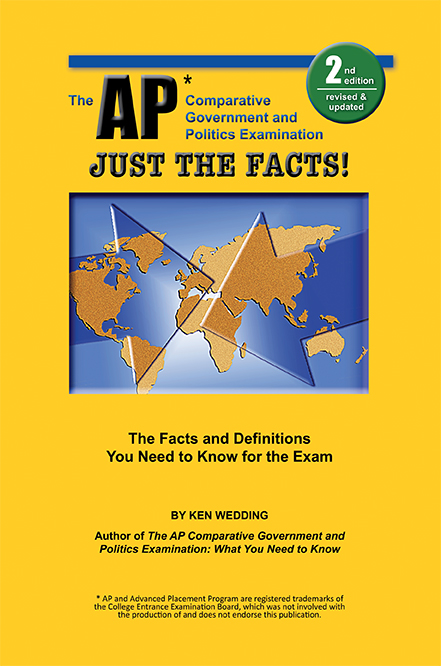 Just The Facts! 2nd edition is a concise guide to concepts, terminology, and examples that will appear on May's exam.


