It's never easy to extend one set of statistics to a whole political system, but they often offer glimpses of the system. IF you can "read" the numbers.
Vladimir Putin has dominated Russian politics as its undisputed leader for almost two decades.
Over successive terms as president and prime minister he has overseen an economic boom, military expansion and the re-establishment of Russia as a major power.
Living standards for most Russians improved, and a renewed sense of stability and national pride emerged. But the price, many say, was the erosion of Russia's fledgling democracy.
How has life changed for ordinary Russians during this time?
1. Fewer people are poor
Levels of poverty may be significantly lower than before, but Russia is still above the average for many of the world's biggest economies.
2. But wage growth has stalled recently
During Mr Putin's first stint as president, wages consistently grew by over 10% annually. Since returning to office in 2012, following a period as prime minister, significant growth has proved more elusive, with a series of crises and economic sanctions…
3. More people have a car, and there are more microwaves than households
Russia's enduring love affair with the Lada continues, with Ladas accounting for 311,588 of the total 1,595,737 new cars sold in 2017…
4. Russians fell in love with Ikea
Russia got its first store in 2000, as part of a MEGA branded shopping centre in Khimki, near Moscow. It went straight into Ikea's top 10 grossing stores worldwide.
By 2015, the country was the flat pack empire's second fastest growing market…
5. And champagne...
There's some dispute over how much Russians drink.
Official figures show a drop, but not the 80% claimed by the health minister…
6. Like everywhere, the internet took off
The Russian internet has its own giants - the top site is social media platform VK (aka VKontakte) with around 90 million users compared to Facebook's 20 million, according to World Bank analysis.
Search engine Yandex occupies the second slot. Being built on Russian language and algorithms gives it a competitive advantage over Google.
7. But circuses are in decline
With more than 60 permanent venues across Russia circuses, like the Moscow State Circus, are a national institution. But they have faced strong competition from, and defections to, western rivals such as Cirque du Soleil…
8. And so are public libraries
Much like everywhere else, the humble library has declined as access to the web has exploded…
9. Russia's population is growing again
One of President Putin's big goals is to turn around the dramatic population decline which began around the time of the ending of communism in 1991…
10. And Putin is spending more than ever on the military
A strong military has always been a key part of Russia's national identity, but the Soviet Union effectively bankrupted itself in an effort to match the United States during the Cold War…
Vladimir Putin gave early intent to reverse this decline and rebuild Russia as a modern military force…
Teaching Comparative blog entries are indexed. Use the search box to look for country names or concept labels attached to each entry.
Just The Facts! 2nd editionis a concise guide to concepts, terminology, and examples that will appear on May's exam.
Gapminder World has long been one of my favorite resources for teaching about specific topics. I never fail to learn something from it.
Hans Rosling, creator of Gapminder
The dynamic charts you can produce with Gapminder are wonderful and wonderous.
There are hundreds of factors (environmental, health, energy, education… ) that you can choose to display on the Gapminder World graph and look for relationships between the factors.
Countries are displayed on the graph by circles whose size is dependent upon population and whose color is determined by location. You can choose to display all countries or just selected ones.
You can choose to see comparisons for nearly any year in the past two centuries (or more in some cases).
If you or your students have the hardware, set them to work evaluating hypotheses they make or describing changing relationships over time.
Many Gapminder demonstrations are available at YouTube as well.
A fact-based worldview starts with getting the big picture right. Each of these videos answer a common fact-question about global proportions and macro trends, in less than 90 seconds. We've left out any distracting details in order to make the big picture as clear as possible and easy to remember. Enjoy!
How Did The World Population Change?
How Did Babies per Woman Change in the World?
How Reliable is the World Population Forecast?
How Did Babies per Woman Change in Different Regions?
How Does Income Relate to Life Expectancy?
Will Saving Poor Children Lead to Overpopulation?
How Can the World Population Forecasts Be So Good?
How Many are Rich and How Many are Poor?
What Makes the World Population Continue to Grow?
Where Do People Live?
The Rapid Growth of the World Population, When Will it Slow Down?
Teaching Comparative blog entries are indexed. Use the search box to look for country names or concept labels attached to each entry.
The Comparative Government and Politics Review Checklist.
Two pages summarizing the course requirements to help you review and study for the final and for the big exam in May. It contains a description of comparative methods, a list of commonly used theories, a list of vital concepts, thumbnail descriptions of the AP6, and
a description of the AP exam format. $2.00. Order HERE.
Just The Facts! 2nd editionis a concise guide to concepts, terminology, and examples that will appear on May's exam.
If you have forgotten about Gapminder or not yet learned of it, now's a great time to poke around in the Gapminder universe. There is great material here for comparative politics students as well as for students of history.
The most wonderful thing about Gapminder is its flexibility. Teachers can use it to prepare materials for presentation. Students can use it to test hypotheses or teach each other about a huge variety of ideas.
There are dozens of statistical indicators that can be used to create comparisons between and among nations over the last 200 years. It's possible to select which countries to compare. (Want to limit the comparisons to the AP6 in Comparative Government and Politics?)
You can download or subscribe to the Factpods here.
Factpods are 1 to 7 minute podcasts by Hans Rosling. The most recent of them are about the fight against Ebola since Rosling has been working in Liberia since last September.
Teaching Comparative blog entries are indexed. Use the search box to look for country names or concept labels attached to each entry.
Want to teach about correlation, frequency distributions, sampling, standard error, and/or variance? Want to use interpretive dance? The British Psychological Society has produced four short (< 5 minutes) videos that dramatically illustrate these concepts.
And thanks to Maggie Koreth-Baker for posting a link to them on BoingBoing.
If you're the type of person who really needs some good visuals to make a concept stick in your head, this series of YouTube videos made by the British Psychological Society Media Centre will help you remember the meanings behind statistical concepts like "correlation", "frequency distributions", and "sampling error"…
Teaching (and learning) comparative government and politics is a complex and demanding task. We can all use all the help we can get. This cyber place is somewhere to facilitate helpful interactions.

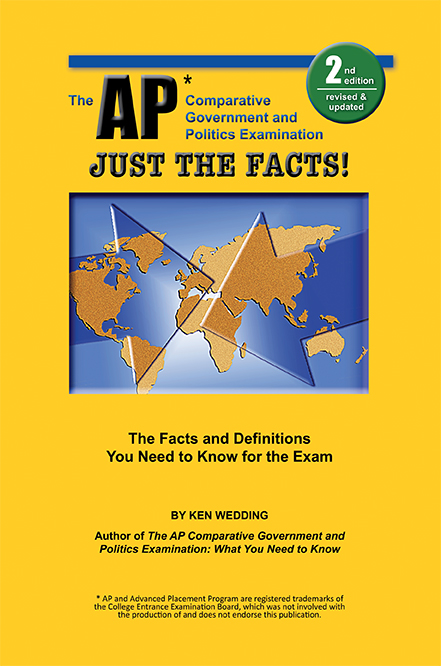 Just The Facts! 2nd edition is a concise guide to concepts, terminology, and examples that will appear on May's exam.


