This morning I read Kevin James' blog, "AHS Comparative Government.," from Albany (CA) high school. It's something I do several times a week.
His blog is useful to me because he often finds articles I've missed or he understands things I don't.
If you're looking for articles that might be useful for your comparative government and politics course, make a habit of looking at "AHS Comparative Government."
Seven years ago, Mr. Frank Franz, who teaches in Virginia offered a list of great suggestions that will help you write better responses to FRQs.
I posted them then and every year since.
I think these ideas are excellent. The only thing I’d add to the list would be to paraphrase the question as an introduction to your response. In the last few years some rubrics have insisted that responses have introductions that label what is being discussed.
Here's what Mr. Franz wrote:
Here's the strategy I place on every FRQ I give my students. I believe it helps them focus on the questions and will help them earn as high of a score as possible. Some of these ideas are my own and some are from colleagues who have served as readers and table leaders.
Free Response Strategy
Mark-up the question on the question sheet.
Count up how many points you are trying to earn. (Look for number references, count the verbs)
Write as many sentences as there are points.
Write simple, declarative sentences.
Answer the question asked. Nothing else.
Answer every part of the question.
Look for time references, patterns, and passage of time.
I doubt we'd get unanimity about these ratings, but I think the following are generally good. Students should get used to evaluating the biases of sources and this list is a good beginning. Perhaps you could assign students to evaluate the ratings.
Media Bias/Fact Check (MBFC News) is an independent online media outlet. MBFC News is dedicated to educating the public on media bias and deceptive news practices.
MBFC News’ aim is to inspire action and a rejection of overtly biased media. We want to return to an era of straight forward news reporting.
Funding for MBFC News comes from site advertising, individual donors, and the pockets of our bias checkers.
MBFC News follows a strict methodology for determining the biases of sources…
The sources that are evaluated are sorted into eight categories:
Left Bias
Left-Center Bias
Least Biased
Right-Center Bias
Right Bias
Pro-Science
Conspiracy-Pseudoscience
Satire/Fake News
The first five on the "Left Bias" list are Addicting Info, Advocate, All That’s Fab, Alternet, and Amandla.
The first five on the "Left-Center Bias" are ABC News, Al Jazeera, Al Monitor, Alan Guttmacher Institute, and Alaska Dispatch News.
The first five on the "Least Biased" list are ABC News Australia, AFP (Agence France Presse), Ahram Online, Al Arabiya, and Al Majalla.
The first five on the "Right-Center Bias" list are Against Crony Capitalism, American Action Forum, American Council on Science and Health, American Foreign Policy Council, and Arab News.
The first five on the "Right Bias" list are 100 Percent Fed Up, Accuracy in Media (AIM), Allen B. West, Allen West Republic, and American Enterprise Institute.
The first five on "Pro-Science" list are Air & Space Magazine, American Association for the Advancement of Science (AAAS), American Journal of Archaeology, Archaeology Magazine, and Ars Technica.
The first five on the "Conspiracy-Pseudoscience" list are 21st Century Wire, 369News, A Sheep No More, ACN Latitudes, and Activist Post.
The first five on the "Satire/Fake News" list are 70 News, AbcNews.com.co, Amplifying Glass, Atomic Monkey, and Borowitz Report.
Hopefully there's lots of critical thinking ahead.
Teaching Comparative blog entries are indexed. Use the search box to look for country names or concept labels attached to each entry.
The Comparative Government and Politics Review Checklist.
Two pages summarizing the course requirements to help you review and study for the final and for the big exam in May. . It contains a description of comparative methods, a list of commonly used theories, a list of vital concepts, thumbnail descriptions of the AP6, and
a description of the AP exam format. $2.00. Order HERE.
I have heard that some people have begun classes already. In my homeland, starting classes before the state fair is over is nearly unheard of. As a matter of fact it's illegal without special dispensation from the Department of Education Commissioner.
Well, my habit is based on experience since 1950, so I'm not ready to abandon summer vacation yet. I suspect it will be over three weeks before I try to get back on a regular schedule with these blog posts. (I do have to spend some time meditating on Gitchee Gumee.
But there's hope.
I have over the years posted nearly 3,900 items here. Yes, some of them are out of date and irrelevant. Most are not.
I have been dutiful about adding labels to the blog posts, so you can search them. For instance if you want to see which posts deal with an introductory concept like regime, search for it and see if there's a post relevant to your introduction. Or send your students off to search and then explain why they chose the item they identified as relevant.
Stay tuned! Translations and more to come later this year.
Please help make the tools even better! The new tools are not fully polished yet, so check them out at gapminder.org/tools and give us feedback at info@gapminder.org.
All comments are most welcomed.
Teaching Comparative blog entries are indexed. Use the search box to look for country names or concept labels attached to each entry.
Amazon's customers gave this book a 5-star rating.
The Comparative Government and Politics Review Checklist.
Two pages summarizing the course requirements to help you review and study for the final and for the big exam in May. . It contains a description of comparative methods, a list of commonly used theories, a list of vital concepts, thumbnail descriptions of the AP6, and
a description of the AP exam format. $2.00. Order HERE.
Six years ago, Mr. Frank Franz, who teaches in Virginia offered a list of great suggestions that will help you write better responses to FRQs.
I posted them then, five years ago, four years ago, three years ago, two years ago, last year, and here they are once again.
I think these ideas are excellent. The only thing I’d add to the list would be to paraphrase the question as an introduction. In the last few years some rubrics have insisted that responses have introductions that label what is being discussed.
Here's what Mr. Franz wrote:
Here's the strategy I place on every FRQ I give my students. I believe it helps them focus on the questions and will help them earn as high of a score as possible. Some of these ideas are my own and some are from colleagues who have served as readers and table leaders.
Free Response Strategy
• Mark-up the question on the question sheet.
• Count up how many points you are trying to earn. (Look for number references, count the verbs)
• Write as many sentences as there are points.
• Write simple, declarative sentences.
• Answer the question asked. Nothing else.
• Answer every part of the question.
• Look for time references, patterns, and passage of time.
• Do not argue with the premise of the prompt.
• Skip a line between parts, but do not label.
Some people have been asking about teaching plans.
Ten years ago I wrote 40 teaching plans for The Center for Learning. I was paid for the work back then and I do not earn royalties from sales. All the lessons require student activity, there are no lecture notes. But, following the Center for Leaning's outline, each lesson includes objectives, "Notes to the Teacher," procedural instructions, and a rubric. Lessons include handouts that can be duplicated (or you can buy a separate volume of handouts).
Some things are undoubtedly outdated (especially statistics), but most of those can be pretty easily updated (even by your students). You can purchase this book directly from The Center for Learning or from Social Studies School Service.
Now, somebody out there is ambitious and creative enough to redo, revise and/or update this collection of teaching plans. Maybe you can organize a team of readers from your table in June to share the work. The Center for Learning concentrates these days on producing on-line lessons. If you're a classroom teacher and interested in this project, contact The Center for Learning. E-mail to access@centerforlearning.org
Table of Contents (click to enlarge)
Teaching Comparative blog entries are indexed. Use the search box to look for country names or concept labels attached to each entry.
Amazon's customers gave this book a 5-star rating.
The Comparative Government and Politics Review Checklist.
Two pages summarizing the course requirements to help you review and study for the final and for the big exam in May. . It contains a description of comparative methods, a list of commonly used theories, a list of vital concepts, thumbnail descriptions of the AP6, and
a description of the AP exam format. $2.00. Order HERE.
Daniel Aaron Lazar and I started our blogs in 2006. He teaches at the John F. Kennedy School in Berlin.
Lazar's blog is worth looking at because, as you should suspect, his perspectives are different from mine. Look at his blog and the recent entries. I think you'll find ideas and resources that are valuable.
Note that he blogs about all the courses he teaches, not just Comparative Government and Politics.
This is a forum to post articles and to share ideas about my historical and political interests. I hope to provide a valuable resource for my students and to contribute to the marketplace of ideas.
So much worse than Auschwitz
Nuremberg Trial Bore Witness to the Nazis’ Worst Crimes
Boko Haram Ranked Ahead of ISIS for Deadliest Terror Group
Lecture – The One China Myth: Xinjiang, Tibet, and Hong Kong
Iranians Reclaim Public Spaces and Liberties
Lecture: The Enlightenment: Constructing a New Paradigm of Man and Society
Election 2015 – Why The Conservatives Won
“Death to America,” Explained (by Ayatollah Ali Khamenei)
Another blog I've recommended before is Kevin James' blog from Albany High School in California. He started his a couple years after I started mine and we rely on many similar sources. But we don't choose the same contents. Check it out as well.
Nigeria, a country of pain, promise and complexity
Can Nigeria’s booming economy lift its poorest people?
How a cancer of corruption steals Nigerian oil, weapons and lives
Gay Nigerians face beatings, harsh prison sentences, even death
The Way to Incorporate Technology in the Classroom
The GAO, Interest Groups and Gun Control
NY Regents DBQs
Flipping and Grouping to a Better Learning Enviornment
Teaching Comparative blog entries are indexed. Use the search box to look for country names or concept labels attached to each entry.
The Comparative Government and Politics Review Checklist.
Two pages summarizing the course requirements to help you review and study for the final and for the big exam in May. . It contains a description of comparative methods, a list of commonly used theories, a list of vital concepts, thumbnail descriptions of the AP6, and
a description of the AP exam format. $2.00. Order HERE.
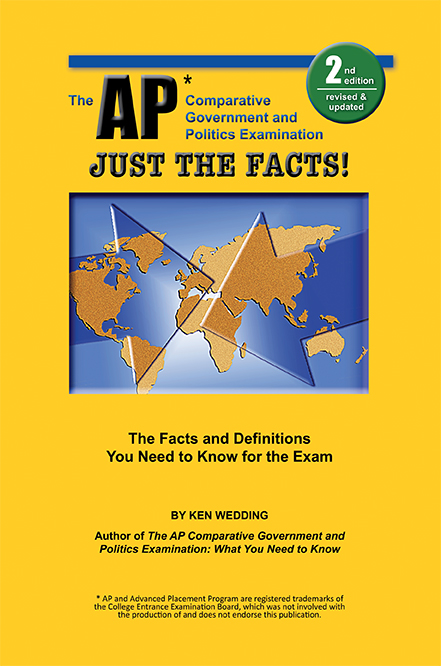
Just The Facts! 2nd editionis a concise guide to concepts, terminology, and examples that will appear on May's exam.
Ken Halla has found more good material for comparative gov/pol and posted the link on his US Government Teachers Blog.
This time he posted a link to a good three-minute video titled, "Why does Iran hate the US?" This is a bit marginal for the comparative course, but it does help explain a lot about the motivations of political actors in Iran.
The real prize here is TestTube. It's an offshoot of cable TV's "Discovery Digital Networks." TestTube produces a short video each day on topics of current interest.
For instance, I found one titled, "How Powerful is Nigeria?" The Nigeria production is pretty superficial and only a beginning point for a comparative study of the country. But, what can you expect from a 3-minute news item? This report on Nigeria comes from AJ+, a producer of digital content from Al Jazeera America television.
Check these out. Subscribe and get updates. Evaluate and let us know what you find. Assign students to check the library of videos and report on the contents.
The U.S. and Iran have a long history of aggression and deceit, but both countries desire to take down ISIS in Iraq and Syria. Can they mend their strained relationship to team up and defeat ISIS? To find out, we take a deeper look into the origins of their tension and distrust.
Nigeria is expected to surpass the population of the US sometime before the year 2050 - which would put them third in the world behind India and China. Experts expect to see major economic growth during this time. So, how powerful is Nigeria?
Teaching Comparative blog entries are indexed. Use the search box to look for country names or concept labels attached to each entry.
Not only does Ken Halla post things about Comparative Gov Pol on his US Gov't Teachers blog, he posts things about the art and science of teaching. Here's a link the latest. Cause for thought and discussion.
[T]he doctor who helped bring my son Grant into the world had only delivered ten kids prior to us... Lawyers who can't win for their clients the first time, can appeal and law makers often have to try year after year to get their bills or amendments through. But as a father of two middle schoolers, I see how motivated students can be and how much they (my girls) want to improve their scores if they didn't do well enough the first time.
I have been transitioning... the last few years to mastery teaching.
I think mastery teaching has also been possible as I work more one on one with each of my kids than I have ever had time to do before...
Ken Halla keeps sneaking Comparative Gov Pol things into his US Government Teachers Blog. (And I try to repost them to a wider audience. Summary/review sheets like this are great tools. I recommend using them in my What You Need to Know book.)
"I credit the assignment with [being] one of the reasons why my kids had some great scores last year...
"[W]e watch our flipped videos and discuss them. For my discussion I use the Socratic method and do it in a comparative sense so that the kids are constantly referring back to previous countries we have done. If you look at the AP Comparative multiple choice and FRQs this is what they do, so it is a good idea to constantly do it in class.
"We also constantly refer back to US government so they do not forget that material as well."
Ken Halla has found more good material for comparative gov/pol and posted the link on his US Government Teachers Blog.
This time he posted a link to a good three-minute video titled, "Why does Iran hate the US?" This is a bit marginal for the comparative course, but it does help explain a lot about the motivations of political actors in Iran.
The real prize here is TestTube. It's an offshoot of cable TV's "Discovery Digital Networks." TestTube produces a short video each day on topics of current interest.
For instance, I found one titled, "How Powerful is Nigeria?" The Nigeria production is pretty superficial and only a beginning point for a comparative study of the country. But, what can you expect from a 3-minute news item? This report on Nigeria comes from AJ+, a producer of digital content from Al Jazeera America television.
Check these out. Subscribe and get updates. Evaluate and let us know what you find. Assign students to check the library of videos and report on the contents.
The U.S. and Iran have a long history of aggression and deceit, but both countries desire to take down ISIS in Iraq and Syria. Can they mend their strained relationship to team up and defeat ISIS? To find out, we take a deeper look into the origins of their tension and distrust.
Nigeria is expected to surpass the population of the US sometime before the year 2050 - which would put them third in the world behind India and China. Experts expect to see major economic growth during this time. So, how powerful is Nigeria?
Teaching Comparative blog entries are indexed. Use the search box to look for country names or concept labels attached to each entry.
If you have forgotten about Gapminder or not yet learned of it, now's a great time to poke around in the Gapminder universe. There is great material here for comparative politics students as well as for students of history.
The most wonderful thing about Gapminder is its flexibility. Teachers can use it to prepare materials for presentation. Students can use it to test hypotheses or teach each other about a huge variety of ideas.
There are dozens of statistical indicators that can be used to create comparisons between and among nations over the last 200 years. It's possible to select which countries to compare. (Want to limit the comparisons to the AP6 in Comparative Government and Politics?)
You can download or subscribe to the Factpods here.
Factpods are 1 to 7 minute podcasts by Hans Rosling. The most recent of them are about the fight against Ebola since Rosling has been working in Liberia since last September.
Teaching Comparative blog entries are indexed. Use the search box to look for country names or concept labels attached to each entry.
One of the things I noticed about Lawrence Stroud's lectures was something that I, and nearly all of us do: we read the visual that's on the screen.
After all, we've done the research, organized the content, and now want to present it in an understandable and coherent way. We've put words together and tried to ensure we haven't left anything out.
But if you're in the audience of someone who reads words off the visual to you, it's difficult to simultaneously read the words and hear what's being said. And sometimes it's hard to stay awake.(I advocate handing out the visuals before the presentation so students can take notes on the handouts.)
All right, you say. None of those things takes into account the demands and circumstances of the classroom and an Advanced Placement curriculum.
I agree. You have to "monitor and adjust," as my colleague Ken MacDonald used to chant. You have to adapt to your schedule, your population, your school culture, and your abilities.
But it's really worth thinking about. As the Weinot Films presentation points out, planning and thinking through this kind of presentation takes time and effort. But the results are often amazing.
Don't read your visuals. Don't complicate your presentations. Don't make them very long (even if you have a block). If you class is longer than 20 minutes, plan several 20 minute activities.
Teaching Comparative blog entries are indexed. Use the search box to look for country names or concept labels attached to each entry.
Ken Halla, on his confusingly named usgovteducatorsblog recently posted links to the "flipped" AP Comparative GovPol lectures of one of his colleagues, Larry Stroud. There are 10 of Larry Stroud's lectures for comparative plus about a dozen for US GovPol.
Thanks to Ken Halla for pointing to Allan Carrington's elaboration on Bloom's Taxonomy and his suggestions for how to achieve things defined by Bloom. Carrington is associated with The University of Adelaide.
I have pointed to Bloom's taxonomy before as a guide to designing teaching methods and materials. It's great to aim for those higher levels, especially in an AP course. I've also noted that AP testing only rarely asks students to go beyond Bloom's second cognitive domain. That doesn't mean you can't set expectations beyond application to analysis, evaluation, and creation.
That wheel was produced by Sharon Artley and was an adaption of Kathwohl and Anderson’s (2001) adaption of Bloom (1956). The idea to further adapt it for the pedagogy possibilities with
mobile devices, in particular the iPad, I have to acknowledge the creative work of Kathy Schrock on her website
Bloomin’ Apps.
Teaching (and learning) comparative government and politics is a complex and demanding task. We can all use all the help we can get. This cyber place is somewhere to facilitate helpful interactions.