Gapminder World has long been one of my favorite resources for teaching about specific topics. I never fail to learn something from it.
Hans Rosling, creator of Gapminder
The dynamic charts you can produce with Gapminder are wonderful and wonderous.
There are hundreds of factors (environmental, health, energy, education… ) that you can choose to display on the Gapminder World graph and look for relationships between the factors.
Countries are displayed on the graph by circles whose size is dependent upon population and whose color is determined by location. You can choose to display all countries or just selected ones.
You can choose to see comparisons for nearly any year in the past two centuries (or more in some cases).
If you or your students have the hardware, set them to work evaluating hypotheses they make or describing changing relationships over time.
Many Gapminder demonstrations are available at YouTube as well.
A fact-based worldview starts with getting the big picture right. Each of these videos answer a common fact-question about global proportions and macro trends, in less than 90 seconds. We've left out any distracting details in order to make the big picture as clear as possible and easy to remember. Enjoy!
How Did The World Population Change?
How Did Babies per Woman Change in the World?
How Reliable is the World Population Forecast?
How Did Babies per Woman Change in Different Regions?
How Does Income Relate to Life Expectancy?
Will Saving Poor Children Lead to Overpopulation?
How Can the World Population Forecasts Be So Good?
How Many are Rich and How Many are Poor?
What Makes the World Population Continue to Grow?
Where Do People Live?
The Rapid Growth of the World Population, When Will it Slow Down?
Teaching Comparative blog entries are indexed. Use the search box to look for country names or concept labels attached to each entry.
The Comparative Government and Politics Review Checklist.
Two pages summarizing the course requirements to help you review and study for the final and for the big exam in May. It contains a description of comparative methods, a list of commonly used theories, a list of vital concepts, thumbnail descriptions of the AP6, and
a description of the AP exam format. $2.00. Order HERE.
Just The Facts! 2nd editionis a concise guide to concepts, terminology, and examples that will appear on May's exam.
Teaching Comparative blog entries are indexed. Use the search box to look for country names or concept labels attached to each entry.
The Comparative Government and Politics Review Checklist.
Two digital pages summarizing the course requirements to help you review and study for the final and for the big exam in May. It contains a description of comparative methods, a list of commonly used theories, a list of vital concepts, thumbnail descriptions of the AP6, and
a description of the AP exam format. E-mailed to you. $2.00. Order HERE.
Just The Facts! 2nd editionis a concise guide to concepts, terminology, and examples that will appear on May's exam.
The Monkey Cage, a blog I've read for years, recently was adopted by The Washington Post. This recent post offers a source for creating some wonderful activities for comparing constitutions.
And as a follow-up to constitutional comparisons, students should find out how closely the regimes actually follow their constitutions.
A very neat new Web site — Constitute — allows you to search the constitutions of almost all the independent states in the world, with more constitutions on the way. You can find search by country and by topic. Interested in which constitutions have provisions for the right to bear arms? Or gender equality? Or free speech? You can look for it.
The Web site… was seeded with a grant from Google Ideas…
If you pick a few trenchant paragraphs out of this essay, you can instigate a good discussion. The discussion might be one of those that recurs over the course of the semester.
Is the discussion about comparative politics? That's one of the topics. You might guess from my choice to post this that I think it is.
The essay is by Adam Etinson, a Mellon Postdoctoral Fellow at The Graduate Center of the City University of New York.
In August of 1563, Michel de Montaigne… was introduced to three Brazilian cannibals who were visiting Rouen, France… The three men had never before left Brazil… Despite this, they still had enough poise to lucidly respond to Montaigne’s questions about what they thought of their new surroundings.
The observations shared by the native Brazilians have a certain comical quality. Because they looked on French society with such fresh eyes, their observations make the familiar seem absurd. But they are also morally revealing… [T]he Brazilians were shocked by the severe inequality of French citizens, commenting on how some men “were gorged to the full with things of every sort” while others “were beggars at their doors, emaciated with hunger and poverty.”…
Montaigne makes the… provocative claim that, as barbaric as these Brazilian cannibals may be, they are not nearly as barbaric as 16th-century Europeans themselves. To make his case, Montaigne cites various evidence [including] the fact that some European forms of punishment — which involved feeding people to dogs and pigs while they were still alive — were decidedly more horrendous than the native Brazilian practice of eating one’s enemies after they are dead…
Montaigne most certainly wasn’t the first to make note of our tendency to automatically assume the superiority of local beliefs and practices; Herodotus, the Greek historian of the fifth century B.C., made very similar observations in his Histories, noting how all peoples are “accustomed to regard their own customs as by far the best.”…
Philosophers have responded to the pervasive influence of culture on our moral beliefs in various ways. Many have embraced some form of skepticism… John L. Mackie (1917-81) famously cited ethnocentrism as evidence that there are no objective moral facts, or at least none that we can access…
Many have argued, for instance, that the influence of culture on our moral beliefs is evidence… of moral relativism: the idea that the moral truth, for any given people, is determined by their culture… We know from various sources, including Plato’s dialogues, that some Ancient Greeks defended such a view…
[H]owever obvious it may be that culture plays an important role in our moral education, it is nevertheless very hard to prove that our moral beliefs are entirely determined by our culture… For it’s not at all clear why the influence of culture on our moral beliefs should be taken as evidence that cultures influence the moral truth itself…
J. S. Mill
Most important of all is the fact that there are other, more straightforward, and less overtly skeptical, ways of responding to ethnocentrism. Chief among these, in my view, is the simple but humbling acknowledgment that ethnocentrism is a danger that confronts us all, but not one that should disillusion us from the pursuit of truth altogether. This is the sort of response to ethnocentrism one finds, for instance, in the work of the 19th-century English philosopher John Stuart Mill… The fact that our deepest-held beliefs would be different had we been born elsewhere on the planet (or even, sometimes, to different parents farther down the street), should disconcert us, make us more open to the likelihood of our own error, and spur us to rigorously evaluate our beliefs and practices against alternatives, but it need not disillusion…
Several years ago, I pointed out some ideas from Jeffrey Sachs. These involve self-fulfilling prophecies. I suggested then and do again that these ideas can be the basis for research by students. Iran seems the most likely subject, but I can imagine using Russia, Mexico, Nigeria, China, or even the UK (although examples there would probably be more subtle).
Jeffrey D. Sachs is the Director of The Earth Institute, a professor at Columbia University, Director of the UN Millennium Project, Special Advisor to United Nations Secretary-General on the Millennium Development Goals. Sachs is also President and Co-Founder of Millennium Promise Alliance, a nonprofit organization aimed at ending extreme global poverty…
In… Scientific American, Sachs wrote a little op-ed piece. It contains some interesting hypotheses that students could evaluate by doing some research on case studies…
For nations in a deep crisis, the greatest danger is a self-fulfilling prophecy of disaster...
When the public thinks that a newly elected national government will succeed, local leaders throw their support behind it. Expectations of the government's longevity rise. Individuals and companies become much more likely to pay their taxes, because they assume that the government will have the police power to enforce the tax laws.
A virtuous circle is created…
When the public believes that a government will fail, the same process runs in reverse. Pessimism splinters political forces. Tax payments and budget revenues wane. The police and other public officials go unpaid. The currency weakens. Banks face a withdrawal of deposits and the risk of banking panics. Disaster feeds more pessimism…
When we study "others," it matters that we have accurate perceptions of "them." This article suggests that most of us in the USA might have to update our perceptions of Mexico.
Thanks to Rebecca Small, who teaches in Virginia, for directing me to this article.
When the governor of Colorado came to Mexico on a trade mission this year to see the sights, “one of the most amazing” was a Costco…
The growing middle class that is fast becoming Mexico’s majority is buying more U.S. goods than ever, while turning Mexico into a more democratic, dynamic and prosperous American ally.
“We are obsessed with China when we ought to seriously focus, for our own benefit, on our neighbor Mexico,” said Robert Pastor, a professor of international relations at American University and author of “The North American Idea.”…
In a Costco store in the suburbs at the edge of Mexico City, shoppers browse shelves loaded with pallets of Kirkland vitamins, value packs of Nature Valley granola bars and sacks of Cape Cod kettle-cooked potato chips…
“Costco members here in Mexico are middle class, even upper middle class,” [Iñigo Astier, the executive in charge of purchasing for Costco’s Mexico operations] said. “As our economy grows, consumers are looking for quality products, and Costco is consistent in quality.”…
Emergence of the middle class in Mexico 2011
This video was distributed by Ogilvy Public Relations on behalf of the Ministry of Tourism of the Government of Mexico. Additional information is on file with the Department of Justice, Washington, DC.
(Sorry about the advertisement at the beginning.) Teaching Comparative blog entries are indexed.
The First Edition ofWhat You Need to Know: Teaching Toolsis now available from the publisher The Fourth Edition ofWhat You Need to Knowis available from the publisher (where shipping is always FREE).
William Wan and Liu Liu venture into comparative politics and political culture while discussing the upcoming leadership transition in China in the Washington Post.
Can your students identify the evidence used by the reporters for their assumptions and comparisons? Are the comparisons persuasive? What standards did they use in making those evaluations? (There are more comparisons made in the complete article.)
With China facing a worsening economy, its biggest political crisis in two decades, and growing public anger and domestic unrest, what do people here say about the seismic change about to take place in the country’s top leadership?
“Wu suo wei.” It doesn’t matter.
Exercises in the park
You hear this from old men exercising in the park, from young professionals heading home from work and even, in hushed tones, from lower-ranking members of the Communist Party.
On one level, they’re probably right. The leadership change is unlikely to have an immediate effect on the majority of China’s 1.3 billion people. Neither will the masses have any say in the Communist Party’s mysterious selection of the nine-member Politburo Standing Committee that rules China.
The process is so cloaked in secrecy that no one knows for sure who’s in the running besides the top two officials set to replace President Hu Jintao and Premier Wen Jiabao…
But on another level, the leadership change will affect everything and everyone, and in many ways already has. Preparations for the 18th Party Congress have forced most of the government into gridlock for the past year, as though the entire system were holding its breath in anticipation. Major reforms and new laws have been stymied. No real solutions have been prescribed for the economy’s systemic problems even amid a worrying slowdown…
The indifference is something the government has at times nurtured. For years, the party — looking to preserve its lock on power — has pushed the idea that an uneventful, smooth transition was not only expected, but inevitable.
And while American children are taught basic civics and the importance of elections from grade school, the real method by which China’s top leaders are chosen is unknown to anyone but the leaders themselves. Many experts, in fact, think the new lineup was decided at a meeting of party elites at a luxury costal resort early last month.
Similarly, while nearly all aspects of the American candidates’ lives have been thoroughly explored in the course of the U.S. presidential campaign, most Chinese know little about China’s leading contenders beyond their official hagiographies…
“We are walking down a road filled with serious problems,” said one 82-year-old retired party member exercising on a recent day at a downtown park. “So, of course, the direction of the country is important and depends on the upcoming meeting. But these are not things for ordinary citizens to know, so what’s there to talk about?”
Simple minded folk like me have always blithely assumed that progressive taxation made for a more egalitarian distribution of income. I guess I am learning the dangers of simple mindedness.
Lucy Barnes, who is a postdoctoral fellow at Nuffield College, Oxford, offers some data to demonstrate the dangers of "common sense."
So, what are the facts about tax progressivity? The most comprehensive scholarly work on this question to date comes from sociologists, Monica Prasad and YingYing Deng, who use data on individual incomes to calculate total tax burdens at different levels of the income distribution. [There is a link to a PDF version of the paper in the Monkey Cage blog report.] Their main takeaway finding is illustrated in the two figures below, which show the Kakwani index of taxation (a measure of the progressivity of the system that parses out the impact of income concentration on the concentration of the tax burden) for a number of advanced democracies.
These data are from the most recent year available (around 2000 in most cases). The… figure shows those taxes that are paid directly by individuals: income, wealth, property and employee social security contributions…
[There's a second chart in the blog adding the effects of consumption (sales and VATs) taxes to the progressively.]
This claim, that the American tax system is progressive compared to those of its advanced economy peer countries, is hard for many (in both the US and in Europe) to accept. The conventional wisdom is that the United States intervenes comparatively little in redistributing income from rich to poor. It is not that these stylized facts are untrue: the figure below shows the reduction in inequality accomplished by government intervention (again using data from the Luxembourg income study)—both taxes and transfers.
Here the United States takes up its more accustomed place at the bottom of the pack (and it is data like these that have been used in the recent debate to refute the claim that US taxes are progressive). How is it possible that American taxes be progressive, while achieving so little redistribution?…
Things change, but not the US Constitution (very often)
The U.S. Constitution gets less respect, globally, now than in the past. If the U.S. model is no longer as popular as it once was, what are the models countries are following as the write new basic laws or modify the old ones (on average, once every 19 years)?
[Thanks to former student Kyle Potter for pointing this article out to me.]
Sure, it is the nation’s founding document and sacred text. And it is the oldest written national constitution still in force anywhere in the world. But its influence is waning.
In 1987, on the Constitution’s bicentennial, Time magazine calculated that “of the 170 countries that exist today, more than 160 have written charters modeled directly or indirectly on the U.S. version.”
A quarter-century later, the picture looks very different. “The U.S. Constitution appears to be losing its appeal as a model for constitutional drafters elsewhere,” according to a new study by David S. Law of Washington University in St. Louis and Mila Versteeg of the University of Virginia…
“Among the world’s democracies,” Professors Law and Versteeg concluded, “constitutional similarity to the United States has clearly gone into free fall…
“The turn of the twenty-first century… saw the beginning of a steep plunge that continues through the most recent years for which we have data, to the point that the constitutions of the world’s democracies are, on average, less similar to the U.S. Constitution now than they were at the end of World War II.”
There are lots of possible reasons. The United States Constitution is terse and old, and it guarantees relatively few rights. The commitment of some members of the Supreme Court to interpreting the Constitution according to its original meaning in the 18th century may send the signal that it is of little current use to, say, a new African nation…
The rights guaranteed by the American Constitution are parsimonious by international standards, and they are frozen in amber. As Sanford Levinson wrote in 2006 in “Our Undemocratic Constitution,” “the U.S. Constitution is the most difficult to amend of any constitution currently existing in the world today.”…
Andrew J. Orzel who teaches in Alexandria, VA, posted a link to this Pew Research Center poll on the College Board discussion list. The poll results might be a way of opening discussion about comparative government and politics. There are many bits of data and implications for politics and policies. It would be preferable to have greater diversity in the countries considered, but this task is huge already.
There is a good section on the polling methodology and it's possible to download a PDF version of the full report.
As has long been the case, American values differ from those of Western Europeans in many important ways. Most notably, Americans are more individualistic and are less supportive of a strong safety net than are the publics of Britain, France, Germany and Spain. Americans are also considerably more religious than Western Europeans…
These differences between Americans and Western Europeans echo findings from previous surveys conducted by the Pew Research Center. However, the current polling shows the American public is coming closer to Europeans in not seeing their culture as superior to that of other nations…
These are among the findings from a survey by the Pew Research Center’s Global Attitudes Project, conducted in the U.S., Britain, France, Germany and Spain from March 21 to April 14 as part of the broader 23-nation poll in spring 2011…
Henry Farrell, one of the main contributors to The Monkey Cage blog, announced that "Scott Page at University of Michigan is offering a free graded course on ‘thinking with models.’" The topic is relevant to the study of comparative politics.
We live in a complex world with diverse people, firms, and governments whose behaviors aggregate to produce novel, unexpected phenomena. We see political uprisings, market crashes, and a never ending array of social trends. How do we make sense of it?
Models. Evidence shows that people who think with models consistently outperform those who don't. And, moreover people who think with lots of models outperform people who use only one…
I present a starter kit of models: I start with models of tipping points. I move on to cover models explain the wisdom of crowds, models that show why some countries are rich and some are poor, and models that help unpack the strategic decisions of firm and politicians.
The models cover in this class provide a foundation for future social science classes, whether they be in economics, political science, business, or sociology. Mastering this material will give you a huge leg up in advanced courses. They also help you in life.
Here's how the course will work.
For each model, I present a short, easily digestible overview lecture. Then, I'll dig deeper. I'll go into the technical details of the model. Those technical lectures won't require calculus but be prepared for some algebra. For all the lectures, I'll offer some questions and we'll have quizzes and even a final exam. If you decide to do the deep dive, and take all the quizzes and the exam, you'll receive a certificate of completion. If you just decide to follow along for the introductory lectures to gain some exposure that's fine too.
It's all free.
And it's all here to help make you a better thinker!
Peter Whitehouse, who teaches at The Bolles School in Jacksonville, FL, suggests this blog post by Kusha Sefat, a Doctoral Student in Sociology at Queens’ College, University of Cambridge, as a discussion starter for considering the Occupy Wall Street protests in a comparative context. Sefat has suggestions for the OWS protestors based on his observations about the green protests in Iran. Your students can evaluate them and see if they can come up with suggestions based on other countries' experiences with protests. Get them to pay attention to the context within which the protests occur.
Following the disputed Presidential election in Iran, our Western compatriots gave many suggestions on combating state oppression. Various tactics and strategies were devised for Iranian protesters… It seems that most of those recommendations were ineffective within Iran’s particular social and political context. It may be worth outlining some of the tactics that were in fact useful to Iranian protesters…
Pick a color to represent your movement
Have an all-inclusive strategy
Demonstrate peacefully
Be rigorous
Be creative
Record protests with your mobile phones and send to television stations
Send your footage of acts of violence committed by the police to foreign television broadcasters
Write, “I am 99%” or “OWS” on all dollar bills that you circulate
Do not let politicians co-opt your movement
Write arguments and op-eds that aim at the logic of the system
Melody Dickison sent from Ohio a link to a wonderful web site, If It Were My Home. Created and designed by Andy Lintner and Annette Calabrese, the site offers the opportunity to compare material life in nearly any two countries.
Each comparison comes with a great map showing the two countries' maps overlaying one another. If the US is one of the compared countries, the US map is centered on the location of your Internet connection. That might work in other countries as well, but I'm unable to check it out since my passport has expired. Each of the comparisons offers more details in a drop down option. The source of the data is The CIA World Factbook.
There is also a one-paragraph description of the country you choose to compare to and a list of books to read. And you can join a discussion that doesn't seem very active.
I can imagine creating an activity to use as an introduction to a comparative course. Students would not only learn some basics about the countries they will study but could also speculate about the comparative methodology, the limits of the meaning of the data, and the kinds of comparisons that are impossible with the data offered.
Here's a summary of the comparison between the USA and Mexico as a sample.
The largest urban areas have traffic problems. How do governments deal with those problems? Are the methods keys to recognizing differences between political systems?
The Beijing municipal government said Thursday it will limit 2011 issuance of new car license plates to 240,000 and implement harsh traffic control measures to ease the city's traffic congestion.
… Beijing car buyers will have to draw lots before obtaining a car license plate, said Zhou Zhengyu, deputy secretary-general of the Beijing municipal government…
In 2010, more than 700,000 news cars were sold in Beijing, bringing the city's total number of automobiles to more than 4.7 million, statistics from the Beijing Municipal Commission of Transport (BMCT) show.
According to the city's regulation, a Beijing driver will be permitted to own only one car in his or her name…
After more than 15,000 suggestions about improving Moscow’s traffic problems, City Hall has unveiled some of its jam-busting plans.
And it all boils down to persuading motorists to leave their cars at home and hop on to public transport – even though the city’s network already struggles to carry huge passenger numbers every day.
Mayor Sergei Sobyanin has found 200 billion roubles from the city’s budget which he hopes can transform the metro, bus and overland rail networks – enabling them to carry even more passengers...
An on-going effort to ease the traffic problems will see a move to create off-road car-parking, particularly around suburban metro stations and bus interchanges.
The plan is to encourage drivers from Moscow Region to stop bringing vehicles into the city centre…
Monday: no driving if license plate ends with 5 or 6.
Tuesday: no driving if license plate ends with 7 or 8.
Wednesday: no driving if license plate ends with 3 or 4.
Thursday: no driving if license plate ends with 1 or 2.
Friday: no driving if license plate ends with 9, 0 or a letter.
Saturday and Sunday: All vehicles may be driven.
Lagos has strict traffic regulations but the impunity with which it is flouted is legendary…
To nip the chaotic traffic situation within the metropolis in the bud, the state government established the Lagos State Traffic Management Authority (LASTMA) in July 2000 to regulate, control, and manage traffic operations in the state.
Some city residents, however, argue that though the traffic police succeeded in instilling a level of sanity in Lagos drivers during its first decade of operation, its mode of operation leaves much to be desired…
From here, the chaotic traffic of Tehran is monitored 24 hrs around the clock. Loudspeakers positioned at various points throughout the vast traffic network of Tehran blare out warnings and admonishments to drivers.
I'm often tempted to look at charts and statistics and assume that numbers from one country are comparable to those from other countries. Turns out I probably wasn't paying enough attention when I was studying statistics. Here's an example.
Mexico's recent accounting revision… involves a big jump. After a new methodology was introduced in 2008, official GDP figures were boosted by nearly 15%. In 2007, the latest year for which both old and new indices are available, income per head was equivalent to $9,694 per year, not $8,445 as the old method suggested.
The old methodology was revised in 1993 but drawn up as long ago as 1980, when Mexico’s economy “was like Russia’s: all oil and corruption,” according to Luis de la Calle, an economist. The new formula gives due importance to services and to trade. It adopts the economic classification system shared by the United States and Canada, breaking the economy down into 750 different activities, rather than 362 as before.
But even the new method may underestimate Mexico’s output…
Other official data suggest Mexicans eat about twice as much meat as they did in 1990, and visit the cinema four times as often, while retail square-footage has more than tripled since 1993. These apparent improvements are not reflected in the statistics. “Who do you think is right: the intellectuals, or Wal-Mart?” asks Mr de la Calle.
Mo Ibrahim has made a pile of money by selling telephones in Africa. He's also created a foundation to improve governance on the continent. The foundation gives out a prize for "Achievement in African Leadership," intended to offer prestige like a Nobel Prize. (The foundation was unable to identify a head of state who deserved the prize in 2009 or 2010.)
The foundation also publishes the Ibrahim Index of African Governance, ranking the performance of 48 countries in sub-Saharan Africa. The rankings for 2010 were released recently. These rankings offer students of comparative politics wonderful opportunities to search for correlations.
Africa is making historic gains in health and economic growth, yet this progress is being jeopardized by a dangerous erosion of democratic rights in many countries, according to a new report.
The annual index on African governance, by the respected Mo Ibrahim Foundation, found… [that] most countries are improving their economies and their human development, yet nearly two-thirds are suffering a “democratic recession” – a deterioration in human rights, physical security and the rule of law…
At the top of the African rankings this year, once again, is the small island nation of Mauritius…
Of the 53 nations on the African continent, 30 have declined in their level of human rights and political participation since the previous index, while 35 have declined in the category of safety and rule of law…
South Africa ranks as one of the wealthiest and best-developed countries on the continent. Yet it is racked by crime, and its level of personal safety is one of the worst in Africa, ranking it alongside countries such as Nigeria and Chad in the bottom 10 countries in this category in the index…
Jeremy Weate, in Naijablog quotes a comparison of Nigeria and Indonesia by Peter Cunliffe-Jones of the BBC. Indonesia might not appear in many comparative government courses, but the comparison is worth looking at for its efforts to explain how the two political cultures developed so differently.
An interesting comparison between Indonesia and Nigeria in a personal account of his time in both countries by Peter Cunliffe-Jones here. Both countries were created by European powers just over 100 years ago; both countries were rich in palm oil and in recent decades have amassed wealth from the discovery of oil and gas. And yet, the developmental difference between the two is now stark. For instance, in Indonesia, life expectancy is now 70; in Nigeria it is 47…
Perhaps, in the final analysis, the difference in models of corruption and commercial contracts boils down to a stronger civil society in the archipelago state. In which case, the lesson Nigeria can learn from Indonesia is the importance of building up a healthy civil society, which includes non-governmental organisations, the media and religious organisations. The work is still all ahead.
From the air, the place certainly looked familiar.
I had never before been to Jakarta, the chaotic and teeming capital of the sprawling Indonesian archipelago.
But, as the plane dodged in and out between the clouds, there it lay below. And just as I had been told it would, it looked like my former home - Nigeria.
"Indonesia and Nigeria?" I'd protested to the friend who first suggested the comparison to me some weeks earlier.
"They're 7,000 miles apart. One's Africa, one's Asia. There's no comparison to make."…
Certainly, Indonesia has many troubles. But today, for all its problems, Indonesia is holding elections that the world applauds, while Nigeria's last elections, in 2007, were said to be the worst in Africa that year.
So why the discrepancy? The reasons most commonly given for the trouble with Nigeria - for its failure to meet its enormous potential as an African giant - are many and complex. They range from the legacy of colonial rule to the problems of a divided nation, and the impact of the so-called oil curse...
The Globalization Index, like other comparative surveys offers opportunities for creating exercises seeking correlation and maybe even causations for students.
The Swiss Economic Institute (KOF) Globalization Index measures the economic, social and political dimensions of globalization. The current analysis refers to the year 2007. Consequently, the developments triggered by the financial and economic crisis are not yet included.
Globalization in the economic, social and political fields has been on the rise since the 1970s, receiving a particular boost after the end of the Cold War.
Political and economic globalization advanced once again compared to the previous year.
In contrast, social globalization is stagnating - and has been since 2001. Get your copy ofWhat You Need to Know
Is there a correlation between politics and crime? Want to give students a little project of researching correlations and speculating about causations? Here are some places to begin.
The LA Times has an interactive map illustrating the "number of people who have died in drug-related violence since the start of 2007." It's pretty dramatic.
Al Jazeera has an interactive map illustrating which cartels "control" which areas in Mexico.
Are there any correlations between the areas controlled by the cartels and the areas won by candidates in the last presidential election? Do the winners of state or legislative elections show similar patterns?
Transparency in government and even business decision making that affects national or global economics is generally thought to be a good thing. Transparency International has helped publicize the idea and make it desirable. The latest ranking of 180 countries has been released.
How would your students evaluate the importance of transparency? Would they see any disadvantages to transparency (can there be too much)? What differences are implied if a country is ranked 19th or 135th? Do your students understand how this ranking is done? Do they think the process creates legitimate results?
There are many good teaching ideas and online materials at TI's Policy Research web page.
The rank shows how one country compares to others included in the index. The CPI score indicates the perceived level of public-sector corruption in a country/territory.
The CPI is based on 13 independent surveys. However, not all surveys include all countries. The surveys used column indicates how many surveys were relied upon to determine the score for that country.
The confidence range indicates the reliability of the CPI scores and tells us that allowing for a margin of error, we can be 90% confident that the true score for this country lies within this range.
Teaching (and learning) comparative government and politics is a complex and demanding task. We can all use all the help we can get. This cyber place is somewhere to facilitate helpful interactions.


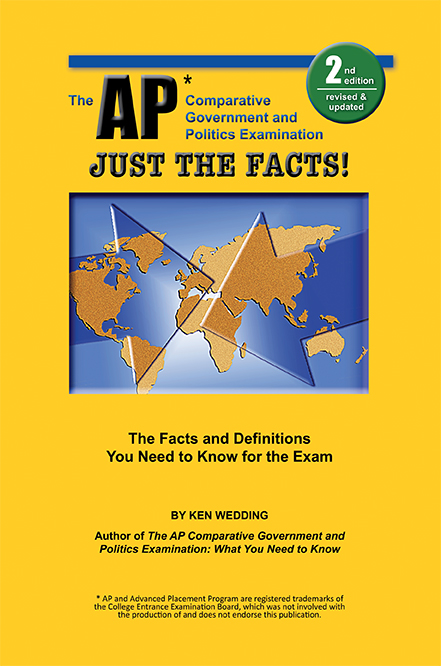 Just The Facts! 2nd edition is a concise guide to concepts, terminology, and examples that will appear on May's exam.


