What brings democracy down?
It was only 16 years ago that Francis Fukuyama wrote
The End of History and the Last Man, a best selling book that celebrated the "victory" of democracy. Things look different in this part of the 21st century. What accounts for the changes?
After decades of triumph, democracy is losing ground
The world has grown far more democratic since the second world war. In 1941 there were only a dozen democracies; by 2000 only eight states had never held a serious election. But since the financial crisis of 2007-08, democracy has regressed.
Most watchdogs concur. The latest survey by Freedom House, an American think-tank, is called “Democracy in Crisis”. In 2017, for the 12th consecutive year, countries that suffered democratic setbacks outnumbered those that registered gains… According to the Democracy Index from The Economist Intelligence Unit, a sister company of The Economist, 89 countries regressed in 2017; only 27 improved…
What these indices measure is not simply democracy (ie, rule by the people), but liberal democracy (ie, with a freely elected government that also respects individual and minority rights, the rule of law and independent institutions)…
This system is now under siege. In many countries, voters are picking leaders who do not respect it, and gradually undermine it, creating what Viktor Orban, Hungary’s prime minister, proudly calls “illiberal democracy”…
The mature democracies of the West are not yet in serious danger. Donald Trump may scorn liberal norms, but America’s checks and balances are strong, and will outlast him. The real threat is to less mature democracies, where institutions are weaker and democratic habits less ingrained…
Meanwhile, China supplies an alternative model. Having grown much less dictatorial after the death of Mao Zedong, it is reconcentrating power in one man, Xi Jinping, whose term limits as president have just been removed. Some would-be autocrats cite China as evidence that authoritarianism promotes economic growth—though what they often mean is that they too want to be presidents for life.
Globally, public support for democracy remains high. A Pew poll of 38 countries found that a median of 78% of people agreed that a system where elected representatives make laws was a good one. But hefty minorities approved of non-democratic alternatives. A worrying 24% thought that military rule would be fine, and 26% liked the idea of “a strong leader” who “can make decisions without interference from parliament or the courts” (see chart 2). In general, autocracy was more popular among the less educated.
To oversimplify, a democracy typically declines like this. First, a crisis occurs and voters back a charismatic leader who promises to save them. Second, this leader finds enemies. His aim, in the words of H.L. Mencken, a 20th-century American wit, “is to keep the populace alarmed (and hence clamorous to be led to safety) by an endless series of hobgoblins, all of them imaginary.” Third, he nobbles independent institutions that might get in his way. Finally, he changes the rules to make it harder for voters to dislodge him. During the first three stages, his country is still a democracy. At some point in the final stage, it ceases to be one. All four stages are worth examining…
Would-be autocrats need a positive agenda, too. Often they pose as defenders of an identity that voters hold dear, such as their nationality, culture or religion. Poland’s ruling party, for example, waxes lyrical about the country’s Catholic way of life, and lavishes subsidies on big families, who are likely to be rural and religious…
To remain in power, autocrats need to nobble independent institutions. They do this gradually and quietly. The first target is often the justice system…
The media must be nobbled, too. First, an autocrat in waiting puts his pals in charge of the public broadcaster and accuses critical outlets of spreading lies. Rather than banning independent media, as despots might have done a generation ago, he slaps spurious fines or tax bills on their owners, forcing them to sell their businesses to loyal tycoons…
Getting the security forces on side is essential. Robert Mugabe, Zimbabwe’s former president, took their loyalty for granted and was thrown out. Other strongmen are less complacent…
With the courts, press and armed forces in his pocket, a strongman can set about neutering every other institution that counts. He can sideline parliament, redraw the electoral map and bar serious opponents from politics…
Much has been said about the failures of liberal democracies. Although they are typically rich and peaceful, many of their citizens are disgruntled. Globalisation and technology have made them fear for their jobs. The culture wars ensure that more or less everyone feels disrespected by someone. The rise of autocracy is in part a reaction to these big historical trends. But it is also because power-hungry leaders have learned how to exploit them. You cannot have autocracy without an autocrat.
Most authoritarian regimes are filthy. Of the countries and territories in the dirtiest third of Transparency International’s corruption perceptions index, not one is rated “free” by Freedom House. Of those in the cleanest 20, only Singapore and Hong Kong fail to qualify as free…
That strongmen make up their own rules is why liberal democracy is worth defending. And in the long run, it seems to deliver better material results. A study by Daron Acemoglu of the Massachusetts Institute of Technology found that switching from autocracy to democracy adds 20% to income per head over 30 years, though some economists dispute these findings. Guillermo Vuletin of the World Bank argues that autocrats fall when economies slump, and the democrats who succeed them take credit for the inevitable recovery.
What is certain, however, is that freely elected governments bound by the rule of law have less power to abuse citizens. “Little by little they took away our rights,” says a journalist in Diyarbakir, who was recently arrested for five innocuous tweets. “Every day I check the news to see which of my friends has been detained.”
Teaching Comparative blog entries are indexed. Use the search box to look for country names or concept labels attached to each entry.
 Just The Facts! 2nd edition is a concise guide to concepts, terminology, and examples that will appear on May's exam.
Just The Facts! is available. Order HERE.
Amazon's customers gave this book a 5-star rating.
Just The Facts! 2nd edition is a concise guide to concepts, terminology, and examples that will appear on May's exam.
Just The Facts! is available. Order HERE.
Amazon's customers gave this book a 5-star rating.
Labels: concepts, democracy, illiberal democracy, liberal democracy, political change
Flexible election rules
Heather Tafel of Grand Rapids, MI posted this article to one of the
AP Comparative Government and Politics teachers groups. It's valuable because it traces the ways in which the Kremlin elite have adjusted election rules over the years to ensure their continued dominance of the legislature in Russia. How about these facts as example of an illiberal democracy? How about evaluating rule of law in Russia?
The author of the article is Vladimir Gelman, a Professor at the European University at St. Petersburg and Distinguished Professor at the University of Helsinki.
Thank you, Heather.
Correction of Errors: How the Kremlin Re-Equilbrated Authoritarian Elections in 2016.
After Russia’s wave of protest during the 2011-2012 election cycle, the country’s authorities embarked on an effort to prevent anti-regime mass mobilization during subsequent election periods. They made a series of institutional changes and implemented a “politics of fear” to weaken the political opposition. Before the 2011-12 elections, the opposition had organized an effective negative campaign against Kremlin candidates. Now, as the September 18 parliamentary elections approach, the Russian leadership is confident that they have substantially reduced the risk of public protest. Analyzing the Kremlin’s 2016 parliamentary election campaign sheds light on how Russian authoritarianism survives.
The first two decades after the collapse of the Soviet Union were accompanied by a remarkably low degree of political protest inside Russia. Most instances of anti-regime mobilization brought together only a few hundred activists at best. This is why the appearance of tens of thousands of protesters on the streets of Moscow and other Russian cities during the 2011-12 “winter of discontent” was perceived by the Kremlin as a major challenge to its general strategy of containing dissent...
After 2012, the Kremlin targeted the infrastructure of organized dissent, following not only the model of late Soviet repression but also replicating the tactics of the authoritarian regime in neighboring Belarus...
A combination of harsh new regulations and selective enforcement has now become the essence of a systematic and consistent “politics of fear.”...
Meanwhile, disloyal opposition parties have come under severe pressure. They have been denied participation in a number of sub-national elections and their mobilization capacity is very low...
Before the current campaign, the parliamentary electoral system was changed once again. While the 2007 and 2011 elections were held under a proportional representation (PR) system with a seven percent barrier for entry, there now exists a mixed electoral system with a five percent threshold, similar to the system in place from 1993 to 2003...
Another factor stacking the deck was the change to the electoral schedule. All previous parliamentary elections have been conducted in December, while the upcoming one is set for mid-September. This move aimed to decrease public interest in the elections thanks to the summer vacation season. This will decrease voter turnout, offer greater room for manipulation on election day, and diminish the potential effects of negative campaigning by the opposition. Holding earlier elections may also be considered a pre-emptive move against protest voting, given the expectation of increased voter dissatisfaction in the winter due to Russia’s economic situation...
[All the changes] serve as camouflage. As one political technologist linked with the Kremlin has confessed on Facebook, the presidential administration made it clear to the lower levels of the “power vertical” that UR must get two thirds of the seats in parliament by whatever means necessary. In Moscow and St. Petersburg, however, “honesty should be imitated to avoid the discontent of politically-concerned urban residents.” In the provinces, “imitation of honesty will be abandoned, and elections should be conducted there as usual, through administrative pressure and a very special counting of votes” (i.e., overt fraud)...
According to a July 2016 Levada Center survey, Russians are demonstrating their lowest-ever interest in elections. Only 46 percent of respondents said they discuss election-related matters (in October 2011, this share was 62 percent), only 33 percent agreed that the parliamentary election is an important event, and 39 percent considered electoral participation “useless.” Russia’s climate of mass political apathy has been fueled by a lack of political competitiveness or a public desire for major political change. Public opinion is one of “resigned acceptance” to the status quo—not because of genuine support of the authorities but because alternatives are perceived as less attractive and/or unrealistic.
Despite the fact that the 2011 parliament remained loyal to the Kremlin, all elections are now risky moments for the regime. Tightening the screws, institutional re-engineering, and more efficient top-down political control greatly assist in maintaining authoritarian equilibrium and legitimizing the status quo. Non-democratic elections also serve as a tool for the partial replacement of elites through careful selection and advancement of candidates by the Kremlin and its subordinates.
The Russian leadership’s upcoming victory in next month’s parliamentary elections will give it free reign going forward: at the moment, there are no domestic restraints other than increasing economic problems. With an eye toward the 2018 presidential election, the newly elected parliament could even turn into a major provider of constitutional change. A logical extension of Russia’s authoritarian trajectory would be the adoption of a new constitution stripped of declarations on individual rights and liberties, the primacy of Russia’s international obligations, and other such liberal statements (not to mention the removal of presidential term limits). After the expected restoration of authoritarian equilibrium this September, the Kremlin will be interested to further consolidate political and institutional arrangements that can help Russia’s leadership maintain its monopoly on power for some time to come.
Labels: elections, illiberal democracy, politics, rule of law, Russia
Meaningless elections?
Comparative politics students should be able to come up with a couple answers to this article's title question before they read the article.
Myanmar votes on Sunday. Why do authoritarian governments even hold elections?
On Sunday [Nov. 8], Myanmar will conduct general elections for its regional and state assemblies, and the lower and upper houses of the national parliament…
Widespread manipulation and misconduct has marred the run-up to the election…
Such problems are hardly surprising. They speak to how authoritarian elections are not designed to aid the selection of political representatives in the democratic way we understand.
Why do authoritarian regimes bother with elections?
- To collect information…
- To pursue legitimacy…
- To manage political elites…
- To sustain neopatrimonialism…
While only a handful of authoritarian regimes do not hold elections, major challenges remain for those that do. For dictators, the crux of the issue is whether these four benefits outweigh five underlying costs. This includes how elections are:
- Ideologically objectionable…
- Politically risky…
- Propagandistically ineffective…
- Strategically superfluous…
- Unnecessarily demanding…
Myanmar’s past elections have included many of the above attributes…
The 1990 election, however, backfired on the ruling junta…
[W]hy is Thein Sein holding the current election? One reason is domestic legitimacy… By retaining power through the “will of the people”, the USDP [his party] can then position itself as the only political actor capable of nurturing “democracy”…
Teaching Comparative blog entries are indexed. Use the search box to look for country names or concept labels attached to each entry.
Just The Facts! 2nd edition is a concise guide to concepts, terminology, and examples that will appear on May's exam.
Just The Facts! is available. Order HERE.
Amazon's customers gave this book a 5-star rating.
What You Need to Know 7th edition is ready to help.
Order the book
HERE
Amazon's customers gave this book a 4-star rating.
What You Need to Know: Teaching Tools, the original version and v2.0 are available to help curriculum planning.
Labels: concepts, elections, illiberal democracy
Illiberal democracy in action
Looking for examples of an illiberal democracy in action to spice up your FRQs? Read the whole article for more details.
As Putin’s Popularity Soars, Voices of Opposition Are Being Drowned Out
There were two large rallies on Saturday in Moscow. One was a pro-government rally “in support of Crimea and against fascism,” led by a phalanx of husky men in identical crimson jackets, marching military-style in a sea of red…
The other was called a “March for Peace,” convened by the opposition to President Vladimir V. Putin. Holding paper doves aloft, they chanted “Putin Is Afraid of the Maidan” and a Ukrainian phrase that translates as “Putin, Get Out!” The police estimated that there were 3,000 people in this crowd, but it seemed many times larger, in the tens of thousands, filling a boulevard with
bodies for many blocks. The split reaction here reflects domestic tensions. Mr. Putin, who was shaken by large antigovernment demonstrations in Moscow two years ago, is using the confrontation to consolidate the public behind his rule, tapping into the deep well of emotion about the Soviet Union’s suffering at the hands of Nazi Germany. The authorities have tried to mobilize support on federal television channels, and have muted independent voices on the Internet…
Opponents of intervention in Ukraine have found themselves isolated as the crisis has mounted, and several marchers acknowledged that differences over Crimea had split their families or social circles. But the large crowd — numbers that the Kremlin could not ignore — made the mood buoyant…
While the world’s attention is trained on Ukraine, the Russian authorities are cracking down on independent news outlets here, and scores of young journalists… are facing unemployment…
On Wednesday, the editor of a respected independent news site, Lenta.ru, was abruptly replaced with a pro-government journalist after the site published an interview with a Ukrainian nationalist…
On Thursday, three opposition websites and a blog were blocked by the government’s communications watchdog, the first use of a new law that came into effect last month, which allows sites to be blocked without a court order…
Teaching Comparative blog
entries are indexed.
The First Edition of Just The Facts! is ready to ship to you without cost.
The Second Edition of What You Need to Know: Teaching Tools is now available from the publisher
The Fifth Edition of What You Need to Know is also available from the publisher.
Labels: illiberal democracy, politics, Russia
Talk amongst yourselves
Well, get your students to talk to each other as they evaluate Thomas Friedman's analysis of the state of democracy in the 21st century. He's discussing illiberal democracies, transitions to post-industrial economies, and the roles of social media.
It might be interesting to have students discuss these ideas as an introductory lesson. (Take notes.) And then have them evaluate the ideas again at the end of the course. (Compare discussions.)
Takin’ It to the Streets
Why are we seeing so many popular street revolts in democracies?… Former C.I.A. analyst Paul R. Pillar… asks: “The governments being protested against were freely and democratically elected. With the ballot box available, why should there be recourse to the street?”
It is an important question, and the answer, I believe, is the convergence of three phenomena. The first is the rise and proliferation of illiberal “majoritarian” democracies…
 |
| Istanbul protest |
What the protesters in Turkey, Russia and Egypt all have in common is a powerful sense of “theft,” a sense that the people who got elected are stealing something more than money: the people’s voice and right to participate in governance…
A second factor is the way middle-class workers are being squeezed between a shrinking welfare state and a much more demanding job market. For so many years, workers were told that if you just work hard and play by the rules you’ll be in the middle class. That is just not true anymore…
Finally, thanks to the proliferation of smartphones, tablets, Twitter, Facebook and blogging, aggrieved individuals now have much more power to engage in, and require their leaders to engage in, two-way conversations — and they have much greater ability to link up with others who share their views to hold flash protests…
The net result is this: Autocracy is less sustainable than ever. Democracies are more prevalent than ever — but they will also be more volatile than ever…

Teaching Comparative blog
entries are indexed.
The First Edition of What You Need to Know: Teaching Tools is now available from the publisher
The Fifth Edition of What You Need to Know is now available from the publisher.
Labels: civil society, concepts, democratization, illiberal democracy, post-industrial economy, social media


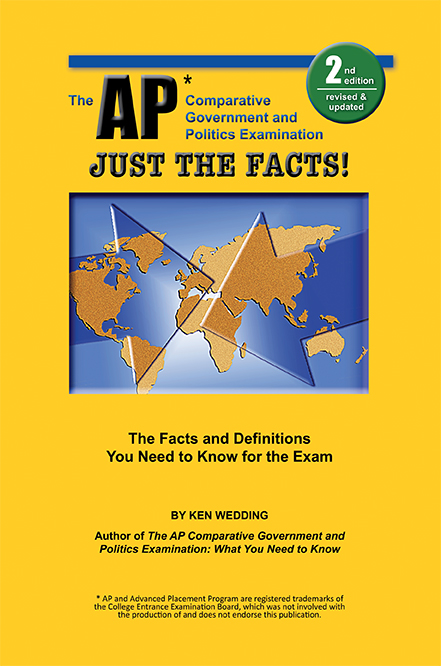 Just The Facts! 2nd edition is a concise guide to concepts, terminology, and examples that will appear on May's exam.


