The annual sitting of the National People’s Congress, China’s well-fed eunuch of a parliament, poses several tests for foreign reporters. Though its committees may suggest tweaks to new laws, and some play a diplomatic role engaging with foreign legislators, meetings of its 3,000 or so delegates are mostly very dull…
There is the odd experience of meeting supposed colleagues who are in fact complete strangers, meaning foreigners employed by Chinese state media, or by obscure Western news outlets that channel Chinese propaganda. Some ask planted questions at press conferences. Others pop up in the state media lauding China’s political system. Xinhua, China’s official news agency, this year put out a video entitled “Chinese democracy in the eyes of an American”. A fresh-faced young man from Chicago, Colin Linneweber, strolls around Tiananmen Square while opining that “it’s widely acknowledged that a key to China’s success is its system of democracy”, and praising the country’s “stability”. He then presents mini-profiles of delegates with such day jobs as farmer, migrant worker and postman, whose proposals for making China better became law. It is tempting to be quite cross with such Westerners. Ordinary Chinese who start praising democracy on the square, a ghost-haunted, massively policed spot, would be instantly arrested. Stability comes at a price, what is more. China’s one-party rule involves more than the absence of messy things like real elections or a free press. It requires active, unsleeping maintenance by state-security agents tasked with tracking, threatening or jailing any who challenge the Communist monopoly on power.
As far back as China’s civil war, party leaders called themselves democrats, unlike their dictatorial rivals, the Nationalist Party or Kuomintang. In 1945 Mao Zedong impressed Chinese intellectuals when he assured a businessman and educational reformer, Huang Yanpei, that democracy would help a Communist government avoid cycles of triumph and decline that doomed imperial dynasties. “Only when a government is subject to the people’s supervision will it not dare to slacken,” Mao declared…
After Mao’s death, when economic opening was not matched by political liberalisation, party leaders sounded a bit defensive about that choice, assuring foreigners that only a firm grip on their vast country could avoid chaos. In the 1990s rule passed to Jiang Zemin, an admirer of Western culture who loved to quote Abraham Lincoln’s call for government of, by and for the people. Asked by an American interviewer whether China was a dictatorship, Mr Jiang replied that he was the elected head of a collective party leadership, although the method of his election had to take account of China’s levels of economic and educational development.
Jump to the present day, and foreigners hear no such half-apologies from the China led by President Xi Jinping. Mr Xi calls China a socialist, consultative democracy, featuring the “orderly participation” of the people and always under the party’s control. Today, state media hail China’s political system as far more responsive and effective than the West’s “conflict-driven”, money-tainted politics…
The Asian Barometer Survey, run by National Taiwan University, has on four occasions quizzed the Chinese public about democracy. Writing in the Taiwan Journal of Democracy, Yue Yin, a political scientist, notes that a narrow majority of the survey’s respondents in China support press censorship in the name of stability, while two-thirds say they are at ease with one-party rule. Yet accountability matters. Nearly 80% reject a government in which “experts decide everything” and 60% say the public should be free to criticise the authorities.
That suggests another way to understand propaganda films in which foreigners call the legislature a beacon of democracy. Such videos are a backhanded tribute to the West. An American’s views on accountable government carry weight, because ordinary Chinese know that American voters can kick the bums out. For now, China’s rulers still mind when their authoritarian system is judged against Western norms. When they no longer think they need the Colin Linnewebers of this world, start worrying.
Teaching Comparative blog entries are indexed. Use the search box to look for country names or concept labels attached to each entry.
Just The Facts! 2nd editionis a concise guide to concepts, terminology, and examples that will appear on May's exam.
You know a democracy is in trouble when two out of three voters don’t bother to turn up for a presidential election. In Nigeria’s just-concluded presidential poll, incumbent Muhammadu Buhari was re-elected with the backing of 15.2 million voters compared to the 11.3 million votes his main rival Atiku Abubakar, was able to amass…
The 35% voter turnout was down from 44% in the 2015 presidential election and way down from the 54% turnout in 2011. In fact, turnout for Nigerian presidential elections has been dropping at an alarmingly consistent rate since 2003. So why are increasingly fewer Nigerians feeling the need to vote in elections that decide the most powerful political office?
Poor organisation is one reason. The last three elections were all postponed at the last minute, causing frustration as well as suspicion that politicians were delaying things to perfect their rigging strategies. Voting itself often involves waiting long hours, in a cumbersome and inefficient process. For some, it’s too much hassle.
Then there is the ever-present fear of violence on election day. Indeed, violence erupted in several places across the country in this election. Politics is a high-stakes game anywhere; in Nigeria the rewards of victory are particularly high…
Furthermore, this year’s choice between the 76-year-old Buhari, who governed highhandedly and often incompetently during his first term, and the 72-year-old veteran politician Atiku, who is widely considered corrupt, was hardly inspiring.
However, it is likely that the largest contributing factor to the extremely low turnout was the feeling that whoever won, nothing would change. The system is so corrupt that it makes no difference whether X or Y is president. Pew Research conducted last year showed that only 39% of Nigerians were satisfied with their democracy, 72% said most politicians were corrupt and 57% said no matter who wins elections, things do not change much. Only 38% felt that elected officials cared what “ordinary people think”.
And so here we are. The problem is that it is difficult for a system to maintain its legitimacy if only one in three citizens believe in it. This is the position Nigerian democracy now finds itself in…
Like a marriage, democracy cannot survive without trust. The relationship between the Nigerian government and its people is broken. Apathy prevails. Trust is scarce. Buhari’s second term needs to be focused on tackling this lack of trust that Nigerians increasingly feel towards their political system. Otherwise, the future of Nigerian democracy looks very bleak indeed.
Teaching Comparative blog entries are indexed. Use the search box to look for country names or concept labels attached to each entry.
Just The Facts! 2nd editionis a concise guide to concepts, terminology, and examples that will appear on May's exam.
The author of this opinion piece is John Keane, Professor of Politics at the University of Sydney and author of ‘The Life and Death of Democracy’. Are his arguments reasonable? Should we join in creating a new category of democratic governance: phantom democracy?
As China rapidly moves to the centre of the international order, the question that’s becoming increasingly pertinent is: what kind of a political system is this new global power? In the booming business of China watching, the standard answer is that it is an “authoritarian” regime, with qualifiers such as “soft authoritarianism”, “hard authoritarianism” and “authoritarian capitalism” commonplace. But by all accounts, China is reckoned the antithesis of a “liberal democracy” defined by open competition among freely formed political parties.
Some Chinese observers celebrate the advantages of this “authoritarianism” and welcome the triumph of a “post-democracy” freed from the curse of free and fair elections and “showbiz democracy”. Outsiders… warn of the onset of dictatorial authoritarianism as the party leadership concentrates titles and decision making in the hands of one man, Xi Jinping.
Perhaps they are right about the dangers. But what’s wrong with their prediction… is its failure to understand the striking paradox of Chinese politics today – its vaguely democratic sensibility, strange as it may sound.
From Xi downwards, state officials understand well… that powerful people should fear too much power just as pigs fear growing fat. The anxiety about unrestrained power and the fear of power-sharing, power-chastening democracy explain why China is more a “phantom democracy” (shenjingshi min zhu) – where the fear of democracy forces a style of political management that in many ways mirrors and mimics electoral democracies, where the fear of elections puts leaders in constant campaign mode.
The leadership knows by instinct that full rice bowls, skyscrapers, shopping malls and holidays abroad aren’t enough. And that is why, for some time, it has been trumpeting China as a “people’s democracy” (ren min min zhu) that conducts experiments with a wide range of locally crafted democratic tools designed to win public support…
But what exactly are these locally made, so-called democratic tools? The examples are numerous. Most obvious are the election of village committees by villagers themselves, and (less obvious) the spread of a culture of elections into social media, city administration and experiments of business houses with “consultative democracy” among their staff…
There are public forums, neighbourhood assemblies, democratic hearings and participatory budgeting experiments. Accountability and competition mechanisms are built into public bureaucracy. Chinese democracy makes room for independent public opinion leaders (yu lun ling xiu), figures such as the online satirist Papi Jiang…
These and many other locally made democracy experiments are typically ignored by those who beat the drum against Chinese authoritarianism. That is unfortunate, if only because the conflict-producing and loyalty-inducing effects of these experiments are not to be underestimated, even if they fall far short of the standards of power-sharing democracy…
But the new anxiety-fuelled efforts of the current rulers to experiment with democratic mechanisms are truly without historical precedent. The official embrace of organised market research and opinion polling techniques is an example. Since the early 1980s, the regime has built a giant information gathering apparatus. The contraption has many parts, comprising different types of information gathering, including hundreds of registered polling firms. Some of them are classified as unofficial (private, for-profit, not directly part of state structures).
Others are semi-official (for-profit, operating at some distance from state ministries); still others are controlled directly by the state, as happens at the People’s Daily Online Public Opinion Monitoring Centre, which uses data-harvesting algorithms to send summaries of internet chatter trends in real time to officials, often with advice about which language to use and avoid in handling hot topics. Some polling agencies are joint ventures with foreign firms and agencies such as A.C. Nielsen, Gallup, Tailor Nelsen and Pew Research Centre…
Data gathering and opinion polling machinery function as early warning detectors, protecting governing structures from political resistance and social disorder. Polls are also cleverly used to calibrate proposed policy changes considered potentially controversial, such as measures to increase public transport fares…
The idea of China as a phantom democracy, rather than a fake democracy or a system of authoritarianism, naturally prompts basic questions about the efficacy and durability of these practices, and where they are steering the political order. The short answer is, nobody knows. In politics, as in life, surprise is often the most powerful player in defining what comes next…
Teaching Comparative blog entries are indexed. Use the search box to look for country names or concept labels attached to each entry.
It was only 16 years ago that Francis Fukuyama wrote The End of History and the Last Man, a best selling book that celebrated the "victory" of democracy. Things look different in this part of the 21st century. What accounts for the changes?
The world has grown far more democratic since the second world war. In 1941 there were only a dozen democracies; by 2000 only eight states had never held a serious election. But since the financial crisis of 2007-08, democracy has regressed.
Most watchdogs concur. The latest survey by Freedom House, an American think-tank, is called “Democracy in Crisis”. In 2017, for the 12th consecutive year, countries that suffered democratic setbacks outnumbered those that registered gains… According to the Democracy Index from The Economist Intelligence Unit, a sister company of The Economist, 89 countries regressed in 2017; only 27 improved…
What these indices measure is not simply democracy (ie, rule by the people), but liberal democracy (ie, with a freely elected government that also respects individual and minority rights, the rule of law and independent institutions)…
This system is now under siege. In many countries, voters are picking leaders who do not respect it, and gradually undermine it, creating what Viktor Orban, Hungary’s prime minister, proudly calls “illiberal democracy”…
The mature democracies of the West are not yet in serious danger. Donald Trump may scorn liberal norms, but America’s checks and balances are strong, and will outlast him. The real threat is to less mature democracies, where institutions are weaker and democratic habits less ingrained…
Meanwhile, China supplies an alternative model. Having grown much less dictatorial after the death of Mao Zedong, it is reconcentrating power in one man, Xi Jinping, whose term limits as president have just been removed. Some would-be autocrats cite China as evidence that authoritarianism promotes economic growth—though what they often mean is that they too want to be presidents for life.
Globally, public support for democracy remains high. A Pew poll of 38 countries found that a median of 78% of people agreed that a system where elected representatives make laws was a good one. But hefty minorities approved of non-democratic alternatives. A worrying 24% thought that military rule would be fine, and 26% liked the idea of “a strong leader” who “can make decisions without interference from parliament or the courts” (see chart 2). In general, autocracy was more popular among the less educated.
To oversimplify, a democracy typically declines like this. First, a crisis occurs and voters back a charismatic leader who promises to save them. Second, this leader finds enemies. His aim, in the words of H.L. Mencken, a 20th-century American wit, “is to keep the populace alarmed (and hence clamorous to be led to safety) by an endless series of hobgoblins, all of them imaginary.” Third, he nobbles independent institutions that might get in his way. Finally, he changes the rules to make it harder for voters to dislodge him. During the first three stages, his country is still a democracy. At some point in the final stage, it ceases to be one. All four stages are worth examining…
Would-be autocrats need a positive agenda, too. Often they pose as defenders of an identity that voters hold dear, such as their nationality, culture or religion. Poland’s ruling party, for example, waxes lyrical about the country’s Catholic way of life, and lavishes subsidies on big families, who are likely to be rural and religious…
To remain in power, autocrats need to nobble independent institutions. They do this gradually and quietly. The first target is often the justice system…
The media must be nobbled, too. First, an autocrat in waiting puts his pals in charge of the public broadcaster and accuses critical outlets of spreading lies. Rather than banning independent media, as despots might have done a generation ago, he slaps spurious fines or tax bills on their owners, forcing them to sell their businesses to loyal tycoons…
Getting the security forces on side is essential. Robert Mugabe, Zimbabwe’s former president, took their loyalty for granted and was thrown out. Other strongmen are less complacent…
With the courts, press and armed forces in his pocket, a strongman can set about neutering every other institution that counts. He can sideline parliament, redraw the electoral map and bar serious opponents from politics…
Much has been said about the failures of liberal democracies. Although they are typically rich and peaceful, many of their citizens are disgruntled. Globalisation and technology have made them fear for their jobs. The culture wars ensure that more or less everyone feels disrespected by someone. The rise of autocracy is in part a reaction to these big historical trends. But it is also because power-hungry leaders have learned how to exploit them. You cannot have autocracy without an autocrat.
Most authoritarian regimes are filthy. Of the countries and territories in the dirtiest third of Transparency International’s corruption perceptions index, not one is rated “free” by Freedom House. Of those in the cleanest 20, only Singapore and Hong Kong fail to qualify as free…
That strongmen make up their own rules is why liberal democracy is worth defending. And in the long run, it seems to deliver better material results. A study by Daron Acemoglu of the Massachusetts Institute of Technology found that switching from autocracy to democracy adds 20% to income per head over 30 years, though some economists dispute these findings. Guillermo Vuletin of the World Bank argues that autocrats fall when economies slump, and the democrats who succeed them take credit for the inevitable recovery.
What is certain, however, is that freely elected governments bound by the rule of law have less power to abuse citizens. “Little by little they took away our rights,” says a journalist in Diyarbakir, who was recently arrested for five innocuous tweets. “Every day I check the news to see which of my friends has been detained.”
Teaching Comparative blog entries are indexed. Use the search box to look for country names or concept labels attached to each entry.
Just The Facts! 2nd editionis a concise guide to concepts, terminology, and examples that will appear on May's exam.
Here's one for students to discuss. And there are enough assertions to be checked with research. (Are nations with monarchies "generally richer and more stable?") Does being a member of a titled aristocracy have any influence on opinions?
Count Nikolai Tolstoy says, more kings, queens and all the frippery that royalty brings would be not just a salve for a superpower in political turmoil, but also a stabilizing force for the world at large.
“I love the monarchy,” Count Tolstoy, 82, said as he sat in his lush garden behind an expansive stone house. “Most people think the monarchy is just decorative and filled with splendor and personalities. They do not appreciate the important ideological reasons for a monarchy.”
The count… leads the International Monarchist League and is part of a loose confederation of monarchists scattered across the globe, including in the United States.
Their core arguments: Countries with monarchies are better off because royal families act as a unifying force and a powerful symbol; monarchies rise above politics; and nations with royalty are generally richer and more stable…
A recent study that examined the economic performance of monarchies versus republics bolsters their views. Led by Mauro F. Guillén, a management professor at the Wharton School at the University of Pennsylvania, the study found “robust and quantitatively meaningful evidence” that monarchies outperform other forms of government…
Count Tolstoy insists that monarchists are not pining for the days of absolute rulers and the divine right of kings…
Dutch King Willem-Alexander
Instead, his group advocates constitutional monarchies, in which a king or queen is head of state and the real power rests with an elected Parliament…
Finding people to reject the monarchists’ vision is not hard, even in Britain, where Queen Elizabeth II is revered by many.
A London-based grass-roots organization called Republic, which wants the country to hold a referendum on the monarchy when the queen dies, says bluntly on its website, “The monarchy isn’t fit for purpose. It is corrupt and secretive.”…
Teaching Comparative blog entries are indexed. Use the search box to look for country names or concept labels attached to each entry.
A regulation to promote transparency in party affairs was reviewed and passed at a meeting of the Political Bureau of the Communist Party of China (CPC) Central Committee on Thursday.
The meeting was presided over by Xi Jinping, general secretary of the CPC Central Committee.
Promoting transparency in party affairs is "an important step" for the implementation of the spirit of the 19th National Congress of the CPC and a must to developing intra-party democracy and socialist democratic politics, according to a statement issued after the meeting.
The move is of great significance in advancing strict party governance and strengthening intra-party supervision, it said.
Promoting transparency in party affairs should adhere to the right direction and implement Xi Jinping Thought on Socialism with Chinese Characteristics for a New Era, said the statement.
Transparency in party affairs should be carried out in the practice of upholding and developing socialism with Chinese characteristics in the new era and advancing the great new project of party building, it noted…
Efforts should be made to promote intra-party democracy to protect party members' rights to know, participate, vote and supervise, and to respond to the concerns of party members and the public in a timely manner.
All party committees should enhance their leadership over the work and carry out the regulation(for trial implementation) in light of realities, it said.
Teaching Comparative blog entries are indexed. Use the search box to look for country names or concept labels attached to each entry.
Just The Facts! 2nd editionis a concise guide to concepts, terminology, and examples that will appear on May's exam.
If a regime is built to frustrate the will of the people, is it possible for "subversives" to act in ways to facilitate following the will of the people?
The author is Shervin Malekzadeh, a visiting assistant professor at Swarthmore College. He is a political scientist whose research interests include the politics of identity and modern state formation. He is a regular visitor to Iran.
In recent years, platforms such as Instagram and Facebook have become effective instruments for the mobilization of voter participation in Iranian elections… Though a crucial component in the current reformist strategy to use the vote… as part of the long march of incrementalism is hardly the stuff of revolutions. Largely unnoticed outside of Iran and lacking the dramatics of large-scale protests, Iranians’ use of their tablets and smartphones to persuade each other — and themselves — to participate in a deeply flawed electoral system nonetheless offers the best measure of citizenship and civil society in Iran today. It is the manner of their participation that we need to pay more attention to, the ad hoc mobilization of millions of families and friends in the days and weeks leading up to election day, a ground game almost always self-forming and rooted in an informal politics from below.
Over the past year these efforts have converged on a single messaging application, Telegram. Last month, Narges Bajoghli described how Telegram’s end-to-end encryption has made it possible for Iranians to engage in open dialogue about politics without fear of government surveillance…
[M]y research in Iran on social media this past February indicates that the successful mobilization of reformist and moderate factions mostly occurred across channels with little to no connection with the elections and those specifically not devoted to political discussion.
Telegram’s particular appeal and power as an instrument of political organization lies in not only its online security but also its ease of use… The app organizes conversations by discrete channels, sorted into categories reflecting the dizzying variety of ordinary life. These groups soon began to intersect: the retired schoolteachers of District 6 in Tehran, say, naturally overlapping with the fanatics of the Persepolis football club and the members of the Sistan Baluchestan mountaineering society, all of them converging on the channel dedicated to “Stage,” a live-singing competition broadcast out of London and the latest obsession of Iranian audiences around the world.
To borrow from Robert Putnam, this bridging effect — a phenomenon in which diverse groups interact and increase their shared social capital — is important among Telegram users because retail politics continues to be the coin of the realm in Iran. The decision to vote tends to be deeply personal, very often made on behalf of a friend, relative or loved one at the last possible moment… Telegram amplifies these existing traditional networks rather than replacing them… Already gathered in a safe, non-politicized, place online, it is a small step for a handful of enthusiasts to mobilize acquaintances or “weak ties” using Telegram around a particular political faction.
For Iran’s reform movement, mobilization is a non-negotiable imperative as low turnout… always favors conservatives… The opposition begins each electoral cycle already in the hole… Making matters worse, these lost votes are roughly matched — 15 percent to 20 percent — by dyed-in-the-wool regime stalwarts who always vote, and always in favor of the conservatives.
Reformists simply cannot afford to leave any voter behind…
Telegram made this difficult work of mobilization much easier… Designed to be a medium of visual as well as textual exchange, Telegram’s architecture enabled organizers to bring an infectious joyousness to what was otherwise a serious and painstaking process of getting-out-the-vote, the proverbial slow boring of politics’ hard boards made more enjoyable by memes, animated videos and funny stickers featuring the endorsements of prominent celebrities and politicians. Initially produced for distribution on channels dedicated to the campaign, these quickly spread across the spectrum as ordinary users shared content that ranged from primers on the rudiments of voting to clips espousing the ethics of small change over large, to banners mocking hardline politicians.
They spread because they were entertaining. For example, a campaign calling itself Prevention is Better than a Cure featured memes made out of the outrageous statements of hardline MPs…
Telegram also played a critical role in rallying the vote through the distribution of voting lists… Absent a proper party system, the list ensured that votes for the reform and moderate camps would not be fractured on election day, a decision that likely facilitated their sweep of Tehran.
Of course, one might ask whether an app or any other corner of social media can be popular or powerful enough to correct a system with permanent, undemocratic features. It was always the dream of the neo-Tocquevillians that associational life would foster democratic souls… faith remains that civil society and social media can act as instruments of progressive change…
[I]n Iran… social media appears to have encouraged many Iranians to live lives at least partially in the public sphere. Tocqueville’s observation that Americans “of all ages, all conditions, and all dispositions constantly form associations” applies to the Iranians, at least in their online selves…
At least part of that excitement carries over into the political realm and was put to great effect in this last set of elections. If nothing else, the vote represents an act of faith that democracy can work in a country where it does not fully exist...
Teaching Comparative blog entries are indexed. Use the search box to look for country names or concept labels attached to each entry.
Amazon's customers gave this book a 5-star rating.
The Comparative Government and Politics Review Checklist.
Two pages summarizing the course requirements to help you review and study for the final and for the big exam in May. . It contains a description of comparative methods, a list of commonly used theories, a list of vital concepts, thumbnail descriptions of the AP6, and
a description of the AP exam format. $2.00. Order HERE.
Brexit (Britain's exit from the EU) won't be on the exam. The referendum isn't until late June. But it's a good case study of governance and sovereignty for the UK. The BBC offers details to consider. There's a 2-minute video in the midst of the column.
What is happening? UK Prime Minister David Cameron has announced a referendum on whether Britain should remain in the European Union to be held on Thursday 23 June. This article is designed to be an easy-to-understand guide - and a chance to ask other questions, a selection of which we'll be answering at the bottom of the page.
What is a referendum?
What is the European Union?
What will the referendum question be?
What does Brexit mean?
Who will be able to vote?
How will you vote?
What are the main changes David Cameron has agreed?
How does that differ from what he wanted?
Why is a referendum being held?
Who wants the UK to leave the EU?
Why do they want the UK to leave?
Who wants the UK to stay in the EU?
Why do they want the UK to stay?
So would Britain be better in or out?
What about businesses?
What are the rules for campaigning?
How much can the parties spend?
So who is going to be leading the rival sides in the campaign?
Which MPs are for staying and which are for leaving?
Will it simply be the case of all votes being counted to give two totals?
I'm away on holiday for the week of 23 June - can I still vote?
When will the campaigns actually begin?
When and how will the results be announced?
If the UK left the EU would UK citizens need special permits to work in the EU?
What about EU nationals who want to work in the UK?
Would leaving the EU mean we wouldn't have to abide by the European Court of Human Rights?
Has any member state ever left the EU, or would the UK be the first?
If we stay in do we keep the pound for ever?
How much does the UK contribute to the EU and how much do we get in return?
If I retire to Spain or another EU country will my healthcare costs still be covered?
Will the opinion polls get it wrong again?
Who counts as a British citizen?
How long will it take for Britain to leave the EU?
Could MPs block an EU exit if Britain votes for it?
What will happen to protected species if Britain leaves the EU?
How much money will the UK save through changes to migrant child benefits and welfare payments?
If we leave the EU does it mean we would be barred from the Eurovision Song Contest?
Do Commonwealth citizens resident in the UK on a limited work visa get to vote?
Can EU citizens living in the UK vote in the referendum?
What impact would leaving the EU have on house prices?
What is the 'red tape' that the opponents of the EU go on about?
Would Britain be party to the Transatlantic Trade and Investment Partnership if it left?
Teaching Comparative blog entries are indexed. Use the search box to look for country names or concept labels attached to each entry.
Amazon's customers gave this book a 5-star rating.
The Comparative Government and Politics Review Checklist.
Two pages summarizing the course requirements to help you review and study for the final and for the big exam in May. . It contains a description of comparative methods, a list of commonly used theories, a list of vital concepts, thumbnail descriptions of the AP6, and
a description of the AP exam format. $2.00. Order HERE.
The author, Loubna El Amine an assistant professor of political theory in the department of government at Georgetown University, asks some great questions about the universality of ideas like democracy. Want to have a debate?
In September 2014, students in Hong Kong gathered in a public square to protest some of the Beijing government’s legislative initiatives. One of their slogans was “When dictatorship becomes a reality, revolution is a duty,” which has been attributed to Victor Hugo…
Some academics and public intellectuals who study non-Western societies, worried about imposing Western values, have expressed concern about the use of categories like human rights and liberal democracy. They have instead favored drawing on non-Western societies’ own intellectual traditions and lived experiences. Thus the academic debate about the form of government that China should adopt has focused on drawing from the ideals of Confucianism…
Protesters in Hong Kong did not mention Confucianism at all, prompting one commentator on a prominent Chinese and comparative philosophy blog to ask, “Where are all the Confucians … tonight?”
If Western categories ought to be rejected in favor of non-Western ones, as these academics tell us, then what should we make of the fact that protestors on the ground continue to cling to the former in a very familiar way, explicitly demanding rights, including women’s rights, equality, elections and the rule of law?
The slogans are familiar… because the situation they are responding to is familiar: a state using extensive and arbitrary power…
I argue that these tools are precisely the so-called Western ideals that some academics are skeptical about: democracy, rights and the rule of law. These should be understood not as Western, but as modern: normative tools particularly suited to the realities of political life under the sovereign state, the central institution of modern politics.
Sovereign states centralize politics and impose a monopoly on the use of force in a way that pre-modern empires could not, and did not. The only protection against the risk that states will abuse their power is to make the government accountable to its people and protect the inviolability of human life. In other words, demand democracy and rights. Non-Western states now have the same essential features of sovereignty as Western ones. And so their citizens can protect themselves only by fighting for these ideals, and their intellectuals can support these citizens’ efforts only by advocating for these ideals.
This is not to deny that many critics around the world denounce human rights and democracy as Western impositions…
However, to justify themselves to the public, these arguments also inevitably build in guarantees against abuse, legally limiting the use of state power and requiring states to consult with the people, usually through elections…
Efforts to provide Islamic variants on democracy or Confucian variants on rights thus should be understood not as alternatives to modern ideals, but as variants on them. This is just as it should be. Just as there are differences between the democratic systems of Germany and the United States, so too would a democratic China and a democratic Yemen be different both from each other and from the U.S. and German models. Crucially, these differences are not between East and West, but among different countries with different material realities…
In short, when citizens in non-Western countries clamor for democracy, there is no reason to suspect elitism or Western manipulation or false consciousness. Not everything familiar is a sign of cultural imperialism. This is not to deny that power differentials continue to structure the relationship between the West and the East, but rather to suggest that overcoming the discourse of “us” and “them” will open up more promising avenues for responding to domination.
Teaching Comparative blog entries are indexed. Use the search box to look for country names or concept labels attached to each entry.
Amazon's customers gave this book a 5-star rating.
The Comparative Government and Politics Review Checklist.
Two pages summarizing the course requirements to help you review and study for the final and for the big exam in May. . It contains a description of comparative methods, a list of commonly used theories, a list of vital concepts, thumbnail descriptions of the AP6, and
a description of the AP exam format. $2.00. Order HERE.
Fist fights among voters who have different political orientations is quite common in developing countries during election seasons. Now, a similar show is shockingly staged in the US, which boasts one of the most developed and mature democratic election systems…
Trump's rise was not anticipated by most analysts and observers. At the beginning of the election, Trump, a rich, narcissist and inflammatory candidate, was only treated as an underdog. His job was basically to act as a clown to attract more voters' attention to the GOP. However, knocking down most other promising candidates, the clown is now the biggest dark horse.
Trump is the last option for the GOP establishment…
The rise of Trump has opened a Pandora's box in US society…
Despite candidates' promises, Americans know elections cannot really change their lives. Then, why not support Trump and vent their spleen?
The rise of a racist in the US political arena worries the whole world. Usually, the tempo of the evolution of US politics can be predicted, while Trump's ascent indicates all possibilities and unpredictability. He has even been called another Benito Mussolini or Adolf Hitler by some Western media.
Mussolini and Hitler came to power through elections, a heavy lesson for Western democracy. Now, most analysts believe the US election system will stop Trump from being president eventually. The process will be scary but not dangerous.
Even if Trump is simply a false alarm, the impact has already left a dent. The US faces the prospect of an institutional failure, which might be triggered by a growing mass of real-life problems.
The US had better watch itself for not being a source of destructive forces against world peace, more than pointing fingers at other countries for their so-called nationalism and tyranny.
Teaching Comparative blog entries are indexed. Use the search box to look for country names or concept labels attached to each entry.
Amazon's customers gave this book a 5-star rating.
The Comparative Government and Politics Review Checklist.
Two pages summarizing the course requirements to help you review and study for the final and for the big exam in May. . It contains a description of comparative methods, a list of commonly used theories, a list of vital concepts, thumbnail descriptions of the AP6, and
a description of the AP exam format. $2.00. Order HERE.
Look for correlations in the Factbook, find historical trends and correlations with Gapminder, explore official and journalistic data from original sources. And, define democracy with V-Dem.
There is no consensus on the definition of democracy and how to measure it. The understanding of what a democracy really is varies across countries and regions. This motivates the V-Dem approach not to offer one standard definition of the concept but instead to distinguish among five principles different versions of democracy: Electoral, Liberal, Participatory, Deliberative, and Egalitarian democracy…
V-Dem differs from previous datasets by distinguishing among different principles of democracy (as discussed) and offering about 350 unique democracy indicators, 34 indices of various aspects of democracy such as freedom of association, and five main democracy indices for Electoral, Liberal, Participatory, Deliberative, and Egalitarian democracy. These all cover 173 countries, measured annually from 1900 to 2012…
Scholars, students, media, policy analysts, practitioners, and others interested in the status of democracy in the world can visit our website, where they can use the online analysis tools to generate graphs showing a country’s regime trajectory and comparisons with other country…
Teaching Comparative blog entries are indexed. Use the search box to look for country names or concept labels attached to each entry.
Amazon's customers gave this book a 5-star rating.
The Comparative Government and Politics Review Checklist.
Two pages summarizing the course requirements to help you review and study for the final and for the big exam in May. . It contains a description of comparative methods, a list of commonly used theories, a list of vital concepts, thumbnail descriptions of the AP6, and
a description of the AP exam format. $2.00. Order HERE.
One of the first posts to this blog back when I started it 2006, was
about a scene from a movie that I used in class. It bears repeating
because many of you were not reading this blog back then. I think the
advice is still good.
When it first came out in 1975, I saw Monty Python and the Holy Grail.
I saw it again several years after I began teaching comparative. From
that point on, one of the beginning scenes (you probably know which one) became a
regular feature of the first day of class.
It's full of conceptual ideas that go a long way to proving that the
Pythons paid attention to at least some of their tutors at Cambridge.
Once you and your students have enjoyed seeing this scene (more than
once, perhaps), there are many opportunities to explore concepts that
should become very common knowledge before the course ends. Here's my
beginning list of things students should explore, research, and discuss:
social class, social cleavages, executive, elections, legitimacy,
mandate, exploitation, ethnic identity, autonomy, autocracy, and divine
right.
(Be careful, your students will want you to show more of this movie,
especially the "I"m not dead yet" scene that follows the "Peasants"
scene.)
Arthur and his trusty servant Patsy "ride" into a field where peasants
are working. They come up behind a cart which is being dragged by a
hunched-over peasant in ragged clothing. Patsy slows as they near the
cart...
ARTHUR: Old woman! DENNIS: Man! ARTHUR: Man, sorry. What knight lives in that castle over there? DENNIS: I'm thirty seven. ARTHUR: What? DENNIS: I'm thirty seven -- I'm not old! ARTHUR: Well, I can't just call you `Man'. DENNIS: Well, you could say `Dennis'. ARTHUR: Well, I didn't know you were called `Dennis.' DENNIS: Well, you didn't bother to find out, did you? ARTHUR: I did say sorry about the `old woman,' but from the behind you looked-- DENNIS: What I object to is you automatically treat me like an inferior!
Arthur: Well I *am* king...
Man: Oh, king, eh, very nice. And 'ow'd you get that, eh? (he reaches
his destination and stops, dropping the cart) By exploiting the workers!
By 'angin' on to outdated imperialist dogma which perpetuates the
economic and social differences in our society. If there's ever going to
be any progress,--
Woman: Dennis! There's some lovely filth down 'ere! (noticing Arthur) Oh! 'Ow'd'ja do?
Arthur: How do you do, good lady. I am Arthur, king of the Britons. Whose castle is that?
Woman: King of the 'oo?
Arthur: King of the Britons.
Woman: 'Oo are the Britons?
Arthur: Well we all are! We are all Britons! And I am your king.
Woman: I didn't know we 'ad a king! I thought we were an autonomous collective.
Man: (mad) You're fooling yourself! We're living in a dictatorship! A self-perpetuating autocracy in which the working classes--
Woman: There you go, bringing class into it again...
Man: That's what it's all about! If only people would--
Arthur: Please, *please*, good people, I am in haste! WHO lives in that castle?
Woman: No one lives there.
Arthur: Then who is your lord?
Woman: We don't have a lord!
Arthur: (surprised) What??...
Arthur: I am your king!
Woman: Well I didn't vote for you!
Arthur: You don't vote for kings!
Woman: Well 'ow'd you become king then? (holy music up)
Arthur: The Lady of the Lake-- her arm clad in the purest shimmering
samite, held aloft Excalibur from the bosom of the water, signifying by
divine providence that I, Arthur, was to carry Excalibur. THAT is why I
am your king!
Man: (laughingly) Listen: Strange women lying in ponds distributing
swords is no basis for a system of government! Supreme executive power
derives from a mandate from the masses, not from some... farcical
aquatic ceremony!
Arthur: (yelling) BE QUIET!
Man: You can't expect to wield supreme executive power just 'cause some watery tart threw a sword at you!!
Arthur: (coming forward and grabbing the man) Shut *UP*!
Man: I mean, if I went 'round, saying I was an emperor, just because
some moistened bink had lobbed a scimitar at me, they'd put me away!
Arthur: (throwing the man around) Shut up, will you, SHUT UP!
Mexico's Congress has approved freedom of information legislation that will allow public access to data from almost any entity that receives government funding.
The measure was passed… in the lower house on a 264-68 vote and now goes to the president for his signature.
President Enrique Pena Nieto wrote in his Twitter account that the law "will strengthen the accountability of the Mexican government and combat corruption."
Mexicans can currently use freedom-of-information requests to get data from government agencies. But the new law now also covers requests to unions, political parties and government-supported councils and commissions…
Teaching Comparative blog entries are indexed. Use the search box to look for country names or concept labels attached to each entry.
Just The Facts!is a concise guide to concepts, terminology, and examples that will appear on May's exam.
Customers who bought this book at Amazon gave it a 5-star rating. But Amazon doesn't have any.
Are even autocratic elections (or is procedural democracy) good for a country? Debate amongst yourselves. (And check out the original article for more references.)
The author is Michael K. Miller an Assistant Professor of Political Science at George Washington University.
After a bitterly contested election campaign and several controversial postponements, Muhammadu Buhari engineered an upset of Nigeria’s incumbent President Goodluck Jonathan… while two other African countries, Sudan and Togo, are also scheduled to hold elections… Besides the coincidence in electoral timing, these countries share another surprising link—all three are generally recognized as autocracies.
The marriage of autocracy with contested elections is, in fact, the norm nowadays. All but five autocracies have held a national election since 2000, with about three in four allowing multiparty competition. What makes these regimes autocratic is that the elections fail to meet democratic standards, typically with state power being used to favor the ruling party. Prominent examples include Singapore, Russia, Jordan and Venezuela…
[T]he spread of multiparty elections is largely a result of international pressure, norms and conditions on foreign aid. As many authors have pointed out, the end product of “democracy promotion” (on which the United States annually spends around a billion dollars) is more often electoral autocracy than real democracy. The fear is that we are encouraging elections that are either pointless window-dressing or, in some cases, may even damage governance and bolster autocratic stability.
Electoral autocracies may be less desirable than true democracies, but they still have a range of positive consequences. As Nigeria demonstrates, it’s a mistake to assume that manipulation makes autocratic elections uncompetitive and meaningless… The result is a series of benefits that make them clearly superior to non-electoral autocracy.
A first consequence is a country’s long-term chances for democracy… If there is an effect, it’s a small one…
A forthcoming paper of mine confirms that democracies are much more likely to survive if they have a history of autocratic elections. This shouldn’t be too surprising, as today’s strongest democracies all passed through a prolonged period of unfair or limited-suffrage elections. Over time, even highly imperfect elections tend to improve a country’s political institutions, allow strong political parties to develop, and give citizens a taste for voting and political activism.
A second benefit of autocratic elections relates to health and education outcomes…
A long-term electoral autocracy should expect roughly one-third fewer infant deaths and an additional 10-25 percent of its population to be literate… this modernization effect improves the conditions for future democratic stability…
[A]utocratic elections often exhibit a meaningful degree of policy responsiveness. Specifically, when ruling parties start losing votes, they often increase their social and education spending following the elections…
[T]he findings further support the benefits of political competition and liberalization. Yet we should recognize that establishing democracy is often not a realistic option…
There’s a sense in which many autocrats are playing a cynical con by embracing elections, reaping the rewards, and then using these elections to magnify their own power.
Yet democracy promoters are arguably playing the longer con, getting dictators to accept the very institutions that, over time, make countries inhospitable to dictatorship…
Teaching Comparative blog entries are indexed. Use the search box to look for country names or concept labels attached to each entry.
Just The Facts!is a concise guide to concepts, terminology, and examples that will appear on May's exam.
I noticed that over the past couple weeks quite a few people have been reading a teaching comparative post titled "Procedural democracy" from April 2008. As I look at that post, I'm reminded that it does illuminate important features of that thing we call democracy.
With upcoming elections in Nigeria and the UK, the ideas might be great ones to focus on for a discussion or two. The concept might also be the basis for a valuable practice FRQ.
I've noted a couple dead links from the original, but here's a rerun.
Procedural Democracy
There's a philosophical debate in the ethereal heights of political science about what is required to label a regime democratic. (You can easily buy research papers on this topic if you search the Internet, but that "wouldn't be the cowboy way.")
[And, it's not just at lofty academic levels that these ideas emerge. Dan Larson and Andrew Conneen wrote in the blog they write for AP students. (The entry I linked to is no longer online and was meant for students of U.S. Government and Politics, but the idea of substantive democracy stands out. It begins, "Elections alone do not make a democracy.")]
The debaters sort of argue over whether democratic procedures or widely-beneficial policies are more important when evaluating the nature of a regime.
Robert Dahl, who has been around long enough that I read at least one of his books over 40 years ago, is one of the participants. The Sterling Professor emeritus of political science at Yale University, seems to be a neo-Madisonian (in the Federalist 10 sense).
He has argued that democracy is a Platonic ideal, that can never be fully realized. However, if a regime meets some basic procedural criteria, it will produce a political system in which elites will compete for political power and authority. He calls this kind of system a polyarchy. Most commonly, people refer to regimes like that as pluralistic. The competing self-interests in such a system, according to Dahl (and Madison), will produce government in the interests of the citizenry.
The criteria that Dahl describes are elected officials; free, fair, and frequent elections; freedom of expression; alternative sources of information; associational autonomy; and inclusive citizenship. (Democracy and Its Critics, 1998)
Others argue that procedures are not all that's necessary for a democratic regime. They argue that economic, cultural, historical, and ideological factors can prevent an apparently democratic procedure from being democratic. Those critics might ask whether the UK had a democratic regime before World War I when only men were allowed to vote. They might ask whether the poverty of Mexican peasants, which leads some of them to sell their votes for t-shirts or patches of paved roads near their homes, negates the legal procedures for elections there. What if a change in government, brought about by a free and fair election changes no laws or policies but only the people in power?
These critics want to emphasize the statutory and policy results of government when defining democratic regimes. Instead of a merely procedural democracy, they want to see substantive democracy.
Charles Tilly, the Joseph L. Buttenwieser Professor of Social Science at Columbia University, might represent the critics of the procedural definition of democracy.
In his book Democracy, he asks about a regime, "Does this regime promote human welfare, individual freedom, security, equity, social equality, public deliberation, and peaceful conflict resolution? If so, we might be inclined to call it democratic regardless of how its constitution reads."
Tilly recognizes limitations on his approach. He also wrote, "Two troubles follow immediately, however, from any such definitional strategy. First, how do we handle tradeoffs among these estimable principles? If a given regime is desperately poor but its citizens enjoy rough equality, should we think of it as more democratic than a fairly prosperous but fiercely unequal regime?"
TradingMarkets.com, a once online investment advice service, offered this bit of description of the democratic nature of Russia's regime (it's a little premature in announcing the end of Putin's presidency and a little loose with its definition of "socialist," but the unnamed writer is probably a stock analyst, not a political scientist): Kremlin Twist.
"By now, everyone knows that Mr. Vladimir Putin stepped down from the chief Kremlin seat, and in his place, sits Mr. Dmitry Medvedev - a 42-year-old lawyer. And what do you know Mr. Medvedev, Putin's protégé was handpicked by the former president to run in Russia's nearly unopposed election. Of course, he not only won but it was a landslide victory. Oh, and by the by, guess who the new prime minister, is? It's former president Mr. Vladimir Putin; so how is that, for a Kremlin twist?
"For the former Soviet, it is a perfect combo of 'Putin Power' and a case of dotting i's and crossing t's, after all, no one wants to be accused of or labelled in running a socialist tight ship, of one man, one power..."
So, we should ask our students to consider whether Russia's regime meets the criteria to be labeled a procedural democracy. Then we should ask them to consider whether it meets the criteria to be labeled a substantive democracy.
And, in AP courses, we should ask them to consider the same things about Iran, Mexico, China, Nigeria and the UK. We should ask them to compare the countries they are studying on procedural and substantive criteria and to compare them with themselves over time. Does Mexico have a more substantive democracy now than it did in the 20th century? Does the Russian regime meet more of the characteristics of a procedural democracy than it did in 1990?
Good things to think about as we lead our students through rehearsals of critical thinking and recall.
Teaching Comparative blog entries are indexed. Use the search box to look for country names or concept labels attached to each entry.
Teaching (and learning) comparative government and politics is a complex and demanding task. We can all use all the help we can get. This cyber place is somewhere to facilitate helpful interactions.

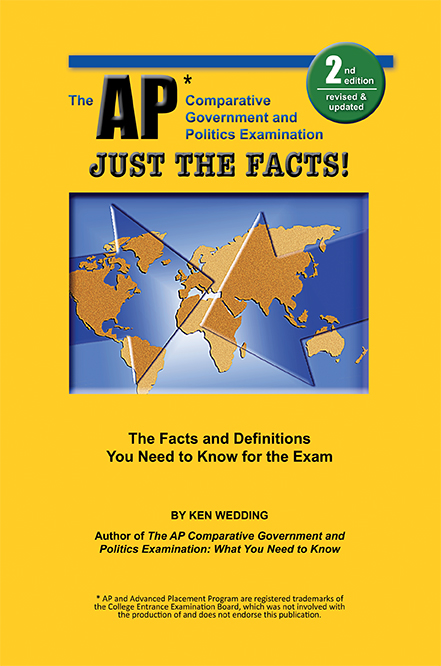 Just The Facts! 2nd edition is a concise guide to concepts, terminology, and examples that will appear on May's exam.


