Iran comes to China
Are there political ramifications for this meeting?
China to host Iranian President Rouhani
China will host Iranian President Hassan Rouhani next month at a regional summit in a Chinese coastal city, the country's foreign ministry said on Monday…
 |
| Presidents Rouhani and Xi |
Rouhani will pay a working visit to China and attend the summit of the China and Russia-led security bloc the Shanghai Cooperation Organization, the ministry said.
It did not give exact dates for his visit, but the summit is scheduled to be held on the second weekend of June in the northern Chinese city of Qingdao.
Iran is currently an observer member of the Shanghai Cooperation Organization, though it has long sought full membership.
Russia has previously argued that with Western sanctions against Tehran lifted, it could finally become a member of the bloc which also includes four ex-Soviet Central Asian republics, Pakistan and India…
Teaching Comparative blog entries are indexed. Use the search box to look for country names or concept labels attached to each entry.
 Just The Facts! 2nd edition is a concise guide to concepts, terminology, and examples that will appear on May's exam.
Just The Facts! is available. Order HERE.
Amazon's customers gave this book a 5-star rating.
Just The Facts! 2nd edition is a concise guide to concepts, terminology, and examples that will appear on May's exam.
Just The Facts! is available. Order HERE.
Amazon's customers gave this book a 5-star rating.
What You Need to Know: Teaching Tools, the original version and v2.0 are available to help curriculum planning.
Labels: China, international relations, Iran
Soft power or imperialism?
Last week the American President reminded Latin American countries of the Monroe Doctrine and warned them about Chinese efforts to spread China's influence.
China moves into Latin America
WHILE Donald Trump was in Davos last week trying to persuade the global plutocracy that “America First” does not mean “America alone”, China’s foreign minister, Wang Yi, was promoting globalisation, free trade and co-operation in Latin America. For his hosts, the contrast was striking. Mr Trump has insulted Mexico, El Salvador and Haiti, discourages investment in the United States’ southern neighbour, and talks trade protectionism. China, in the soothing words of Mr Wang, offers Latin America a “strategy of mutual benefit and shared gain”.
He was speaking at a meeting between China and the Confederation of Latin American and Caribbean States (CELAC), a talking shop comprising all the region’s 33 countries…
The meeting marked the maturing of a relationship that has developed precociously in this century. Total annual trade between China and Latin America shot up from almost nothing to more than $200bn by 2014… Latin America’s exports to China increased by around 30% last year…
The biggest changes are in Chinese investment and lending. Until recently, these focused on oil, mining and Venezuela. Now they are centred on Brazil and Argentina, and are in more sectors…
China’s interest in Latin America is not matched by other big powers. The Trump administration has no clear strategy… The European Union (EU) remains the largest single source of foreign investment. But the conclusion of a long-awaited trade agreement with Mercosur, which includes Brazil and Argentina, has so far been thwarted… “The EU hasn’t worked out clearly what it wants of Latin America,” concludes a new report by the Elcano Institute, a think-tank in Madrid.
The same applies to Latin America in its embrace of China. This brings undoubted benefits. Apart from money, Latin American governments like—and take at face value—China’s stance on global governance and climate change. But the region is entering into a political entanglement with an external power that has no interest in democracy…
See also:
Beware of ‘predatory’ Chinese investment in the Americas, warns Rex Tillerson
Teaching Comparative blog entries are indexed. Use the search box to look for country names or concept labels attached to each entry.
What You Need to Know 7th edition is ready to help.
Order the book
HERE
Amazon's customers gave this book a 4-star rating.
Labels: China, economics, international relations, international trade, soft power
External civil society and politics
Civil society is an important feature of any political system. Why does it seem that many nations are resisting foreign aid funneled through civil society organizations?
The authors are political scientists at the Peace Research Institute Oslo (Norway) and the University of Minnesota.
Across the globe, governments are cracking down on civic organizations. This is why.
Why are some governments cracking down on civil society or nongovernmental organizations (NGOs)? By our count, 39 of the world’s 153 low- and middle-income countries enacted restrictive funding laws between 1993 and 2012, targeting NGOs operating in-country with foreign funding…
In many cases, governments hope to delegitimize NGOs by “naming and shaming” these groups as foreign agents backed by foreign funds…
Our research suggests that NGOs need to generate resources from the communities they serve. This will make them accountable to these communities and enhance their legitimacy. In turn, this resource exchange will incentivize local communities to step up and protect the civic sector from governmental interference…
One reason for the spread of civil society was the way donors chose to deliver foreign aid to developing countries. Frustrated by the perceived ineffectiveness of foreign aid to foster economic development abroad, donors have funneled development aid to NGOs, viewing them as more honest, accountable and responsive to the public’s needs than governments…
Governments love foreign aid when it pays for scarce services, but prefer, whenever possible, to keep it flowing through their own bureaucracies…
[T]rouble seems to start when these groups embrace a “rights-based approach” arguing that citizens have a basic “right” to transparent, accountable and adequate public services. When governments will not, or cannot, respond, they become a target for NGO critiques.
Over time, NGO criticisms can make it appear — in government officials’ eyes — that they have sided with the political opposition. At the very least, NGO reports and news conferences may provide a focal point for anti-government rhetoric and mobilization, especially in major cities and in strategic international arenas.
And so governments respond by playing the nationalism card, highlighting the “foreign agent” aspect of these NGOs’ budgets…
Governments know that crackdowns may cost them internationally, but they are often willing to run the risk of censure or criticism. Their bigger fear, however, is widespread domestic protest…
To avoid a politically unfortunate “NGOization” of civil society, domestic groups must raise more local funds. Although difficult, raising money for local NGOs is not impossible — research shows that people in developing countries already contribute to charity, especially religious charities.
The challenge now is to motivate support for locally based, human rights-oriented civic actors. If international donors truly want to help develop civil society groups, a good place to start might be an effort to broaden their fundraising activities on the local level.
Teaching Comparative blog entries are indexed. Use the search box to look for country names or concept labels attached to each entry.
What You Need to Know 7th edition is ready to help.
Order the book
HERE
Amazon's customers gave this book a 4-star rating.
Labels: civil society, concepts, international relations
Facing external and internal crises
Porfirio Díaz was head of state and head of government in Mexico for most of the 35 years after 1876. Today, he's best remembered for saying, "Poor Mexico, so far from God and so close to the United States." Mexican leaders might be repeating that phrase today.
For Mexican Leaders, a Turbulent Start to the New Year
Six days into the new year, Mexico already has little to be happy about.
 |
| Looting in Mexico City |
This week a jump in gasoline prices unleashed widespread protests that spiraled into looting. The country received an ominous warning that President-elect Donald J. Trump’s protectionist rhetoric could have concrete effects when Ford Motor canceled a $1.6 billion investment. The peso fell to its lowest level ever…
Protests continued on Thursday, as demonstrators blocked highways and gas stations. Scattered looting continued, and marches are planned for this weekend to demand a reversal of the price increases…
Uncertainty has roiled Mexico as the government waits to see how far Mr. Trump will go to keep his campaign promises to renegotiate or tear up the North American Free Trade Agreement, deport Mexican migrants and build a border wall.
On Tuesday, Ford announced that it was canceling its planned investment to build a small-car plant in the state of San Luis Potosí…
In response to the Ford announcement, the peso sank to a record low, prompting the central bank to intervene in markets on Thursday. The peso’s recovery proved short-lived after Mr. Trump took aim at Toyota…
Talk of economic sobriety sits poorly with Mexicans, disgusted by a series of political scandals. “This is a government with a terrible record of corruption,” Mr. Romero said. “State, federal — everything smells of corruption.”…
The gas-price increase was approved last year by Congress as part of an austerity budget designed to insulate Mexico from the market uncertainties of Mr. Trump’s rise… “The incredible thing is that the government didn’t expect the reaction,” said Ignacio Marván, a political analyst at CIDE, a Mexico City university…
Teaching Comparative blog entries are indexed. Use the search box to look for country names or concept labels attached to each entry.
What You Need to Know 7th edition is ready to help.
Order the book
HERE
Amazon's customers gave this book a 4-star rating.
Labels: corruption, economics, international relations, Mexico
The merger of domestic and international politics
Far right-wing Americans praising Putin? Russian operatives promoting Trump's campaign? What's going on?
Russian propaganda is state-of-the-art again
FOR much of post-Soviet history Russia was seen as an outlier whose politics would inevitably move towards those of the West. After the Brexit vote and the election of Donald Trump in America, it appears the opposite is taking place: the style of politics practised by Vladimir Putin’s regime is working its way westward.
From the Mediterranean to the Pacific, Mr Putin is hailed as an example by nationalists, populists and dictators. “My favourite hero is Putin,” said Rodrigo Duterte, the brutal president of the Philippines. Mr Trump called Mr Putin “a leader far more than our president.”…
“Putin enjoys a cult status with all holding a grudge against the West.” Nowhere is that status greater than with the nationalists of America’s “alt-right”. Matthew Heimbach, the founder of the Traditionalist Worker Party and a crusader against “anti-Christian degeneracy”, told the New York Times he sees Mr Putin as “the leader of the free world.”…
The last time Russia had such a role in crystallising anti-establishment ideas was in the 1920s and 1930s, after the Bolshevik revolution…
Today, 25 years after the Soviet collapse, Russia is again seen as an emblem—this time of a nationalist imperial order. And just as in the 1930s, its isolationism does not prevent it from being involved in the global populist, anti-establishment trend. The Kremlin’s bet on marginal right-wing parties has paid off as they have moved into the mainstream. It has pumped out disinformation and propaganda both through its official media channels, such as the RT and Sputnik news networks, and through thousands of paid internet trolls. Its cyber-attacks against Western countries produced troves of emails and documents which it dumped into the hands of foreign media, disrupting America’s presidential elections to the benefit of Mr Trump.
Unlike the Socialists of the 1930s, the Kremlin and its friends today are driven not so much by ideology as by opportunism (and, in Russia’s case, corruption). Mr Putin’s primary goal is not to present an alternative political model but to undermine Western democracies whose models present an existential threat to his rule at home. Having lived through the Soviet collapse, he is well aware that the attraction of the prosperous, value-based West helped defeat communism. The retreat of that liberal democratic idea allows Russian propagandists to claim a victory…
The Kremlin “counters ethnic nationalism with its own version of state nationalism,” Alexander Verkhovsky, an expert on Russian nationalism, writes—one based on wars and other state achievements, not on ethnic identity. In Mr Putin’s view the nation must consolidate around events, figures and ideas provided by the Kremlin…
Teaching Comparative blog entries are indexed. Use the search box to look for country names or concept labels attached to each entry.
What You Need to Know 7th edition is ready to help.
Order the book
HERE
Amazon's customers gave this book a 4-star rating.
Labels: international relations, politics, Russia
History as a backdrop
Political science (as in comparative government and politics) is not history. But sometimes history is a useful backdrop to understanding politics. Here's an example. I offer only bits and pieces of Nathan Vanderklippe's analysis from
The Globe and Mail. If you go to the original, you might find more useful examples.
A Chinese dynasty with a 21st-century outlook
Under the clear blue sky his country had manufactured for the occasion (by closing factories for miles), Xi Jinping stood stony-faced on an enormous red carpet to receive a clutch of world leaders. One by one, statesmen from near and far walked up to the Chinese President to shake hands on the occasion of his first military parade last September. Standing next to his wife, Peng Liyuan, Mr. Xi barely spoke, his face opening into only the thinnest of smiles…
Xinhua, the state-run news agency, tried to capture the spirit of the moment: “China will not be bullied again, and the dream of national rejuvenation is coming true.” For decades, China scrupulously followed the maxim of former leader Deng Xiaoping to “hide your strength, bide your time.” Even as they orchestrated an economic revolution at home, its leaders trod softly on the world stage.
 |
| Xi (on posters in Beijing) |
But things have changed. Under Mr. Xi in recent years, China has struck an increasingly assertive posture, demanding that the world bend to its interests in diplomacy, corporate affairs and the drawing of international borders. When they gather here for G20 meetings next week, Prime Minister Justin Trudeau and other foreign leaders will encounter a Chinese leadership newly eager to shape the outside world to its own needs.
For the better part of 2,000 years, China was ruled by imperial dynasties… Emperors saw themselves in command of… "all under heaven."...
Imperial China saw itself as the centre of the civilized world, a step above the barbarians on its flanks who could not match its technological, cultural or military prowess, and it demanded others acknowledge the same. Scholars call it a form of “ethnocentric hegemony.”
Then it all crumbled, the victim of Western incursions and a sclerotic governance system that could not keep pace with modernization…
Into that humiliation stepped the Communist Party, which… ruled by a single party, governed by elite consensus.
Mr. Xi is different. He has assembled a collection of titles that give him personal leverage over many instruments of internal power…
[T]he country's extraordinary rise in economic power… has underpinned a view inside China that history the gap with the U.S., has underpinned a view inside China that history gave it a rightful place in the world, one it will soon retake…
Liu Mingfu, a Chinese military commentator… [writes], "China's emperors treated the kings of smaller nations like little brothers… Kingliness is China's national character… "
Mr. Xi has mobilized a sweeping set of ambitions to make Beijing a central seat of influence…
The steps China is taking suggest a desire to replicate, if not replace, the U.S. role [in the world]…
Teaching Comparative blog entries are indexed. Use the search box to look for country names or concept labels attached to each entry.
What You Need to Know 7th edition is ready to help.
Order the book
HERE
Amazon's customers gave this book a 4-star rating.
Just The Facts! 2nd edition is a concise guide to concepts, terminology, and examples that will appear on May's exam.
Just The Facts! is available. Order HERE.
Amazon's customers gave this book a 5-star rating.
The Comparative Government and Politics Review Checklist.
Two pages summarizing the course requirements to help you review and study for the final and for the big exam in May. . It contains a description of comparative methods, a list of commonly used theories
, a list of vital concepts, thumbnail descriptions of the AP6,
and
a description of the AP exam format
. $2.00.
Order HERE.
What You Need to Know: Teaching Tools, the original version and v2.0 are available to help curriculum planning.
Labels: China, international relations, leadership, politics
Backgrounder on China and the South China Sea conflict
Unless this conflict escalates, it's not likely to be a major topic for comparative politics, but it's good to get a basic understanding of the issues. Max Fisher, writing in
The New York Times does a good job in this article.
The South China Sea: Explaining the Dispute
After an international tribunal in The Hague ruled emphatically against China in a territorial dispute with the Philippines, many Chinese state media outlets responded on Wednesday by publishing a map. It showed the South China Sea, with most of the waters encircled with the “nine-dash line” that has long represented its claims there.
This week’s ruling may have delivered a sweeping victory in court to the Philippines… But it has only escalated the larger dispute, which involves several Asian nations as well as the United States…
What follows is an explanation of why this body of water is considered such a big deal, and why it may be a harbinger of global power politics in the decades ahead.
1. What is the dispute about?
At its most basic level, this a contest between China and several Southeast Asian nations over territorial control in the South China Sea, which includes some of the most strategically important maritime territory on earth…
This is also about whether China will comply with international laws and norms, which Beijing sometimes views as a plot to constrain the country’s rise…
2. What does this week’s ruling mean?
The tribunal ruled almost categorically in favor of the Philippines… It also said China had broken international law by endangering Philippine ships and damaging the marine environment.
Maybe most important, the tribunal largely rejected the nine-dash line that China has used to indicate its South China Sea claims…
But while the ruling is considered binding, there is no enforcement mechanism… Whether China chooses to defy or comply with that pressure, though, could help to shape its place in the international community…
3. What is the ‘nine-dash line’?
This little line has shown up on official Chinese maps since the 1940s (it began with 11 dashes). It demarcates a vast but vague stretch of ocean from China’s southern coast through most of the South China Sea…
For China, the line represents long-lost historical claims that the country, after two centuries of weakness, is finally strong enough to recover. For the other nations, the line is a symbol of what they characterize as a naked power grab by China.
4. Why is the South China Sea so important?
The United States Energy Information Agency estimates there are 11 billion barrels of oil and 190 trillion cubic feet of natural gas in deposits under the sea… The waters also contain lucrative fisheries… The area’s greatest value is as a trade route…
5. Why does it matter who controls those trade routes?
This gets to a core contradiction in the South China Sea dispute: It is driven by territorial competition, yet all countries involved want open sea routes. Everyone benefits from the free flow of goods between Asia and the rest of the world, and everyone suffers if that is disrupted…
[T]he Chinese… suspect that the global status quo is engineered to serve Western interests first. So it is hardly surprising that China is seeking greater control over waterways it relies on for economic survival…
6. So this is about China’s rise?
China sees itself as a growing power that has a right to further its interests in its own backyard, just as Western powers have done for centuries…
Something Americans often miss is that for China, this is in part defensive. The history of Western imperialism looms large. Chinese leaders often distrust the United States’ intentions, and consider their country to be the far weaker party…
7. Why is the United States so involved in this?
The United States has a treaty obligation to the Philippines… As the world’s largest economy, it also has a real interest in maintaining open sea lanes — and, as the world’s biggest naval power, it often assumes the role of policing them. Plus, as the world’s only superpower, the United States often acts as a balancer in regional disputes.
But this is also, for Washington, about shaping what sort of major power China becomes.
American officials insist that they do not oppose China’s rise. Their concern is whether China will work within what scholars call the liberal order — the postwar system of international laws and institutions — or seek to overturn it…
Teaching Comparative blog entries are indexed. Use the search box to look for country names or concept labels attached to each entry.
What You Need to Know 7th edition is ready to help.
Order the book
HERE
Amazon's customers gave this book a 4-star rating.
Just The Facts! 2nd edition is a concise guide to concepts, terminology, and examples that will appear on May's exam.
Just The Facts! is available. Order HERE.
Amazon's customers gave this book a 5-star rating.
The Comparative Government and Politics Review Checklist.
Two pages summarizing the course requirements to help you review and study for the final and for the big exam in May. . It contains a description of comparative methods, a list of commonly used theories
, a list of vital concepts, thumbnail descriptions of the AP6,
and
a description of the AP exam format
. $2.00.
Order HERE.
What You Need to Know: Teaching Tools, the original version and v2.0 are available to help curriculum planning.
Labels: China, international relations, policy, resources

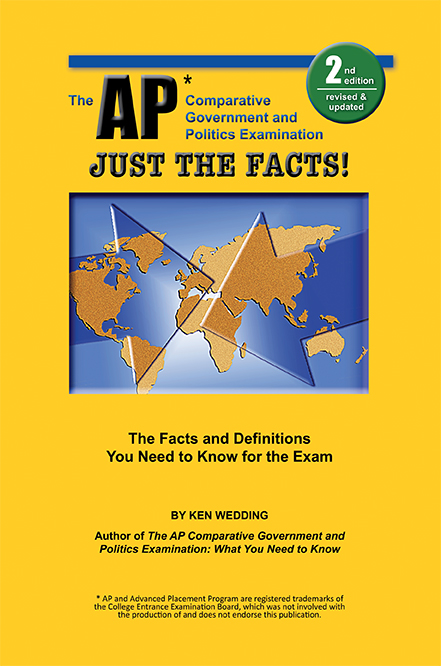 Just The Facts! 2nd edition is a concise guide to concepts, terminology, and examples that will appear on May's exam.


