Nigeria's most senior Muslim cleric has rejected a new gender equality bill, which proposes that women and men inherit an equal share.
Abubakar
The Sultan of Sokoto, Mohamed Sa'ad Abubakar, said Muslims would not accept the violation of Islamic law guaranteeing men a greater share.
Nigeria's main Christian body has welcomed the bill, saying its religion permitted equal inheritance.
Activists have pushed for the bill to end discrimination against women.
Nigeria is a deeply religious society with roughly the same number of Christians and Muslims…
[T]he Sultan… added: "Islam is a peaceful religion; we have been living peacefully with Christians and followers of other religions in this country. Therefore, we should be allowed to perform our religion effectively."…
Lawmakers say they will consider public opinion before a decision is taken on which aspects of the bill to approve and which aspects to reject…
Teaching Comparative blog entries are indexed. Use the search box to look for country names or concept labels attached to each entry.
Just The Facts! 2nd editionis a concise guide to concepts, terminology, and examples that will appear on May's exam.
The more things change, the more they remain the same.
I recall introducing the study of Russia with a comment that went something like this: "Before the revolution there was an absolute ruler who governed a country that preserved authentic civilization and absolute truth. After the revolution, Russia was governed by an absolute ruler who preserved authentic civilization and absolute truth. The rulers, the civilization, and the truths were different, but that hardly seemed to matter.
Since Putin made the Russian Orthodox Church part of the ruling coalition, the custodians of pre-revolutionary absolute truth are back in the power elite.
The golden main dome of a new Russian Orthodox cathedral now under construction on the banks of the Seine shimmers in the sun, towering over a Paris neighborhood studded with government buildings and foreign embassies…
The prime location, secured by the Russian state after years of lobbying by the Kremlin, is so close to so many snoop-worthy places that when Moscow first proposed a $100 million “spiritual and cultural center” there, France’s security services fretted that Russia’s president, Vladimir V. Putin, a former K.G.B. officer, might have more than just religious outreach in mind…
Putin
Mr. Putin has… mobilized faith to expand the country’s reach and influence… the Russian Orthodox Church helps project Russia as the natural ally of all those who pine for a more secure, illiberal world free from the tradition-crushing rush of globalization, multiculturalism and women’s and gay rights.
“The church has become an instrument of the Russian state. It is used to extend and legitimize the interests of the Kremlin,” said Sergei Chapnin, who is the former editor of the official journal of the Moscow Patriarchate…
Andrei Eliseev, the Nice cathedral’s Moscow-educated and multilingual senior priest, denied accusations by his foes in the émigré community that he works for Russia’s security agency…
But he said he nonetheless has a duty to serve the state, explaining that the Russian church has effectively been a government department since Peter the Great took control of religion in the early 18th century.
Teaching Comparative blog entries are indexed. Use the search box to look for country names or concept labels attached to each entry.
Amazon's customers gave this book a 5-star rating.
The Comparative Government and Politics Review Checklist.
Two pages summarizing the course requirements to help you review and study for the final and for the big exam in May. . It contains a description of comparative methods, a list of commonly used theories, a list of vital concepts, thumbnail descriptions of the AP6, and
a description of the AP exam format. $2.00. Order HERE.
One of the mysteries of the Iranian regime is the "morality police." Are they part of the government? Under whose authority do they operate? Or are those questions that only an ignorant non-believer would ask?
And what would be the equivalent of the Ershad in the other countries you have studied?
An anonymous team of Iranian app developers have come up with a solution to help young fashion conscious Iranians avoid the country's notorious morality police known in Persian as Ershad or guidance.
Ershad's mobile checkpoints which usually consist of a van, a few bearded men and one or two women in black chadors, are deployed in towns across Iran and appear with no notice.
Ershad personnel have a very extensive list of powers ranging from issuing warnings and forcing those they accuse of violating Iran's Islamic code of conduct, to make a written statement pledging to never do so again, to fines or even prosecuting offenders.
The new phone app which is called "Gershad" (probably meaning get around Ershad instead of facing them) however, will alert users to checkpoints and help them to avoid them by choosing a different route.
Part of Gershad screen
The data for the app is crowdsourced. It relies on users to point out the location of the Ershad vans on maps and when a sufficient number of users point out the same point, an alert will show up on the map for other users. When the number decreases, the alert will fade gradually from the map.
In a statement on their web page the app's developers explain their motives in this way: "Why do we have to be humiliated for our most obvious right which is the right to wear what we want?…
The app has rapidly become a hot topic on Iranian social media, with users generally welcoming it as an innovative way to avoid a potentially unpleasant encounter with the guardians of national virtue…
Teaching Comparative blog entries are indexed. Use the search box to look for country names or concept labels attached to each entry.
Amazon's customers gave this book a 5-star rating.
The Comparative Government and Politics Review Checklist.
Two pages summarizing the course requirements to help you review and study for the final and for the big exam in May. . It contains a description of comparative methods, a list of commonly used theories, a list of vital concepts, thumbnail descriptions of the AP6, and
a description of the AP exam format. $2.00. Order HERE.
Beneath the apparent absence of cleavages in China, there is diversity. What are the political reasons for the differences between policies in Hui and Xinjiang?
As the call to prayer echoed off the high walls of the madrasa and into the surrounding village, dozens of boys, dressed in matching violet caps, poured out of their dorm rooms and headed to the mosque.
That afternoon prayer ritual, little changed since Middle Eastern traders traversing the Silk Road first arrived in western China more than 1,000 years ago, was at once quotidian and remarkable.
Men gathering before prayers at a mosque in Linxia.
That is because in many parts of the officially atheist country, religious restrictions make it a crime to operate Islamic schools and bar people under 18 from entering mosques…
With an estimated Muslim population of 23 million, China has more followers of Islam than many Arab countries. Roughly half of them live in Xinjiang… where a cycle of violence and government repression has alarmed human rights advocates and unnerved Beijing over worries about the spread of Islamic extremism.
But here in the Ningxia Hui Autonomous Region… that kind of strife is almost nonexistent, as are the limitations on religion that critics say are fueling Uighur discontent.
Throughout Ningxia and the adjacent Gansu Province, new filigreed mosques soar over even the smallest villages, adolescent boys and girls spend their days studying the Quran at religious schools, and muezzin summon the faithful via loudspeakers…
Unlike the Uighurs, who speak a Turkic dialect and whose Eurasian features set them apart from the country’s Han Chinese majority, the Hui speak Chinese and are often indistinguishable from their non-Muslim neighbors. In much of China, the white caps worn by men and the head scarves worn by women are all that give them away…
Religious leaders said that the government had become especially vigilant about tamping down competition and potential strife among different Islamic factions. Several imams said party officials were most concerned about Salafis, an ultraconservative Sunni sect whose strict interpretation of religious texts has been associated with extremism…
The party is increasingly seeking to leverage this good will by positioning the Hui as mercantile emissaries to the Muslim world, a role that has been bolstered by President Xi Jinping’s national initiative for a new Silk Road, known as One Belt, One Road, which seeks to revive China’s ancient trade routes with Asia, Europe and the Middle East…
Teaching Comparative blog entries are indexed. Use the search box to look for country names or concept labels attached to each entry.
Amazon's customers gave this book a 5-star rating.
The Comparative Government and Politics Review Checklist.
Two pages summarizing the course requirements to help you review and study for the final and for the big exam in May. . It contains a description of comparative methods, a list of commonly used theories, a list of vital concepts, thumbnail descriptions of the AP6, and
a description of the AP exam format. $2.00. Order HERE.
Ken Halla posted a link to John Green's version of recent Iranian history and politics. It's good, but in 13 minutes of illustrated lecture, you can't do everything. I wish the narrative was more integrated (it jumps from history to politics to history and back to politics in the middle section). Some things are, to me, over simplified and under explained. Maybe they won't be for your students.
One of the earliest comments on YouTube was
"Great video, however, how did you fail to mention:
"-The Iran-Iraq war
"-Khomeini Mass executions and the sick nature of the Islamic regime
"-The immensely corrupt nature of the Islamic regime
"-The wider scope of the Shah's contributions
"-The further details of the Anglo-Russian invasion? "
I'd recommend Green's lecture as a follow-up to studying government and politics in Iran, and ask students to critique it. If I were using it, I'd divide it into 3 or 4 segments for discussion. And I'd ask students to pay special attention to the final segment which addresses comparative government directly.
John Green teaches you about Iran's Revolutions. Yes, revolutions plural. What was the 1979 Iranian Revolution about? It turns out, Iran has a pretty long history of unrest in order to put power in the hands of the people, and the most recent revolution in 1979 was, at least at first, not necessarily about creating an Islamic state. It certainly turned out to be about that, but it was initially just about people who wanted to get rid of an oppressive regime. Listen up as John teaches you about Iran's long history of revolution
And the citations, in case you don't see them at the bottom of the YouTube annotation:
Citation 1: Caryl, Christian. Strange Rebels: 1979 and the Birth of the 21st Century. New York, Basic Books. 2014, p. 11
Citation 2: Axworthy, Michael, Revolutionary Iran: A History of the Islamic Republic. Oxford U. Press. 2014, p. 62
Citation 3: Quoted in Axworthy, p. 81
Citation 4: Axworthy, p. 114
Citation 5: Axworthy, p. 163
Teaching Comparative blog entries are indexed. Use the search box to look for country names or concept labels attached to each entry.
China will continue to promote the development of Christian theology and establish a Chinese Christian theology, a top religious affairs official said on Tuesday.
"Over the past decades, the Protestant churches in China have developed very quickly with the implementation of the country's religious policy. In the future, we will continue to boost the development of Christianity in China," said Wang Zuoan, director of the State Administration for Religious Affairs.
Wang said Chinese Christian theology should be compatible with the country's path of socialism.
"The construction of Chinese Christian theology should adapt to China's national condition and integrate with Chinese culture," Wang said at a seminar on the Sinicization of Christianity in Shanghai, part of an event to celebrate the 60th anniversary of the founding of the National Committee of the Three-Self Patriotic Movement of the Protestant Churches in China…
According to the State Administration for Religious Affairs in 2012, the country has about 139,000 approved religious places. Among them, there are about 56,000 Christian churches and gathering sites.
By the end of last year, the country had published 65 million copies of the Bible, including editions in minority languages. Additionally, China has 22 theological seminaries across the country…
A five-year campaign to promote Christian theology in China, launched in 2013, will provide theological guidance for church rostrums in China and will promote the positive and correct theological thinking with a range of publications, exchanges, discussions and evangelism…
"This will encourage more believers to make contributions to the country's harmonious social progress, cultural prosperity and economic development," Gu Mengfei, deputy secretary-general of the National Committee of the Three-Self Patriotic Movement of the Protestant Churches in China, said.
Teaching (and learning) comparative government and politics is a complex and demanding task. We can all use all the help we can get. This cyber place is somewhere to facilitate helpful interactions.

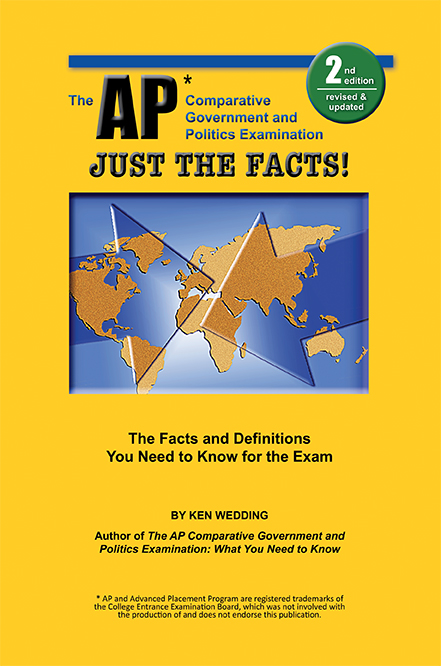 Just The Facts! 2nd edition is a concise guide to concepts, terminology, and examples that will appear on May's exam.


