ON A recent stormy night, Moscow’s hip crowd gathered for the opening of the summer terrace at the Strelka architecture and design institute, which has one of the city’s trendiest bars. It has served as a shelter for educated, Westernised and privileged Muscovites.. .
President Putin
When Vladimir Putin returned to the Kremlin a year ago many expected repression to be swift and brutal. But he took his time, letting the public and the West get used to each small tightening of the screw. A year on the growing repression is clear…
The former president (now prime minister), Dmitry Medvedev, who symbolised a quasi-thaw, has not yet been fired, but he has been weakened…
[F]aced with mass protests by civil activists and ordinary citizens, not politicians, the Kremlin is trying to extend its control to other areas, including the internet and even entertainment magazines which carry protest banners…
A problem with Russian politics is that so much of it happens in one man’s head. A turn towards repression may not be a sign of Mr Putin’s strength, but rather of his fear and desperation. Some advisers say he is worried about instability and is doing as much as he can to eliminate anything or anyone that contributes to it…
What he does not see is that the biggest destabilising factor of all was his own return to the Kremlin. In trying to hold the situation still, he destabilises it further, forcing further repression. Lacking a coherent ideology, the Kremlin is justifying itself by ratcheting up its confrontation with the West and its search for enemies within. It has partly succeeded… Nationalism, xenophobia and intolerance, once part of the political fringe, have become mainstream… Confrontation with the West has a polarising effect on the Russian elite, squeezing out those most linked to the West and strengthening the siloviki, the security services, who demand more purges…
Nigeria's constitution was promulgated by a military government. Ever since, there have been people arguing for a thorough re-write by an elected body. That task has been so politically daunting that it's never gotten off the ground.
Now, the national legislature is beginning a new effort to revise the constitution. Or at least the legislators want it to look like they're making an effort to get people's ideas about revision.
The House of Representatives Committee on Constitution Review is commencing an innovative discourse with Nigerians in 360 centres spread across the federal constituencies in the country tomorrow. It is a bold attempt at addressing the disconnect between "We the People" and the 1999 Constitution decreed by Nigeria's last military dictatorship…
The town hall meetings taking place in all 360 federal constituencies of the country is an innovative effort by the [Speaker of the House] Aminu Tambuwal... to redefine the process of lawmaking. Specifically, at tomorrow's town hall meetings, each member of the House is expected to preside over a meeting in his or her federal constituency during which the inputs of the stakeholders would be garnered into the ongoing constitution review process of the House of Representatives.
Asemota
Chief Solomon Asemota, SAN, one of the country's senior lawyers said… "We need to consult the people and the correct thing is to have a Constituent Assembly to prepare a draft… "
Styled as the Peoples' Public Sessions, the town hall meetings to be presided over by the members representing each of the 360 federal constituencies is expected to incorporate strategic stakeholders from the federal constituencies…
It is expected that the public sessions will sufficiently equip the members of the House of Representatives to articulate the various issues affecting their constituencies for onward presentation to the House Committee on Constitution Review.
In spite of the fact that the Nigerian officer corps is dominated by Muslims from the north, this escalation of terrorism is a threat to national unity.
It seems that the issue of how European the UK should become is always on the table in Britain. This time it's not monetary union, but law enforcement union.
Prime Minister David Cameron told reporters his country would be exercising its right to opt out of a mass of European policing and crime measures…
At issue are about 130 criminal-justice arrangements… access to police databases, membership of Europol and Eurojust… and prisoner transfers. The Lisbon treaty, which came into effect in 2009, converts them from non-binding agreements into mainstream laws enforceable by the European Court of Justice (ECJ) after November 2014… Britain and Ireland, common-law countries in a sea of civil law, got the right to opt out…
Many in Europe find the government’s reluctance to sign on the dotted line incomprehensible. But there is widespread unease in Britain over how some arrangements are working… Local courts have little discretion in executing other countries’ arrest warrants, even when varying standards of procedural fairness and respect for human rights make nonsense of the mutual recognition that underpins the system…
What of the domestic audience? Tory Eurosceptics are pressing for an in-out referendum on EU membership. To Mr Cameron, who does not want one, tossing them the opt-out may appeal as a placatory gesture…
But opting out would enrage the Tories’ Lib Dem coalition partners, who fought the 2010 election on a pledge to keep Britain “fully engaged” in EU crime policies and are sick of reneging on their promises. Parliament is guaranteed a vote and should get it about a year before the next election. By then the coalition partners could well be at daggers drawn, and the Lib Dems join Labour against an opt-out, in a sign of allegiances to come.
If law is so complex that people cannot know what is legal, is that really rule of law? Or is this another example of a Potemkin Village in Russian politics and government?
FOR generations of Russian leaders, the law has been a tool of state power, not a limit on its abuse. In recent months, as Vladimir Putin, Russia’s president, and his advisers have navigated an unfamiliar political environment, they too have fallen back on a kind of nominal legalism, in which the law is less for protecting the citizenry than an instrument of power.
As the Kremlin sees it, compared with uglier measures of neutralising dissent, the law is an “efficient and civilised tool”… In practice, that means the law can be deployed selectively against political opponents, or laws can be drafted to solve immediate problems.
Gudkov
On September 14th a majority in the Duma voted to strip Gennady Gudkov of his seat in parliament… Mr Gudkov, a deputy with the left-leaning Just Russia party, says he was targeted for being the most outspoken member of a small anti-Kremlin group of lawmakers…
He says that his expulsion shows that not only “is it possible to distort the law as convenient” but that “it’s possible to go entirely beyond the law without consequence.”
The past months have been a busy season for the Russian legal system. In August three women from a punk collective, Pussy Riot, were sentenced to two years each in prison for an anti-Putin stunt… In June a package of new repressive laws… raised fines for unsanctioned demonstrations and required foreign-funded NGOs to register as “foreign agents” (the authorities have just told one of the main sources of such grants, America’s USAID aid agency, to cease operations). Other laws recriminalise libel and create a blacklist of (loosely defined) offensive websites.
Taken together, these new laws are not as likely to be consistently enforced as much as they are meant to intimidate. Above all, the goal is to put the opposition and its supporters in a state of permanent legal jeopardy.
The Russian legal code is a thicket of often contradictory rules and responsibilities. Ella Paneyakh of the Institution for the Rule of Law at the European University of St Petersburg says that owners of small and medium-sized businesses “cannot even keep track of the law, let alone decide whether to follow it.” That leaves them vulnerable to arbitrary predation by law-enforcement bodies.
This sense of opacity and impenetrability gives the authorities the upper hand. The overall impression, says Igor Kalyapin of the Committee Against Torture, is that the “law is the property of those of who enforce it, and written exclusively for them.”…
The danger in using the law to solve short-term political problems, say people inside the Kremlin as well as its critics, is that it risks creating a precedent. Legal sanctions, even when subjectively applied, can take on a momentum of their own…
A GLANCE AT THE news from China on Friday might suggest a political system reacting properly to high-level wrongdoing… But does the official version of events in Chongqing match what really happened?…
China possesses courts, laws and judges. But… China still is not governed by rule of law, the simple but unshakable principle that no one — not the party, not the Politburo — is above the law…
China’s Communist Party bosses see the law as a tool of control, a method to intimidate those who challenge their policies or their monopoly on power… A larger point is that rule of law is the best method for regulating competition among different groups in society, for settling disputes and serving as a check against abuse of power. It is an essential pillar of democracy, a concept that fills China’s leaders with trepidation.
In the case of the ousted Mr. Bo, it seems the party wanted to dispose of the embarrassing scandal before the Nov. 8 opening of the 18th Party Congress, at which the next generation of leaders will be anointed. But the high-profile expulsion of Mr. Bo only reinforces a sense that it is the party, and not the law, that reigns supreme.
2005 map of Worldwide Governance Indicators (based on the World Bank's data), which attempts to measure the extent to which agents have confidence in and abide by the rules of society. Colors range from dark green (90th-100th percentile) to light green (75th-90th percentile),yellow (50th-75th percentile),orange (25th-50th percentile),pink (10th-25th percentile) and red (0th-10th percentile). Percentile rank indicates the percentage of countries worldwide that rate below the selected country.
The presumed future supreme leader has not been seen for a couple weeks in China. Rumors abound about a power struggle, an accident, or a heart attack. Will the system be able to adjust when the carefully constructed political deals were almost complete?
With still no sign of China’s designated new leader, Xi Jinping, who has not been seen in public since Sept. 1, many insiders and well-connected analysts say the Chinese political ship is adrift, with factions jockeying to shape an impending Communist Party conclave…
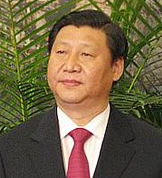
Xi Jinping
By Thursday, a number of ranking party members with years of experience following Chinese politics were generally in agreement that Mr. Xi, 59, had suffered either a mild heart attack or a stroke, forcing him to cancel his appointments…
Planned years in advance, the 18th Party Congress is slated to be the most sweeping government reorganization in a decade, with scores of leaders scheduled to retire. It was still expected to take place next month or soon after in Beijing, where Mr. Xi was to take over as leader from Hu Jintao. The Communist Party has numerous factions, but the overall framework of the transfer was thought to have been mostly ironed out over the past year.
But recent developments, including Mr. Xi’s mysterious cancellation of several public appearances, suggest that may not be the case.
The most obvious sign of discord is that the dates for the congress have not been set. Most political experts here expected it to be held in mid-October, but without an official announcement, some are predicting it will be delayed…
One reason for the delay, the experts say, is what now appears to have been a contentious meeting in early August at the seaside resort of Beidaihe, China… “The atmosphere was very bad, and the struggles were very intense,” said a political analyst with connections to the party’s nerve center, the General Office…
[T]ough questioning may seem the bedrock of courtroom justice in the United States, but here in Mexico… trials are decided by judges and rely almost entirely on written briefs…
Four years ago, Mexico’s Congress adopted a legal overhaul that will enable prosecutors and defense lawyers to present evidence and question witnesses in open court, a practice that already exists in a few states but whose rollout is scheduled to be completed nationwide by 2016.
Discussing cross-examination
More open trials, the theory goes, will increase due process and accountability in a country where the much-publicized arrests of cartel bosses are common, but the actual convictions of criminals are not…
Police corruption is rife. Investigations are often shoddy, and mass jailbreaks common. And while Mexico’s effort to turn around its justice system is a slow, long-term process that may not pay dividends for years, analysts on both sides of the border say it is vital nonetheless.
These reforms “are key,” said José Antonio Caballero Juárez, an investigator at CIDE, a Mexico City research institute. “They will give transparency to a process that is at the moment very opaque.”…
Judges, American officials have said, have been among the most resistant to the change because in the current system, which dates to the 19th century, their determinations face little scrutiny. Prosecutors and defense lawyers submit written reports and documents to a judge who reviews them privately and issues a verdict, often with little explanation. Proceedings are conducted almost entirely behind closed doors, leading to worry about the possibility of bribery…
Mexico has 31 states and one federal district, but only a handful of them have fully adopted the oral trial system. Prosecutors, lawyers and judges have to undergo training, but legal experts say that it is mostly a lack of willingness from the government that has delayed the transition…
Mexico's Supreme Court on Tuesday declared unconstitutional a key portion of a military law that has broadened the influence of military courts and angered civilian victims seeking justice.
The 8-2 ruling said a provision of the Code of Military Justice that claims authority over all crimes committed by soldiers on duty is incompatible with Mexico's constitution. The ruling said it violates a federal law stipulating that military courts should not expand their scope over civilians affected by a case…
Rights groups and Mexican news media obtained records that showed military prosecutors opened nearly 5,000 investigations into alleged violations of human rights between 2007 and April 2012, but only 38 service members were convicted and sentenced. The number of complaints has increased since President Felipe Calderon deployed tens of thousands of soldiers to crack down on drug traffickers…
"This is the most important step the Supreme Court has ever taken toward ending the longstanding practice of sending abuses by soldiers to military courts," said Nik Steinberg, the Mexico and Cuba researcher of Human Rights Watch…
In Mexico, five separate rulings in different cases are required to set a broad precedent beyond the individual cases. The Supreme Court recently issued a ruling in another case holding that when the victim of an alleged crime is a civilian, an ordinary judge should oversee the case, and it still has to rule on 27 other cases involving the military.
A Moscow judge handed down prison sentences of two years on Friday afternoon for three young women who staged a protest against Vladimir V. Putin in the Cathedral of Christ the Savior last February and whose jailing and trial on hooliganism charges have generated worldwide criticism of constraints on political speech in Russia…
As the judge, Marina Syrova, read the lengthy verdict, hundreds of demonstrators gathered outside the courthouse and shouted, “Free Pussy Riot!”
Riot police officers arrested dozens of them, including the former chess champion Garry Kasparov, who is active in the Russian political opposition. Mr. Kasparov fought with the police and appeared to be beaten as he was bundled into a paddy wagon…
Nadezhda Tolokonnikova in court
The case has become a touchstone in the unfolding political drama that began in Russia after disputed parliamentary elections last December. That is partly because of the sympathetic appearance of the defendants — two are mothers of young children — partly because their group uses music to carry its message, and because it has pitted them against a united power-structure: the Kremlin and the Russian Orthodox Church.
While the case has allowed opponents of Mr. Putin, the president, to portray his government as squelching free speech and presiding over a rigged judicial system, it has also handed the government an opportunity to portray its political opponents as obscene, disrespectful rabble-rousers, liberal urbanites backed by the West in a conspiracy against the Russian state and the Russian church…
Empress Dowager Cixi, Soong Mei-ling, Jiang Qing, and now…
As Andrew Jacobs points out in his New York Times report, women close to political power in China have often been cast in roles that are complex and dangerous. And, most of them have been seen as operating behind the scenes. (We ought to expect that given the near absence of women in the top ranks of the Communist Party.)
In a nation that prefers the wives of political leaders to be bland adornments, Gu Kailai was positively fluorescent. Married to Bo Xilai, the Politburo member whose downfall earlier this year is still shaking the Communist Party, she reveled in her brash, ambitious ways…
But in formally charging her… with the poisoning death late last year of a British businessman, the Chinese government, almost certainly intentionally, has placed the larger-than-life Ms. Gu into a familiar Chinese framework: the conniving, bloodthirsty vixen whose hunger for money derailed her husband’s promising career.
[M]any wonder if party leaders are using her case to deflect public disgust over the kind of corruption and abuse of power that critics say was embodied by her husband. Mr. Bo, who was suspended last April from the Politburo and has not been heard from since, has so far remained in a parallel justice system reserved for the party elite. His fate was not mentioned in the brief statement announcing his wife’s trial.
“Throughout Chinese history, whenever there’s a political struggle, whenever someone has to fall, they blame the wife,” said Hung Huang, the publisher of a fashion magazine whose own mother, Mao Zedong’s former English tutor, spent two years under house arrest after she was accused of collaborating with the Gang of Four.
Chinese history is sprinkled with tales of cunning women whose outsize ambitions led them — and sometimes the men in their lives — to ruination. Jiang Qing, Mao’s wife, took much of the blame for the calamitous decade of the Cultural Revolution, a point driven home in a televised show trial that electrified the nation. And Chinese schoolchildren can readily recite the crimes of Empress Dowager Cixi, who is portrayed as a rapacious, homicidal leader whose machinations helped topple the Qing dynasty…
Bo Xilai
Susan L. Shirk, an expert on Chinese politics, said party officials might be reluctant to accuse Mr. Bo of participating in a cover-up of the murder, given his popularity among some ordinary Chinese and with an influential faction of the leadership.
“They have to handle this in a way that protects Bo Xilai’s reputation,” said Ms. Shirk, a former State Department official who teaches at the University of California, San Diego. “They don’t want all the dirty laundry of elite politics to be aired because they really don’t know the potential threat posed by Bo’s followers.”
Like her husband, Ms. Gu is the offspring of a revolutionary hero, and like many “princelings” she experienced her share of hardship during the Cultural Revolution. Forced to fend for herself after her family was imprisoned, she worked for a time as a butcher and a bricklayer, according to accounts in the state news media. In the late 1970s, though, she was among the first batch of students to be admitted to college after the death of Mao...
As if there weren't enough things to learn about in a Constitution and established procedures, then students have to understand the informal methods of governance and politics. And they have to understand that "informal" doesn't mean casual or flexible. It means, in this case, things that are not included in the official rule of law -- like guanxi.
These informal bits include everything from the "rules" of behavior in the House of Commons or how the leadership of China's Communist Party is actually determined.
Are informal politics more important in democratic regimes, regimes that want to be seen as democratic, or non-democratic regimes? (Oh, that sounds like a rough draft of an FRQ.)
Communist Party elders and their families are congregating [in Beidaihe] about 180 miles east of Beijing, to swim and dine and gossip — and to shape the future of the world’s most populous nation.
It is palace intrigue by the sea. In their guarded villas, current and past leaders will negotiate to try to place allies in the 25-member Politburo and its elite Standing Committee, at the top of the party hierarchy. The selections will be announced at the 18th Party Congress this fall in Beijing, heralding what is expected to be only the second orderly leadership transition in more than 60 years of Communist rule.
“This is where the factional struggles are settled and the decisions are made,” said one resident, surnamed Li, who, like others interviewed for this article, spoke on the condition of anonymity because of the delicate nature of Chinese politics. “At the meetings in the fall, everyone just raises their hands.”
Beidaihe is a Chinese combination of the Jersey Shore and Martha’s Vineyard, with a pinch of red fervor:… the party elites remain hidden in their villas and on their private patches of sand…
The informal talks are expected to start late this month and run into August.. In any case, politicking is inevitable when party elders show up to escape the stifling heat and pollution of Beijing…
Mao at a Beidaihe beach
Mao… convened formal conclaves here. His successor, Deng Xiaoping, made the meetings into annual events (he also took swims, supposedly to counter rumors of his ailing health)…
There are plots and counterplots… Negotiations here will be complicated by the continuing scandal over Bo Xilai, the deposed Politburo member who was most recently party chief of Chongqing…
During the negotiations, each current Standing Committee member should, at least in theory, have considerable say in determining the successor to his particular post. But party elders behind the scenes sometimes wield more authority. Mr. Jiang, though retired and ailing last year, may carry the greatest weight next to that of Mr. Hu. The heir apparent, Vice President Xi Jinping, also plays a role.
“Consensus among these three — the former, current and incoming leaders — is extremely important,” said Zhang Xiaojin, a political scientist at Tsinghua University in Beijing….
Those debates are remote from the lives of most people in Beidaihe. Yet talk of politics flows loosely here. At a beach reserved for local officials, next to an almost-deserted patch of sand blocked off for party leaders, a retired official in swim trunks pointed to the villas across the road. He said the children of party leaders had made off with too much money through corrupt practices in state industries…
“What are they good for?” the retired official asked. “What did they inherit from their fathers? They should have inherited the solidarity of the revolution.”
Every year about this time, the temperatures in Tehran rise, and the morality police make extra efforts to enforce what they see as an Islamic dress code. Once in a great while, a man will be cited for an "improper" hair style, but nearly all of the efforts are directed at women. (And every year, Western media cover the story.)
And the political effects? Or the effects on civil society and rule of law?
An annual test of wills between Iran’s morality police and women who dress in ways that are deemed unacceptable has begun in cities across the Islamic republic.
But this year, the stakes are unusually high. As Iranian leaders attempt to deflect the public’s attention away from economic woes spurred by crushing foreign sanctions, they risk alienating large segments of a society that is already deeply divided…
While the laws regarding proper cover haven’t changed, some women have grown bolder in interpreting the limits of what they can wear, creating a conflict that inevitably flares each summer as the temperatures climb.
The government’s offensive this year has been marked by the stationing of mixed-gender teams of morality police in Tehran’s main squares.
Already this summer, 53 coffee shops and 87 restaurants have been closed in Tehran for… gender-related offenses.
Such aggressive enforcement and stiff penalties have spawned resentment.
“I felt disrespected and insulted,” said 30-year-old Sahar, who was arrested for wearing sleeves that only went to her forearms…
Tehran police chief Ahmad- Reza Radan this month called support for improper hijab “part of the enemy’s soft war against us.”…
Finding urban Iranians who actually support the program to enforce hijab is increasingly difficult. Even many women who dress conservatively find the patrols distasteful…
Daring Tehran outfits
Mostafa, a 46-year-old marketing consultant, described how his 16-year-old daughter was arrested in a crowded shopping mall. “They coaxed her into the police van and told her they just wanted to talk to her,” he explained. “Once she was in the van the whole atmosphere changed and they said things that made her cry.”
After a brief time in custody, his daughter, Banafshe, was released. “Do you know what her response was to the whole episode?” he asked. “She said, ‘Dad, as soon as I finish high school I’m leaving this country forever.’”
Russian NGOs that receive funding from abroad will have to register as "foreign agents" and undergo extra checks under a new bill that critics warn is part of a crackdown on independent activists.
The bill, backed by the ruling United Russia party, would require foreign-funded NGOs involved in political activities to tag all publications and websites with the label "foreign agent"…
A video in support of the bill says: "You have the right to know who is trying to influence your opinion. Our country must have an opposition, but if it is protecting foreign interests, you have the right to know that."…
Many of Russia's most prominent NGOs, including the corruption watchdog Transparency International, the election monitor Golos and the environmental group Greenpeace Russia, rely on foreign grants to operate in a country where the government often views them as enemies…
Supporters of the law have likened it to similar legislation in the US that requires lobbyists employed by foreign governments to reveal their financing. Critics worry that it could be applied selectively in a country lacking rule of law…
[Opponents] said finding sponsors among wealthy individuals or businesses inside Russia had become impossible since the arrest of the former Yukos chief Mikhail Khodorkovsky in 2003, which was partly seen as punishment for his funding of opposition and democracy activists.
A source inside the Kremlin said on Sunday that about 1,000 of the 230,000 NGOs operating in Russia were likely to fall under the restrictions…
Details on efforts to prevent voter fraud in Mexico
We don't often learn about the detailed, bureaucratic work that goes into preventing voter fraud — especially in Mexico, where history suggests that corruption is common.
These details come from an experienced Mexican official who is earning a Ph.D at New York University, Marco A. Morales.
A bit of Mexican electoral history could provide some necessary context. Decades of one-party dominance supported by tampering with the vote created a plethora of allegories for common electoral practices…
With these precedents, it is no surprise that recent Mexican electoral history is characterized by attempts to foster trust in electoral outcomes, primarily by coping with three main forms of electoral fraud: controlling who votes, tampering with the vote count, and vote buying.
The first type of fraud – on the voter list – has been addressed through a voter registration list that is administered by an autonomous electoral authority…
The second type of fraud – in the counting of votes – has been addressed with multiple layers of scrutiny. Polling stations are manned by randomly selected citizens, whose performance can be audited in situ by party representatives and citizen observers…
The third one – vote buying – has been addressed by making it a criminal offense that is to be investigated by a Special Prosecutor. But as many have pointed out, the challenge on this specific area is considerable as evidence should show beyond doubt that the “incentive” did change the original vote intent and that these “sold” votes changed the outcome of the election…
To summarize, there were no complaints of the first type of fraud on this election. And while there were plenty of complaints of the second type of fraud, they were for the most part addressed and dispelled in the process that just ended. What lies ahead are complaints of the third type of fraud: massive vote buying.
As you prepare to pay attention to a presidential election in Mexico, think about the tenuous coalition in London, ponder the transition going on in Beijing, the balancing acts in Abuja, and the infighting in Tehran, do you want another example to offer as a comparison to the other countries your students study?
Following the death of Saudi Arabia's Crown Prince Nayef, heir to the throne, in new successor will be determined by the king and a family council known as the Allegiance Council.
Defence minister Prince Salman, likely to be named heir apparent.
The council has a representative of each line of the al-Saud ruling family born to King Abdulaziz Ibn Saud, the kingdom's founder. As well as his surviving sons, it includes his grandsons representing kings and princes who have already died or are not well enough to participate.
It must be headed by the eldest son of the kingdom's founder beside the king or crown prince…
The king nominates one, two or three candidates to become crown prince and the Allegiance Council votes to approve his choice or select one of his nominees. If the council does not find any of his candidates suitable, it can produce its own nominee from the sons or grandsons of Ibn Saud. In a departure from historical practice, the council has the ultimate say on succession instead of the king...
What this report from Edward Wong in The New York Times illustrates is how far the Chinese system has come in creating a rule of law and some of the political limits imposed on that rule of law by those who want to maintain a rule of Party.
China’s Justice Ministry has issued a requirement that new lawyers and those reapplying for licenses swear an oath of loyalty to the Communist Party, another step in a campaign to rein in lawyers who continue to challenge the political and legal systems by which the party maintains power.
The Justice Ministry posted the oath on its Web site on Wednesday. The core of it says: “I swear to faithfully fulfill the sacred mission of legal workers in socialism with Chinese characteristics. I swear my loyalty to the motherland, to the people, to uphold the leadership of the Communist Party of China and the socialist system, and to protect the dignity of the Constitution and laws.”
Several lawyers said the oath was the first they knew of to force them to pledge fealty to the Communist Party. China has been tightening controls over liberal voices for several years, prompted by fears of unrest during the 2008 Olympics, concerns that the Arab revolutions might inspire domestic dissent, heightened tensions with ethnic minorities like the Tibetans and the Uighurs in the west, and the need for stability during this year’s once-a-decade leadership transition.
Rights lawyers say the controls have contributed to a severe rollback of legal reforms and are undermining efforts to strengthen the rule of law…
“The oath itself is full of contradictions,” said Pu Zhiqiang, a lawyer who has represented Lu Qing, the wife of Ai Weiwei, the rebel artist who was detained without charge in two secret locations for 81 days last year. “Lawyers swear loyalty to the party and to the sanctity of the law? We all know that the party’s interference is often the reason why the law can’t be implemented.”…
Stratfor says the Zetas' brutal violence seems to have given the gang an advantage over the Sinaloa cartel, which prefers to bribe people…
According to the study, most smaller drug gangs have been subsumed by either the Zetas or the Sinaloa cartel, turning the two groups into the predominant criminal forces in Mexico.
The Zetas control much of eastern Mexico, while the Sinaloa cartel has its stronghold in the west of the country.
The authors also… say that the Zetas whose leadership is composed of ex-special operations soldiers, resort to extreme violence.
The Sinaloa cartel, although also ruthless, prefers to bribe and corrupt people, as well as providing intelligence on rivals to the authorities…
The Mexican security forces have arrested 11 alleged members of the country's most powerful drug gang, the Sinaloa cartel…
They were arrested during a helicopter raid on a ranch in the north-western state of Durango on Friday.
During the raid, elite troops killed the regional leader of the gang, Luis Alberto Cabrera Sarabia…
The Sinaloa cartel controls much of the flow of cocaine, marijuana and methamphetamines into the United States via air, land and sea, and is believed to have links in as many as 50 countries…
In the past two weeks, the Occupy Nigeria movement has developed far beyond a demand to return the price of fuel to N65 per litre, with calls for the government to reduce its own bloated costs and investigate the obviously rampant corruption in the oil sector. Already, the government has responded, with the Minister of Petroleum’s statement this evening to invite the EFCC to investigate fuel subsidy payments and for an independent auditor to follow-up on the KPMG report. Whether or not this belated action is sufficient to counter a cynical response, deeper issues still have been raised to the surface. Nigerians are beginning to ask fundamental questions about the kind of country they would like to live in. A new sense of what Nigerian citizenship might provide is floating up into the air.
I invite you to compare and contrast for a moment the role the US Constitution plays in the lives of Americans with that of the Nigerian Constitution in Nigeria… At this stage, I’m simply asking you to dwell on the impact and effects of both constitutions on everyday life, and nothing more.
As we know all too readily from US media and discourse, Americans are raised to understand their constitution and the definition of the rights of the citizen enshrined within the all-important Amendments. Laws in the US are grounded in the constitution and must be formulated in accord with how the rights of the citizen are set in balance against the tripartite powers of the state (the executive, the legislature and the judiciary) in the context of a secular federation. Above all, thanks to the constitution, the rights of the individual run deep in American discourse. No matter the myriad and profound historical errors of the United States (originating in the twin horrors of an erasure of indigenous peoples and African slave labour), Americans are justifiably proud of the constitutional and legal instruments that guide their lives…
In Nigeria, we often experience almost the diametric opposite to the statutory privileges of the US Constitution. Many Nigerians have little idea of the contents of their constitution and are not taught the document at school. Nigerians are therefore not educated to be citizens of their own country; they are not made aware of their rights or brought to understand the role government should play in their lives since they are used to performing the roles themselves i.e. providing security, education, health etc…
Nigerians are also scarcely aware what powers the state is given, and what rights Nigerian citizens have in response…
It is therefore little surprise that the 1999 Nigerian constitution is often ignored in the current institutional arrangements of the state… The practice of creating institutions which have no grounding in the constitution effectively licenses an ‘anything goes’ approach to governance, whereby the revenues from oil can be frittered away by quasi-legal quick-fixes without any accountability checks and balances. Billions of dollars can, and have disappeared in the process, with little to show for the money…
Given the collective passion of Nigerians in the past few weeks for a new consensus, the time has never been more ripe for a complete rethinking of the Nigerian constitutional DNA, finally wiping the slate clean the legacy of British colonial rule and its post-Independence military offshoot. The place of beginning should lie in the definition of the core powers of the State (the legislature, the executive and the judiciary) vis-à-vis the rights and obligations of the citizen… The simple truth is that under the current constitutional framework, the president has far too much power in Nigerian governance… There should be many more autonomous counterbalancing powers built into the system and institutions created whose remit is to provide checks and balances on Presidential prerogative…
There are many more aspects of the 1999 Constitution which need to be amended. However, my humble suggestion is this: not to attempt to renovate a house in which people have lived uncomfortably for so long. Why not start again, modelling a new Nigerian Constitution on a paradigm template (from the US, or from South Africa for example), which empowers citizens regardless of region, gender, sexuality or creed and reduces the overwhelming power of the “Commander in Chief”, recalibrating what it means to be a Nigerian citizen, facing the 3rd millennium in a changing world…
Over the last week, a well-known writer and a Jehovah’s Witness in Siberia have become two more Russians to fall foul of a murky and much-criticized law purported to fight terrorism but being turned against a broad and seemingly random array of people.
Grigory Chkhartishvili, better known as Boris Akunin, the writer of best-selling historical mysteries, revealed in his blog that a federal investigative body subordinate to the Kremlin had summoned his publisher for questioning about possible extremist statements in his latest book…
The Investigative Committee of the Russian Federation said it had been alerted that Mr. Chkhartishvili’s novel might be in violation of a law pushed through by the Kremlin in 2002, purportedly to fight terrorism, and amended in 2006…
The Investigative Committee quickly concluded it had found no offending passages…
On Thursday, a court in the Gorno-Altaisk region of Siberia found Aleksandr Kalistratov, a Jehovah’s Witness, guilty on charges of disseminating extremist materials…
Religious literature distributed by the Jehovah’s Witnesses is on a list of extremist literature compiled by Russia’s Ministry of Justice…
Teaching (and learning) comparative government and politics is a complex and demanding task. We can all use all the help we can get. This cyber place is somewhere to facilitate helpful interactions.

 Teaching Comparative blog entries are indexed.