Big government buildings undergo constant repairs and renovations, but sometimes real rebuilding needs doing. (
See a report on the $310 million renovation of Minnesota's state capitol.)
Westminster is rotting from within
The Palace of Westminster, with its cinematic Big Ben clock, set beside the River Thames, is a survivor — of epic fire, German bombs, sulfuric smog and bad plumbing.
An eccentric masterwork of Victorian genius, its dual chambers for lords and commoners are the living, breathing heart of constitutional monarchy, the home of Parliament, and one of the most photographed buildings in the world.
But Westminster is a wreck, its caretakers say.
The palace is not falling down. Not at all. Its bones, the superstructure, are solid enough, and carrying on…
Rather, Westminster is rotting from the inside, its water and waste pipes sclerotic, its ventilation shafts congested, its neural networks — the communication, electric, fire systems — nearly shot…
 |
| Westminster service tunnel |
British lawmakers approved one of the most ambitious restoration projects of the modern age, a $5 billion scheme that would see the entire Parliament — the lawmakers, clerks, staff, guards, journalists, bartenders, everybody — decamp to nearby buildings for six years while a massive refurbishment is undertaken…
The work is scheduled to begin in 2025, with the hope that, sometime in the early 2030s, Parliament will return to its home. Exact dates are fuzzy, because the restorers say they won’t really know what they’re dealing with until they start ripping things apart…
The roofs leak, badly — sometimes there are buckets to catch the weepy drip in the Lords chamber. Moths are nibbling at Augustus Pugin’s wallpaper, mice scurrying across the encaustic tiles, and bad humors rising from the bowels below, where an 1880s sewage ejector plays the role of Sisyphus, condemned to spend its eternity trying to keep up with the flushing loos above.
Which are failing, by the way, occasionally catastrophically…
The Westminster complex covers eight acres, 17 football fields, and has more than 125 staircases and 1,100 rooms, probably more, and almost three miles of passageways.
The palace sees thousands of staff and lawmakers a day pass through and a million visitors a year. The kitchens serve up to 3,000 meals a day in the old-school dining rooms, another 2,500 in the modern cafeteria, and untold cups of tea.
There are eight bars.
The palace is alive…
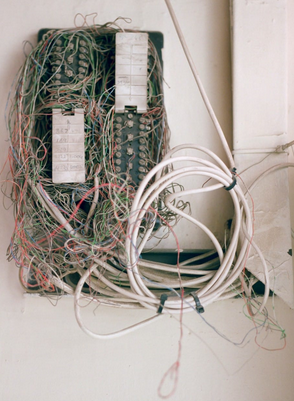
The engineers confessed that there had been so many ad hoc repairs and workarounds over the past half-century that no one was sure what went where.
“We can have an educated guess,” said Stewart, pointing at a mass of water, electric, Internet and phone lines.
“But a phone line to where?” He arched an eyebrow…
Repairs have been delayed for years — because the Parliament did not want to pay for them, and also because of the potential disruption…
Today, fire crews wander the premises 24 hours a day, seven days a week. There were a half-dozen minor but worrying blazes last year, and hundreds of toilet failures, and a crack in a main sewage pipe…
 |
| Westminster junction box |
The engineers point out postwar sewage and water pipes running above 1960s electric lines above 1970s phone lines above more modern Internet cables.
“We can’t fix it as fast as it falls apart,” Healey said. “The Palace of Westminster is 150 years old, and every building has a kind of life cycle.”
“It’s time,” he said.
Teaching Comparative blog entries are indexed. Use the search box to look for country names or concept labels attached to each entry.
 Just The Facts! 2nd edition is a concise guide to concepts, terminology, and examples that will appear on May's exam.
Just The Facts! is available. Order HERE.
Amazon's customers gave this book a 5-star rating.
Just The Facts! 2nd edition is a concise guide to concepts, terminology, and examples that will appear on May's exam.
Just The Facts! is available. Order HERE.
Amazon's customers gave this book a 5-star rating.
Labels: infrastructure, UK
Population growing!
If Nigeria now has the seventh largest population and will be third largest by 2050,
what country's populations will it surpass by 2050?
NPC Puts Nigerian Population at 198m, Seventh Largest in the World
The National Population Commission (NPC) has put Nigeria’s current population at 198 million people with urban population growing at an average annual growth rate of about 6.5 per cent…
 |
| Eze Duruiheoma |
Chairman of NPC, Mr. Eze Duruiheoma… “Nigeria remains the most populous in Africa, the seventh globally with an estimated population of over 198 million.
“The recent World Population Prospects report predicts that by 2050, Nigeria will become the third most populated country in the world…
In terms of demographics, he noted that the class of the population mostly engaged in urbanisation and migration were young people, adolescent girls and boys, women of child bearing age and the working age population.
He said existing urbanisation trends, coupled with internally displaced persons (IDPs) in cities, pose critical challenges to securing sustainability in Nigerian urban centres, including efforts to make them smart and responsive to the human influx…
Duruiheoma said like in other developing countries, Nigerian cities host wide spread poverty, under-employment and unemployment at an average of 18.4 per cent, according to the National Bureau of Statistics (NBS) 2017 report.
The NPC boss bemoaned the insecurity in the country and inadequate and inequitable healthcare services for adolescents and women of childbearing age…
“We are committed to providing adequate healthcare services, reducing maternal mortality, rebuilding safe schools and empowering our women, ensuring no one is left behind in terms of achieving sustainable development,” he added…
Teaching Comparative blog entries are indexed. Use the search box to look for country names or concept labels attached to each entry.
Just The Facts! 2nd edition is a concise guide to concepts, terminology, and examples that will appear on May's exam.
Just The Facts! is available. Order HERE.
Amazon's customers gave this book a 5-star rating.
Labels: demographics, infrastructure, Nigeria
Adequate infrastructure
Traffic in Lagos is so crowded that crossing the city can take hours. Traffic is referred to as "go slows." See
. Entrepreneurs waltz through the traffic jams selling merchandise and motorcycles are just about the only ways that deliveries can be made.
But, when the president comes to town, the city government closes busy roads for him. And declare a holiday.
Lagos to Shut Roads for Buhari's Two-Day Visit, Declares Tomorrow Work-Free Day
Lagos State Government has said that some roads will be shut during President Muhammadu Buhari's two-day visit to Lagos.
The President, who is expected to be in Lagos… would commission the newly-built Ikeja Bus Terminal, attend the colloquium to mark Asiwaju Bola Tinubu's birthday as well as the flag-off of the construction of the Lekki Deep Sea port.
 |
| Lagos "go slow" |
However, the state government has declared tomorrow… as work-free day in the state.
The state Commissioner of Police, Imohimi Edgal… said the closure became imperative to ensure the President's smooth and hitch-free visit.
The commissioner… appealed to Lagos residents to understand and co-operate with security and emergency responders.
Teaching Comparative blog entries are indexed. Use the search box to look for country names or concept labels attached to each entry.
Just The Facts! 2nd edition is a concise guide to concepts, terminology, and examples that will appear on May's exam.
Just The Facts! is available. Order HERE.
Amazon's customers gave this book a 5-star rating.
Labels: infrastructure, leadership, NIgiera
World Toilet Day
We missed the special day last week, but at least the Chinese government was talking about it. We expect the British are up to top standards, but what are sewerage systems like in poor and rural Russia, Nigeria, Mexico, and Iran?
China’s public bathroom blitz goes nationwide as Xi Jinping rallies forces in the ‘toilet revolution’
Chinese President Xi Jinping said public toilets throughout the country – from rural villages to urban areas – should be upgraded to help improve living standards, Xinhua reported on Monday…
In 2015, China started a three-year campaign to improve the standard of public toilets at tourist sites across the country.
In April that year, Xi said upgrading toilet facilities was integral to improving conditions in China’s tourism industry…
As of last month, more than 68,000 public toilets had been refurbished, 20 per cent more than the original target, according to Xinhua.
The overhaul was backed by more than 1 billion yuan (US$152 million) in central government funding and over 20 billion yuan from local authorities.
To mark World Toilet Day on November 19, the National Tourism Administration pledged to erect another 47,000 toilets and refurbish 17,000 others over the next two years…
Bai Lin, China project manager with the World Toilet Organisation, said the toilet revolution was driven by a desire to boost tourism, but hygienic toilets were essential to the wider public.
“There is still a yawning gap between China’s strong economic development and people’s standard of living. A beautiful environment and hygienic toilets are essential to a good standard,” Bai said.
While building new toilets and upgrading others, China also needed to work on waste treatment, with sewage threatening the country’s vulnerable underground water system, he said…
He said China’s toilet coverage was good compared to other Asian countries, but its waste water processing was still not up to international standard.
Teaching Comparative blog entries are indexed. Use the search box to look for country names or concept labels attached to each entry.
Just The Facts! 2nd edition is a concise guide to concepts, terminology, and examples that will appear on May's exam.
Just The Facts! is available. Order HERE.
Amazon's customers gave this book a 5-star rating.
Labels: China, economics, infrastructure
Licenses for your car, your motorcycle, your bike, and your television. Television!??
If you marvel at the productions of the BBC, you ought to marvel at the license fee for televisions in the UK.
HEADLINE
The UK's annual television licence fee is to rise to £147 from £145.50 [$182], the government has announced.
The increase, which will come into effect on 1 April, marks the the first rise in the licence fee since 2010…
Last year, the government announced that it would rise in line with inflation from April 2017 for the next five years.
The Government is responsible for setting the level of the licence fee, which covers all BBC services and contributes to the costs of rolling out broadband to the UK population.
It also helps to fund the Welsh Language TV channel S4C and local TV channels…
Licence fee payers will receive a payment plan or a reminder reflecting the new amount when their licence is next due for renewal, the BBC said in a statement.
Those buying or renewing a licence after 1 April will pay the new fee.
Those already buying a licence on an instalment scheme which started before 1 April will continue to make payments totalling £145.50 until their licence comes up for renewal…
Teaching Comparative blog entries are indexed. Use the search box to look for country names or concept labels attached to each entry.
Just The Facts! 2nd edition is a concise guide to concepts, terminology, and examples that will appear on May's exam.
Just The Facts! is available. Order HERE.
Amazon's customers gave this book a 5-star rating.
Labels: infrastructure, taxes, UK
Electric power, a key to political power
An irony of Nigerian life and politics is that the largest producer of petroleum in Africa suffers from fuel shortages. And, the largest economy in Africa manages without reliable electricity.
Electricity in Nigeria: Powerless
OUT in the farthest reaches of Lagos, a bumpy boat ride across the city’s dividing lagoon, Egbin power plant is trying to light up one of the world’s darkest nations. Six turbines growl in its huge belly, watched over by mechanics in a futuristic control room. They say the place is barely recognisable since privatisation in 2013. Output has rocketed…
 |
| Egbin power plant |
Of Nigeria’s many daily headaches, power is perhaps the worst. After years in which state-owned power plants decayed, the government changed course by selling power stations and the distribution grids that carry power to homes and businesses. This bold stroke was meant to turn the lights on, and indeed it has encouraged investors to put millions of dollars into upgrading the battered system. Yet the supply of power has failed to respond as hoped in the two years since privatisation. At the moment the country’s big stations produce a pitiful 2,800MW, which is about as much as is used by Edinburgh [a city of about 500,000 people]. Only just over half of Nigerians have access to electricity, and it is still harder for businesses to hook up to the grid than almost anywhere else.
One reason why privatisation has failed to improve Nigeria’s power supply… was that many could not get the gas they needed to power their plants. Government meddling held down gas prices, which meant that many producers would simply flare it off (while extracting oil) instead of bothering to sell it at a deep loss…
The privatisation process was also incomplete and left the transmission grid (which carries electricity from power stations to the local distribution grids) in the hands of the state. It has not invested much, so huge amounts of power fizzle out on its dilapidated lines…
Still, there are glimmers of hope. In recent years the government has raised the price of gas, and supplies are growing more reliable. Distribution companies are installing new meters, which are harder to fiddle. Unpaid public electricity bills are being chased up. Most crucially, tariffs were increased in February by as much as 45%. It did not go down at all well with locals. But if Nigerians can be convinced to pay their bills, it ought to get some cash flowing through the system. That would be a start.
Teaching Comparative blog entries are indexed. Use the search box to look for country names or concept labels attached to each entry.
What You Need to Know 7th edition is ready to help.
Order the book
HERE
Amazon's customers gave this book a 4-star rating.
Just The Facts! 2nd edition is a concise guide to concepts, terminology, and examples that will appear on May's exam.
Just The Facts! is available. Order HERE.
Amazon's customers gave this book a 5-star rating.
The Comparative Government and Politics Review Checklist.
Two pages summarizing the course requirements to help you review and study for the final and for the big exam in May. . It contains a description of comparative methods, a list of commonly used theories
, a list of vital concepts, thumbnail descriptions of the AP6,
and
a description of the AP exam format
. $2.00.
Order HERE.
What You Need to Know: Teaching Tools, the original version and v2.0 are available to help curriculum planning.
Labels: economics, infrastructure, Nigeria, politics
And what's happened to Nigeria's rankings?
Nigeria elected a new president in a pretty fair election. The winner overcame the established power. The transition was smooth and peaceful. Did Nigeria's rankings improve?
Africa’s governance: The stalling continent
WHAT can be measured, business school gurus like to say, can be managed. Yet a saying that is normally applied to companies may also apply to countries. That, at least, is the thinking behind the Ibrahim Index of African Governance, an annual report card of how African governments are faring, which is compiled by the Mo Ibrahim Foundation, a body set up by a British Sudanese-born telecoms magnate turned philanthropist.
The latest report… sadly shows a continent in which progress in governance is stalling. The index itself, which takes into account a variety of indicators ranging from corruption and rule of law to infrastructure and sanitation, is little changed on average from 2011. That in itself marks a big change. In previous years the index had shown steady improvements by most countries. More worrying are signs of reversal at the top of the list. Of the ten countries ranked best, five have seen a decline in their governance scores since 2011.
The main reasons for the stall are declines in two broad areas: those relating to safety and the economy…
The 2015 Ibrahim Index of African Governance
The Mo Ibrahim Foundation is an African Foundation. It was established with one clear objective – to put governance at the centre of any conversation on African development. It is our belief that governance and leadership lie at the heart of any tangible and shared improvement in the quality of life of African citizens.
Ibrahim Index of African Governance (IIAG)
Teaching Comparative blog entries are indexed. Use the search box to look for country names or concept labels attached to each entry.
What You Need to Know 7th edition is ready to help.
Order the book
HERE
Amazon's customers gave this book a 4-star rating.
Just The Facts! 2nd edition is a concise guide to concepts, terminology, and examples that will appear on May's exam.
Just The Facts! 2nd edition is available NOW!. Order HERE.
Amazon's customers gave this book a 5-star rating.
What You Need to Know: Teaching Tools, the original version and v2.0 are available to help curriculum planning.
Labels: governance, human rights, infrastructure, Nigeria, policy, rule of law
Saying the right things
In his quest for foreign investment, President Buhari is saying the right things. Can he follow those words with effective actions?
President Buhari - No Going Back On Looted Funds Recovery
President Muhammadu Buhari has said that his administration remains focused on the recovery of stolen funds.
He spoke in Paris yesterday while addressing leading French businessmen and investors at the headquarters of the Movement of the Enterprises of France (MEDEF).
 |
| President Buhari and French President Hollande |
Buhari… reaffirmed his administration's determination to curb corruption in Nigeria…
Buhari also stated that the privatisation of key sectors of the Nigerian economy, which started under previous administrations, would be pursued and expanded to include other sectors.
According to President Buhari, privatisation exercise under his leadership, will be conducted in an open, transparent and competitive manner.
He said his government was poised to redress the serious infrastructural gaps in Nigeria, raise production to create more jobs, build capital and stimulate further growth and prosperity of the country…
Teaching Comparative blog entries are indexed. Use the search box to look for country names or concept labels attached to each entry.
What You Need to Know 7th edition is ready to help.
Order the book
HERE
Amazon's customers gave this book a 4-star rating.
Just The Facts! 2nd edition is a concise guide to concepts, terminology, and examples that will appear on May's exam.
Just The Facts! 2nd edition is available NOW!. Order HERE.
Amazon's customers gave this book a 5-star rating.
What You Need to Know: Teaching Tools, the original version and v2.0 are available to help curriculum planning.
Labels: corruption, infrastructure, leadership, Nigeria
Obstacles to industrialization
Geoffrey York, writing in
The Globe and Mail offers another good picture of how things work (don't work?) in Nigeria.
Industrialization, in the standard version of economic development, is an important step. From the industrial revolution on, that step has involved difficult and often painful adjustments. The same will probably be true for Nigeria.
One note: York writes, "Nissan was the first major automaker to assemble vehicles in Africa’s most populous country…" In fact,
Peugeot began assembling cars in Nigeria in the early 1970s. York writes from his office in South Africa. He might need to visit Nigeria more often. That fact does not contradict the facts he describes about Nissan's business in Nigeria (particularly the implied obstacles created by corruption).
Steep, bumpy road ahead for Nigeria’s ‘Industrial Revolution’
 |
| Jonathan and new Nissan |
Nissan was the first major automaker to assemble vehicles in Africa’s most populous country, and President Jonathan touted it as a key element in his “Industrial Revolution” policy. His dream was to diversify the oil-rich economy by creating thousands of manufacturing jobs.
But ten months later, the Japanese carmaker is unconvinced that the “revolution” is real. While its Nigerian plant has created 600 jobs by assembling hundreds of cars every month from imported components, it still faces huge obstacles: bad roads, congested ports, customs delays, severe electricity shortages and a competing “parallel” market of illicitly imported vehicles…
Jim Dando, general manager of Nissan’s Africa regional office said Nissan was fully aware of Nigeria’s chronic structural problems, so it launched its Nigerian operations last year by simply importing “semi knocked down” or dissassembled vehicles and then reassembling them at its Lagos plant. “This is baby steps,” he said.
While the carmaker hopes to move into more complex manufacturing in Nigeria eventually, this will take time. Nissan is still forced to rely on expensive diesel generators for much of its electricity in Lagos. And when its knocked-down cars arrive in container ships, it can take as long as three months to get them through the congested ports and heavily bureaucratic customs procedures, Mr. Dando said.
Last year, Nissan persuaded the Nigerian government to impose a heavy 70 per cent duty on imported cars, to protect the fledgling auto plants of Nissan and other newcomers, including Hyundai and Kia. But importers have found loopholes in the rules, creating a “parallel” market of luxury cars, usually from Dubai, which arrive at the port in nearby Benin. The cars are then brought into Nigeria as “used” cars – after having been driven for short distances in Dubai. In other cases, the importers simply bribe the customs officers to get the cars in.
At a Nigeria economic forum in Johannesburg on Wednesday, investors and analysts spoke of Nigeria’s enormous potential, but also cited its many vulnerabilities and weaknesses, including the government’s heavy reliance on oil revenue and its failure to push ahead with desperately needed infrastructure projects to improve its roads, ports, airports and electricity grid…
Teaching Comparative blog entries are indexed. Use the search box to look for country names or concept labels attached to each entry.
What You Need to Know 6th edition is available
HERE.
This will help you prepare for the big exam.
Labels: corruption, economics, infrastructure, Nigeria, politics
Campaigning with utilities
Sometimes campaigning takes unusual forms. Will this win votes for President Jonathan? Do you know why this is such a big deal? What's next?
Nigeria: FG Cuts Electricity Tariff By Over 50 Percent
Following recent complaints of high electricity tariff by consumers and its grave impact on the nation's economy, the Federal Government has announced reduction of electricity tariff by over 50 percent in some places…
Teaching Comparative blog entries are indexed. Use the search box to look for country names or concept labels attached to each entry.
What You Need to Know 6th edition is available
HERE.
Get it now while there's still time for real review.
Labels: infrastructure, Nigeria, politics
As if there weren't enough demands on the state in Nigeria
What are the impediments to good roads in Nigeria?
Nigeria's road shame goes online in hope of better days
The dismal state of Nigeria's roads is a constant source of exasperation for the long-suffering population but a tongue-in-cheek campaign on social media is trying to shame the authorities into action.
Posting under the hashtag #MyRoadIsWorseThanYours, Nigerians have been sharing examples of the country's worst highways.
Bomb crater-sized potholes, roads resembling muddy rivers in the annual rainy season and some unrecognisable even as public thoroughfares have been posted online.
"Here's one Lagos road (state governor Babatunde) Fashola needs to repair fast," says one tweet, with a picture of a motorcyclist navigating a flooded road, with water nearly up to his saddle.
The tweets have an underlying seriousness: when Africa's leading economy and oil producer claims to have pumped 1.4 trillion naira ($8.5 billion, 6.75 billion euros) into infrastructure improvements since 1999, why are the roads so bad?
They have also helped balance out the pages of self-congratulatory newspaper advertisements taken out by state governments, proudly displaying the smooth tarmac of upgraded, traffic-free roads…
"Nigerians spend a lot of money on maintaining their vehicles because of potholes, which damage tyres, wheel rims, shock absorbers and other components," said quantity surveyor Alani Amusa.
Time spent in traffic jams is also dead time, robbing businesses of productivity and effective workers. When they eventually arrive, they are often exhausted…
Motorists stuck for hours in jams are sitting ducks for armed robbers.
And bad roads mean more accidents. Nigeria had the highest road fatality rates in Africa in 2010…
Nigerian states and the federal authorities have been in dispute about who is responsible for maintaining and improving the roads -- meaning nothing gets done.
The Lagos State government for example has been at loggerheads with Abuja over reimbursements for repairs to federal-owned roads dating back to when Lagos was the country's capital.
As in so many walks of Nigerian life, corruption is also part of the problem.
"Contractors like to cut corners by not working to specification," said Amusa, who is involved in a number of road projects in Lagos state.
"They connive with corrupt officials to use sub-standard materials in order to maximise their profits…
Works Minister Mike Onolememen blamed chronic under-funding from the federal government, which has led to contractors revising up their project costs to accommodate rising prices of materials.
"About 500 billion naira was needed every year for the next four years to pave bad roads," he said. So far, he said the treasury has released just a quarter of the sum for the coming year.
Teaching Comparative blog entries are indexed. Use the search box to look for country names or concept labels attached to each entry.
What You Need to Know SIXTH edition is NOW AVAILABLE.
Updated and ready to help.
Just The Facts! is a concise guide to concepts, terminology, and examples that will appear on May's exam.
What You Need to Know: Teaching Tools, the original version and v2.0 are available to help curriculum planning.
Labels: infrastructure, Nigeria, politics, state capacity
A partial explanation
Nigeria seems unable to produce electricity. Public utilities, subsidies to government agencies and private corporations have done little to make things better. Timi Soleye, a business consultant, offers this explanation.
However good and interesting it is, I have two problems with it. Nowhere in his explanation does he approach the problem of corruption. He doesn't even try to ask or answer the question of who walked off with the millions of dollars worth of public spending on power generation that have produced little more than concrete foundations of planned power plants. And, he claims, ironically, that Nigeria is the greenest country on earth because it generates so little electricity. He ought to take into account the pollution produced by the hundreds of thousands of small, diesel-powered generators used by people to produce their own electricity.
Why Nigeria Generates So Little Power
Nigeria is the greenest populous country in the world, but it is so entirely by accident. We fuel a population north of 170 million -- the seventh largest in the world -- on an available installed grid electricity generation capacity of fewer than 6GW…
[T]he average Nigerian, who uses 136KWH per year, consumes just 3 percent of the power of the average South African, 5 percent of the average Chinese citizen and, under a quarter of the average Indian…
In Nigeria only one in four have access to the grid, and of those that do only a small minority have supplies of electricity for more than a few hours a day. "Epileptic" power outages are characteristic of a sector starved of investment: first as a state-owned monopoly and now, following privatization, from poorly conceived price controls and private regional distribution monopolies that have scared away necessary capital, impeded competition and discouraged new entrants to the market…
The newly established Nigerian Bulk Electricity Trading plc (NBET) is now the sole purchaser of power from the national grid. It would seem its only purpose is to obstruct development in the power sector. The NBET fixes the price at which power is sold and the internal rate of return (IRR) for power projects.
If we baked bread like we generate power then we'd starve…
This means that in Nigeria the majority of electricity is generated by expensive small private diesel and petrol generators, and if a household cannot afford a generator they go without. Ironically then fixing the price and profitability of power does not just create shortfalls in supply but, in aggregate, results in some of the most expensive electricity in the world; which most Nigerian's can scarcely afford…
Teaching Comparative blog
entries are indexed.
What You Need to Know SIXTH edition is NOW AVAILABLE.
Updated and ready to help.
Just The Facts! is a concise guide to concepts, terminology, and examples that will appear on May's exam.
What You Need to Know: Teaching Tools, the original version and v2.0 are available to help curriculum planning.
Labels: corruption, infrastructure, Nigeria, politics
Keeping up to date on changes in Mexico
The changes to Mexico's petroleum industry have been underway for a long time. Here's the latest.
Mexico approves oil sector reforms
Mexico's Congress has approved sweeping changes to the country's energy industry which will see private oil contracts awarded in the country for the first time since 1938…
As a result, state-owned energy group Pemex will lose the monopoly it has held since nationalisation…
Crumbling infrastructure, bureaucracy and corruption have pared Mexican production from 3.6 million barrels a day in 2004 to just 2.5 million.
The ending of Pemex's monopoly required changes to the constitution, signed into law last year.
 |
| President Pena Nieto |
The reforms are expected to attract billions of dollars of investment into the country, the world's ninth-largest oil producer.
They also authorise private production of electricity.
President Pena Nieto tweeted: "A more competitive and prosperous Mexico. They have laid the foundation for a new era of development and prosperity for Mexican families."…
The break-up of the oil industry is the climax of years of attempts to liberalise the Mexican economy that began in the early 1980s…
Teaching Comparative blog
entries are indexed.
What You Need to Know SIXTH edition is NOW AVAILABLE.
Updated and ready to help.
Just The Facts! is a concise guide to concepts, terminology, and examples that will appear on May's exam.
What You Need to Know: Teaching Tools, the original version and v2.0 are available to help curriculum planning.
Labels: infrastructure, Mexico, politics, privatization
Daily life in Nigeria
In our household, we often joke about our "First World Problems" when a squirrel trips a fuse on an electrical transformer and we lose power for an hour or so or when we overtax the water heater by running the dishwasher and showering at the same time. As Adewale Maja-Pearce writes, there are people with real problems.
Nigeria’s Power Problem
The NEPA people came the other day… Though the organization is now called the Power Holding Company of Nigeria…
I had been expecting them. They come about once a month, a van containing a crew of four or five guys, going from house to house, ready to cut off your power if you lack proof that your payments are up to date…
I owed several months for the electricity they had barely been providing. Even though about 85 percent of Nigeria’s urban areas and 30 percent of rural areas are on the power grid — the result of years of government monopoly and its attendant corruption — the supply is intermittent at best. I’ve been getting about three hours a day, if lucky, and even then rarely at a stretch. Sometimes you don’t get any power for three or four days. Like many people here, I rely on a private generator to bridge the gaps…
 |
| Nigerian power meters |
The affable crew boss who confronted me was sincerely understanding as I explained to him how my problem had begun six months ago, when my monthly bill jumped from $30 to nearly $185. But arguing was pointless… my power was cut…
I was looking at fees of around $525. I went home and discussed the problem with my wife, but in truth there was nothing to discuss and we both knew it. We already paid $215 a month to run our generator, which is not powerful enough to draw water from the well I had dug when the state water authority, equally comatose, finally stopped supplying us many years ago.
To say that this couldn’t have happened at a worse time assumes that there is ever a good time to be hit with an outrageous bill. We had just embarked on major renovations, and a newspaper that had hired me to write a weekly column suddenly and without explanation stopped paying.
Then there was always “the Nigerian factor,” which is to say the uncertainties of life in a country where even the power of the government itself is something of a fiction. This is most obviously demonstrated by the fact that none of the more than 200 schoolgirls who were abducted over three months ago by Boko Haram terrorists have been rescued (although a few of them managed to escape)…
And yet, even as I write this, I’m not as perturbed as perhaps I should be. Cutting corners has become a way of life for all Nigerians, great and small. We don’t expect anything better, which is why we are so quiescent under conditions that should ordinarily make people rise up and say, enough is enough.
But power corrupts, absolute power corrupts absolutely, and, in their own small way, so do power shortages.
Teaching Comparative blog
entries are indexed.
What You Need to Know SIXTH edition is NOW AVAILABLE.
Updated and ready to help.
Just The Facts! is a concise guide to concepts, terminology, and examples that will appear on May's exam.
What You Need to Know: Teaching Tools, the original version and v2.0 are available to help curriculum planning.
Labels: capacity, corruption, infrastructure, Nigeria, politics
Noisy power
A friend of mine who worked for the Nigerian Ministry of Education more than 20 years ago, tried to describe the deafening roar of little generators that came to life whenever there was a power outage. He always claimed his words couldn't really convey the experience. And power outages were daily events.
The irregular availability of electricity is still a major problem. President Jonathan seems to have begun a re-election campaign by promising to dramatically improve the power grid.
Given the history of the problem and the corruption within the system, I'd keep a generator handy, like the people interviewed by the BBC reporter in Lagos in this 2-minute video.
How noisy generators became a way of life
In Nigeria, 60 million people own generators to provide electricity for their homes and businesses.
The country has experienced major power shortages for decades and made daily power blackouts the norm…
Teaching Comparative blog
entries are indexed.
The Second Edition of What You Need to Know: Teaching Tools is now available from the publisher
The Fifth Edition of What You Need to Know is also available from the publisher.
Labels: corruption, infrastructure, Nigeria
Learning from Iran
Sometimes the benefits of comparative studies appear in unexpected places. Borrowing ideas from Iran to deal with problems in the USA? Sounds unlikely, but…
The Iranian system reminds me of the
barefoot doctor program during the Cultural Revolution in China.
Curing Mississippi's blues with Iranian care?
An American doctor from Mississippi searched far and wide for solutions to his state’s endemic health problems.
Now, after years of practicing what he calls “health diplomacy,” Dr. James Miller, director of Oxford International Development Group in Mississippi, thinks he may have found some solutions in what may seem like an unlikely place: Iran…
Miller began looking around the globe for successful systems of health care delivery that might be adaptable to Mississippi.
Iran’s system stuck out – particularly since it faces similar challenges like a lack of money and medical personnel, as well as vast rural distances and limited public transportation…
Iran has developed an integrated health system. The foundation of the system is a network of community health houses staffed by locals who create a cultural competency and affinity with the people they are serving…
 |
| Behvarze class for new mothers |
In Iran’s health care system, remote village health houses are the first line of defense, staffed by villagers known as behvarzes.
The behvarzes are trained to provide basic health services for villages of up to 1,500 people who live within an hour's walking distance. Male behvarzes take care of sanitation, water testing and environmental projects. The women concentrate on child and maternal health, family planning, vaccinations and tracking each family’s births, deaths and medical histories. There are currently about 17,000 health houses across the country serving 23 million rural Iranians…
See also a
New York Times article:
What Can Mississippi Learn From Iran?
Teaching Comparative blog
entries are indexed.
The Second Edition of What You Need to Know: Teaching Tools is now available from the publisher
The Fifth Edition of What You Need to Know is also available from the publisher.
Labels: infrastructure, Iran, politics
Catching up
Mexico's economy is globalized. One bit of infrastructure needs some major work. Can the government lead the way? Rachel Levin, reporting for
al Jazeera in this 2-minute video offers one perspective.
Mexico aims to close the digital divide
Mexico wants to be recognised as high-tech, but 70 percent of country lacks computer or internet access.
Mexico wants to be recognised as a high-tech nation competing against countries like China and India with manufacturing jobs and foreign investment.
Mexico has signed more free-trade agreements than any other country in the world, and its economy is currently out-pacing Brazil, but there is one thing that could threaten its potential - that is the digital divide.
Around 70 percent of Mexicans have no access to either computers or the internet. As Mexico's economy roars towards the future, much of its success will depend on how many people get the skills necessary to participate in the boom.
See the video report
Teaching Comparative blog
entries are indexed.
The First Edition of What You Need to Know: Teaching Tools is now available from the publisher
The Fifth Edition of What You Need to Know is now available from the publisher (where shipping is always FREE).
Labels: economics, infrastructure, Mexico, politics, technology
Nigeria's space program
As an old man who has paid attention to Nigeria for 50 years, I need reminders that Nigeria is a modern nation. I think that students also need to be reminded that most of Nigeria is a 21st century country. (Correct me if I'm wrong.)
This 3-minute video report from the BBC in Lagos illustrates the politically controversial Nigerian space program.
Nigeria develops one of Africa's biggest space programmes
Nigeria is running one of Africa's biggest space programmes in a bid to combat flooding, urban overcrowding and desertification.
Data collected from satellite images assists the government as it shapes policies which help ensure food security for a rapidly expanding population.
 |
| Space program headquarters in Lagos |
Teaching Comparative blog
entries are indexed.
 The First Edition of What You Need to Know: Teaching Tools is now available from the publisher
The Fifth Edition of What You Need to Know is now available from the publisher (where shipping is always FREE).
Labels: infrastructure, Nigeria, technology

 Just The Facts! 2nd edition is a concise guide to concepts, terminology, and examples that will appear on May's exam.


